Home
Class 12
PHYSICS
In the circuit shown, C(1)=C(2)=2 muF. C...

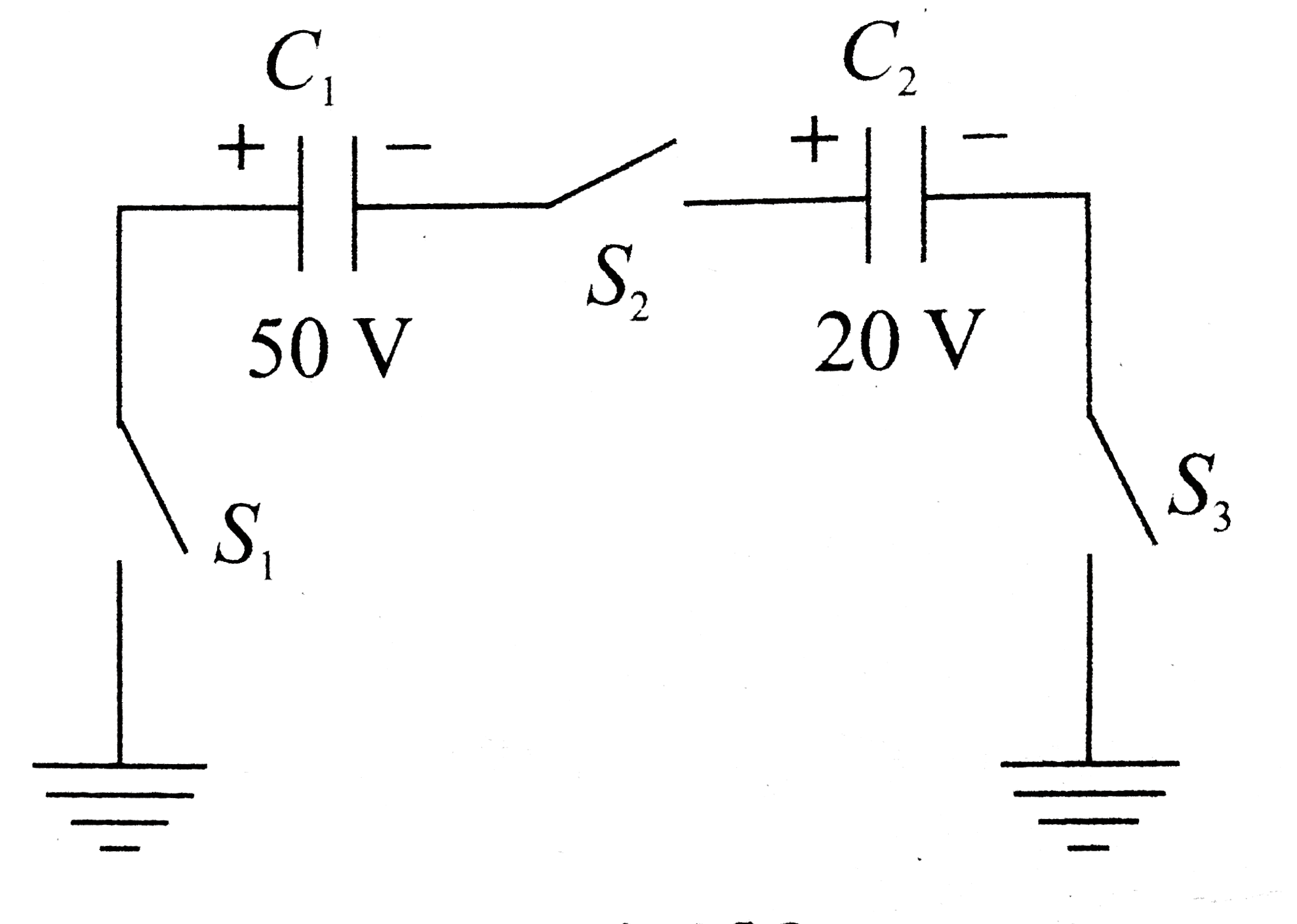
In the circuit shown, `C_(1)=C_(2)=2 muF`. Capacitor `C_(1)` is charged to `50 V` and `C_(1)` is charge to `20 V`. After charging they are connected as shown. When `S_(1), S_(2)`, and `S_(3)`, are clsosed,
.

A

`70 muC` of charge will pass through `S_(1)`

B

`100 muC` of chaarge will pass throuth `S_(1)`

C

`70 muC` of charge will pass throuth `S_(3)`

D

`40 muC` of chaarge will pass throuth `S_(3)`.

Text Solution

Verified by Experts

The correct Answer is:
A, C

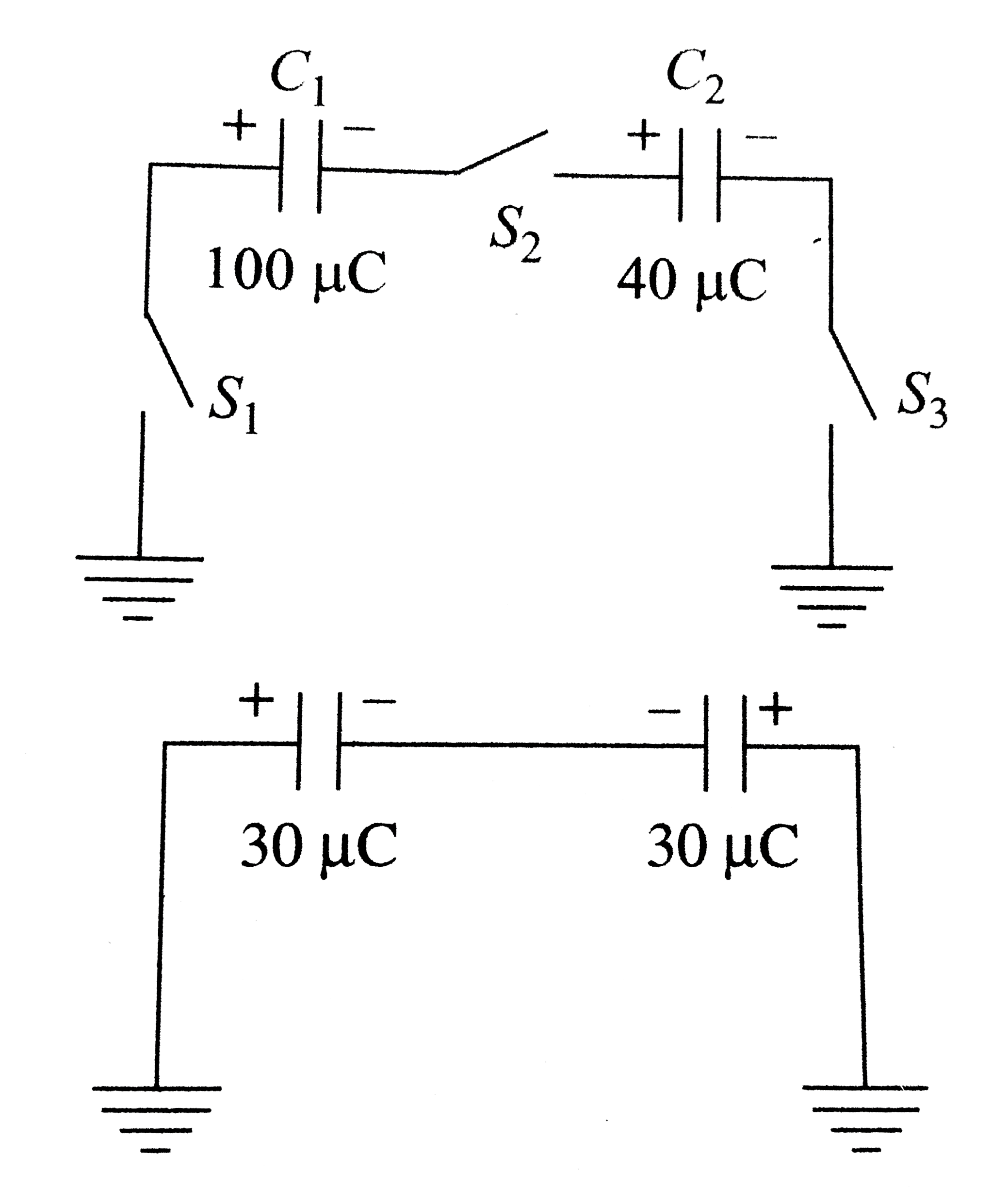
When switches are open, charges on the capacitor are capacitor are shown. When switches are closed, capacitors become parallel, charges are shown on two capacitors. Comparing two diagrams, it is clear that `70 muC` of charge will pass through switches `S_(1)` and `S_(3)`. Hence choices a and c are correct and choices b and d are wrong.
.
Promotional Banner

Topper's Solved these Questions

  • CAPACITOR AND CAPACITANCE

    CENGAGE PHYSICS ENGLISH|Exercise Comprhension|35 Videos
  • CAPACITOR AND CAPACITANCE

    CENGAGE PHYSICS ENGLISH|Exercise Integer|5 Videos
  • CAPACITOR AND CAPACITANCE

    CENGAGE PHYSICS ENGLISH|Exercise Single Correct|49 Videos
  • ATOMIC PHYSICS

    CENGAGE PHYSICS ENGLISH|Exercise ddp.4.3|15 Videos
  • CENGAGE PHYSICS DPP

    CENGAGE PHYSICS ENGLISH|Exercise subjective type|51 Videos

Similar Questions

Explore conceptually related problems

In the circuit shown in figure C_(1) = 2 C_(2) . Capacitance C_(1) is charged to a potential of V. The current in the circuit just after the switch S is closed is

In the circuit shown, the capacitor C_1 is initially charged with charge q_0 . The switch S is closed at time t = 0 . The charge on C_2 after time t is

Consider the circuit shown where C_(1) = 6 mu F, C_(2) = 3 mu F and V=20 V. Capacitor C_(1) is first charged by closing the switch S_(1). Switch S_(1) is then opened, and the charged capacitor is connected to the uncharged capacitor C_(2) by closing S_(2).

Two capacitors C_(1) and C_(2) are charged to same potential V , but with opposite polarity as shown in the figure. The switches S_(1) and S_(2) are then closed

Two capacitors of capacity 6 muF and 3 muF are charge 100 V and 50 V separately and connected as shown in Now all the three switches S_(1), S_(2) , and S_(3) are closed. Which plates form an isolated system?

In the figure shown C_(1)=1F, C_(2)=2F and L=5H . Initially C_(1) is charged 50V and C_(2) to 10V. Switch S is closed at time t=D. Suppose at some instant charge on C_(1) is 20C with the same polarties as shown in the figure Energy stored in capacitor C_(2) at this instant will

In the figure shown C_(1)=1F, C_(2)=2F and L=5H . Initially C_(1) is charged 50V and C_(2) to 10V. Switch S is closed at time t=D. Suppose at some instant charge on C_(1) is 20C with the same polarties as shown in the figure Current in the circuit at this instant will be

In the figure shown C_(1)=1F, C_(2)=2F and L=5H . Initially C_(1) is charged 50V and C_(2) to 10V. Switch S is closed at time t=D. Suppose at some instant charge on C_(1) is 10C with the same polarties as shown in the figure Maximum current in the circuit will be

n the circuit shown in the figure, the capacitor C is charged to a potential V_(o) The heat generated and charge flow, in the circuit to when the switch S is closed, is

Two capacitros of capacity 6 and 3 mu F are charged to 100 V and 50 V separately and connected as shown. Now all the three switches S_(1), S_(2) and S_(3) are closed. Charges on both the capacitors in steady state will be (on 6 mu F first)

