Home
Class 12
PHYSICS
A charged capacitor C1 is discharged thr...

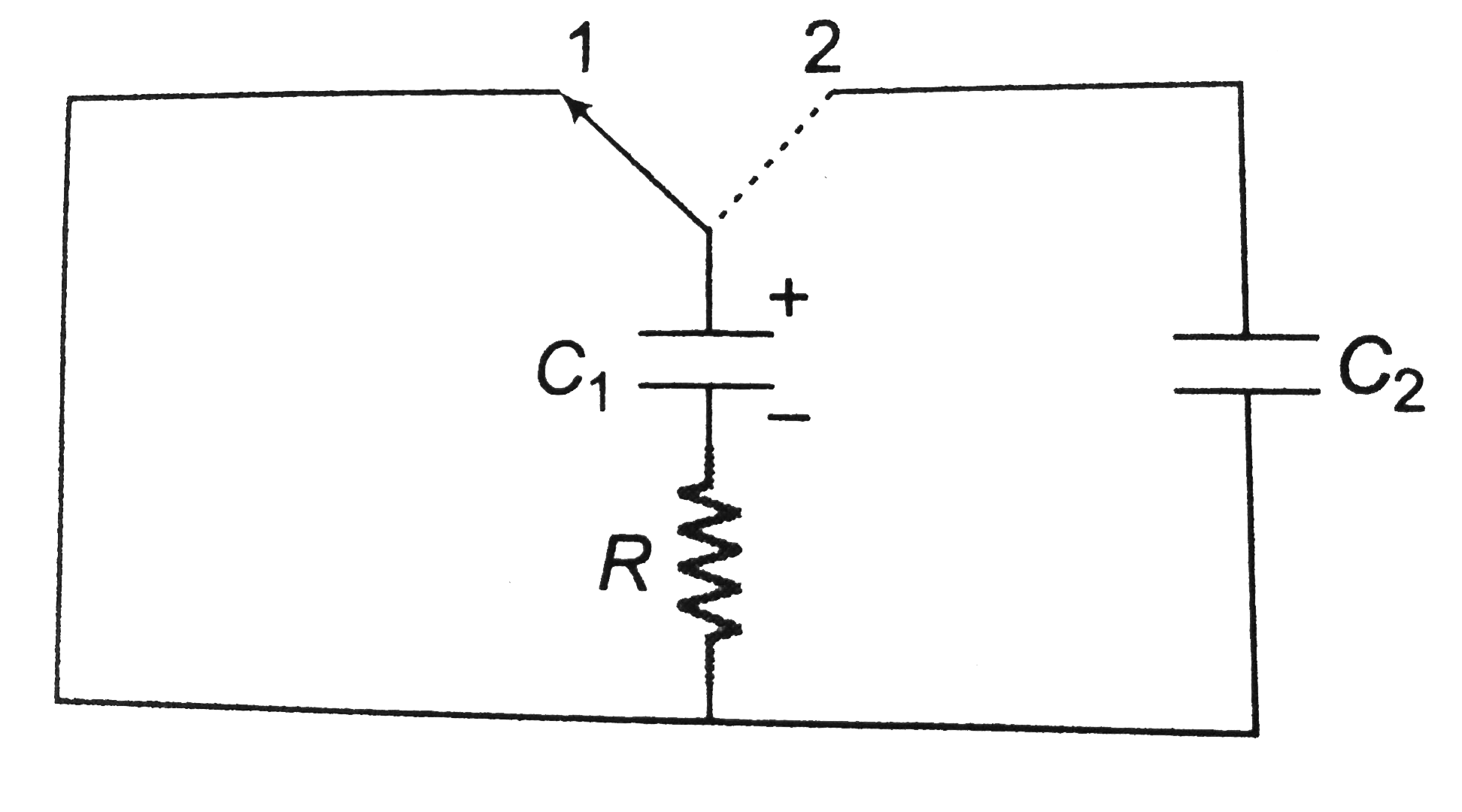
A charged capacitor `C_1` is discharged through a resistance `R` by putting switch `S` in position 1 of circuit shown in figure. When discharge current reduces to `I_0`, the switch is suddenly shifted to position 2. Calculate the amount of heat liberated in resistance `R` starting from this instant.

Text Solution

Verified by Experts

Let the charge on capacitor `C_1 be q_0` when the switch was
shifted from position 1 to position 2. just before shifting of
switch, the circuit was as shown in fig 5.202

`(q_0)/(C_1) - I_0R =0 or q_0 = I_0 RC_1`
When the switch is shifted from position 1 to 2,
the capacitor `C_1` continues to be discharged while `C_2` starts
charging. Let at time t, after shiffting of switch to position 2,
charge on capacitor `C_2` be q and let current through the circuit
be I.
Therefore, charge remaining on `C_1` is equal to `(q_0 - q)` as
shown in fig 5.202 (b). Applying Kirchhoff's voltage law on
the circuit shown in fig. 5.202 (b) we get
`(q)/(C_2) + IR - ((q_0 - q))/(C_1) = 0`
or ` IR = (q_0 - q)/(C_1) - (q)/(C_2) =((q_0 C_2 - qC_2) -qC_1)/(C_1C_2)`
But current , `I= dq/dt` (rate of increase of chargen `C_2`
or `R = (dp)/(dt) = (q_0C_2 -q(C_1+C_2))/(C_1C_2)`
or `(dp)/( q_0C_2 - q (C_1+C_2)) = (dt)/(RC_1xxC_2)`
But at t = 0, q= 0,
`int_0^q (dq)/(q_0C_2 - q(C_1+C_2)) = int_0^1 (dt)/(RC_1C_2)`
From the above equation, we get
`q = ((q_0C_2)/(C_1+C_2)) [1-e^(-((C_1+C_2)/(RC_1C_2))t)]`
Substituting `q_0 = I_0 RC_1,` we get
`q = I_0(RC_1C_2)/(C_1+C_2) [1-e^(-((C_1+C_2)/(RC_1C_2))t)]`
But current
`I = (dq)/(dt) = I_0e^(-(C_1+C_2)/(RC_1C_2)t)`
in a steady state, the common potential difference across
capacitors is given by
`V = (q_0 +0)/(C_1+C_2) = (I_0RC_1)/(C_1+C_2) ("using "V = (C_1V_1+C_2V_2)/(C_1+C_2))`
Initially energy stored in `C_1` was
`U_1 = (q_0^2)/(2C_1) =(1)/(2) I_0^2R^2C_1`
In steady state, energy stored in two capacitors is
`U_2 = (1)/(2)C_1V^2 +(1)/(2) C_2V^2 = (1)/(2) (C_1 +C_2) (I_0^2R^2C_1^2)/((C_1+C_2)^2) = (I_0^2R^2C_1^2)/(2(C_1+C_2))`
Heat generated across resistor R is equal to the loss of
energy stored ni capacitors during redistribution of charge, i.e.,
`U_1 = U_2 =(I_0^2R^2C_1C_2)/(2(C_1+C_2))`
Promotional Banner

Topper's Solved these Questions

  • ELECTRIC CURRENT AND CIRCUIT

    CENGAGE PHYSICS ENGLISH|Exercise Exercise 5.1|28 Videos
  • ELECTRIC CURRENT AND CIRCUIT

    CENGAGE PHYSICS ENGLISH|Exercise Exercise 5.2|50 Videos
  • ELECTRIC CURRENT AND CIRCUIT

    CENGAGE PHYSICS ENGLISH|Exercise Interger|8 Videos
  • ELECTRIC CURRENT & CIRCUITS

    CENGAGE PHYSICS ENGLISH|Exercise Kirchhoff s law and simple circuits|15 Videos
  • ELECTRIC FLUX AND GAUSS LAW

    CENGAGE PHYSICS ENGLISH|Exercise MCQ s|38 Videos

Similar Questions

Explore conceptually related problems

A charged capacitor C_1 is discharged through a resistance R by putting switch S in position 1 of the circuit as shown in fig.5.201. When the discharge current reduces to i_0 , the switch is suddenly shifted to position 2. Calculate the amount of heat liberated in resistor R starting form this instant. Also calculate current I through the circuit as a function of time.

When a capacitor discharges through a resistance R, the time constant is tau and the maximum current in the circuit is i_0 . Then,

The capacitor C shown in the figure is in steady state condition when switch is shifted from position 1 to position 2.The heat liberated in the process is

In the circuit shown in figure switch S is thrown to position 1 at t=0 . when the current in the resistort is 1A , it is shifted to position 2. the total heat generated in the circuit after shifting to position 2 is

In the circuit shown in the figure The steady state currents i_(1)and i_(2) in the coils after the switch S is closed are

In the circuit shown in the figure initialy the switch in position 1 for a long time, then suddenly at t=0 the switch is shifted to position 2. It is required that a constant current should flow in the circuit, the value of resistance R in the circuit

In the circuit shown switch S is connected to position 2 for a long time and then joined to position 1 .The total heat produced in resistance R_(2) is:

Initially, switch S is connected to position 1 for a long time . The net amount of heat generated in the circuit after it is shifted to position 2 is .

In figure, the switch is in the position 1 for long time, then the switch is shifted to position 2 at t=0 . At this instant the value of i_1 and i_2 are

In the circuit shown below, the switch is in position 1 for a long time. At some moment after that the switch is thrown in position 2. The quantity of heat generated in the resistance of 375 ohm after the switch is changes to position 2 is :

