Home
Class 12
PHYSICS
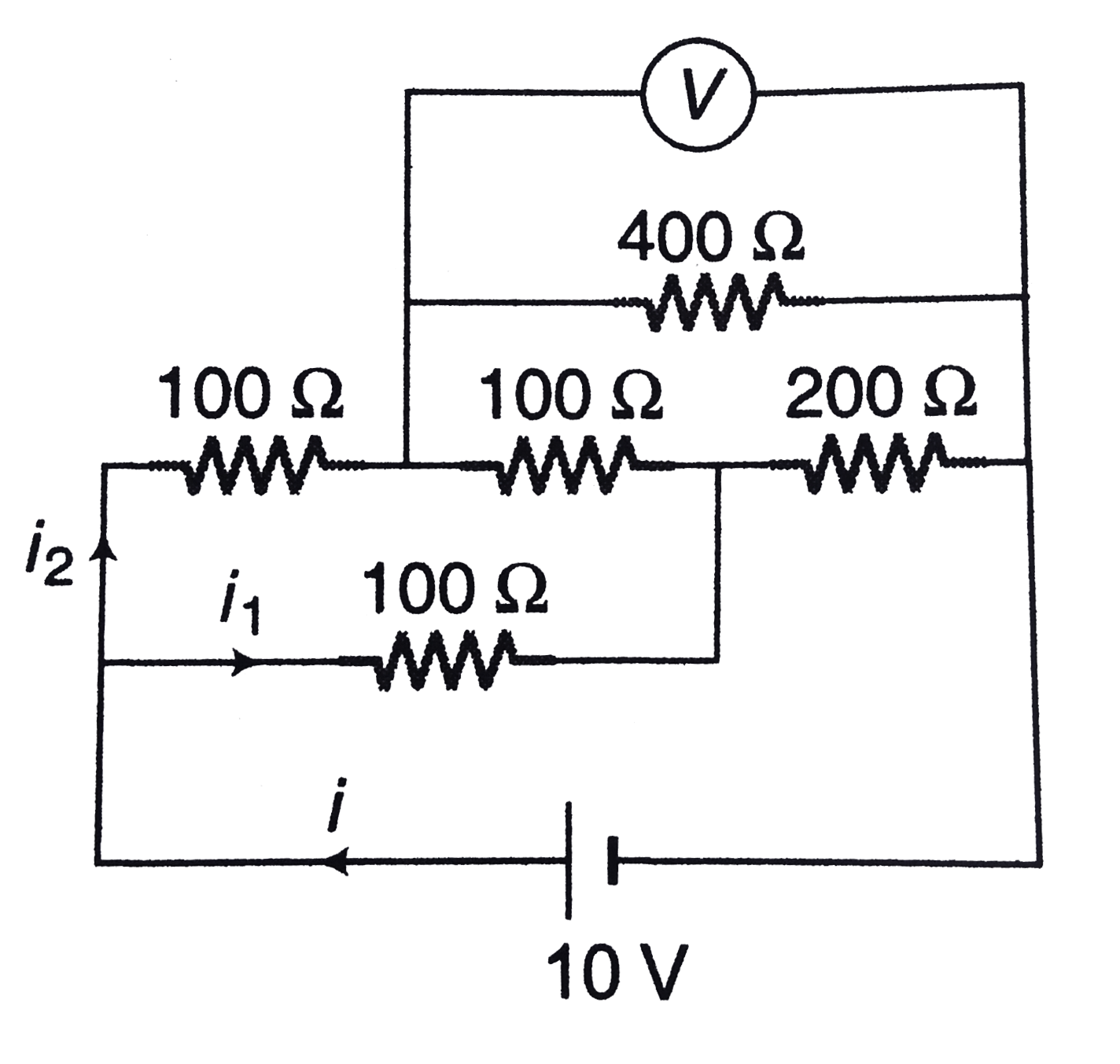
An electrical circuit is shown in figure...

An electrical circuit is shown in figure. Calculate the potential difference across the resistor of `400 Omega` as will be measured by the voltmeter Vof resistance `400 Omega` either by applying Kirchhoff's rules or otherwise.

Text Solution

Verified by Experts
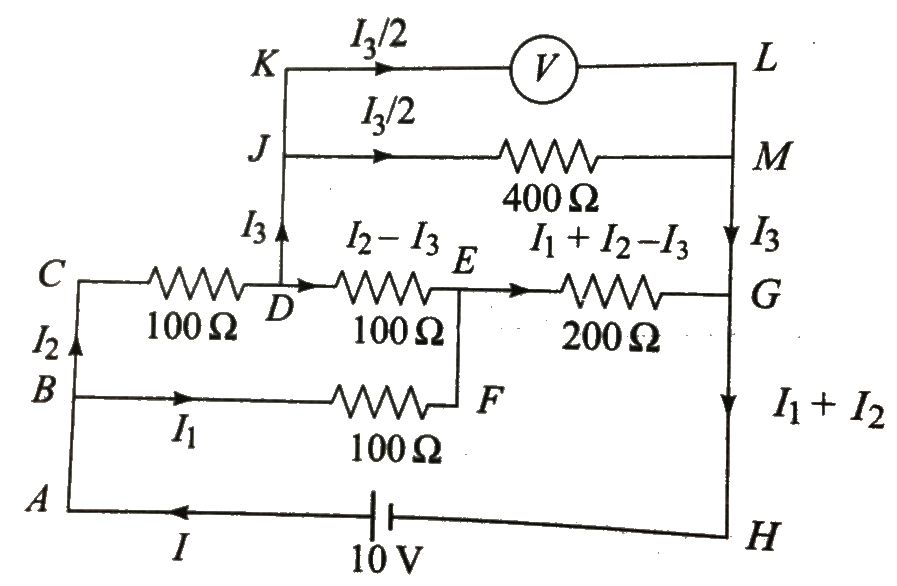
Applying kirchhoff's law in loop `JMGDJ`, we get

`-(I_(3))/(2) xx 400 + (I_(1) + I_(2) - I_(3)) 200 + (I_(2) - I_(3)) 100 = 0`
or `- 500 I_(3) + 200 I_(1) + 300 I_(2) = 0` or `2 I_(1) + 3I_(2) - 5I_(3) = 0` (i)
Applying kirchhoff's law in `CDEFBC`, we get
`- 100I_(2) - 100(I_(2) - I_(3)) + 100I_(1) = 0`
or `I_(1) - 2I_(2) + I_(3) = 0` (ii)
Mulplying Eq. (i) by `2` and subracting from Eq. (i), we have
`2I_(1) + 3I_(2) - 5I_(3) - 2I_(1) + 4I_(2) - 2I_(3) = 0` or `I_(2) = I_(3)` (iii)
Applying kirchhoff's law in `ABEFGHA`, we get
`- 3I_(1) - 2I_(2) + 2I_(3) + 0.1 = 0` (iv)
Multiplying Eq.(ii) by `3` and adding it to Eq.(iv), we get
`3I_(1) - 6I_(2) + 3I_(3) - 3I_(1) - 2I_(2) + 2I_(3) + 0.1 = 0`
or `-8I_(2) + 5I_(3) + 0.1 = 0` or `-8I_(3) + 5I_(3) + 0.1 = 0`
or `3I_(3) = 0.1` or `I_(3) = (0.1)/(3)`
Therefore, potential difference across `JM` is
`(0.1//3)/(2) xx 400 = (0.1)/(2 xx 3) xx 400`
`= (20)/(3) = 6.67 V`
Alternative method
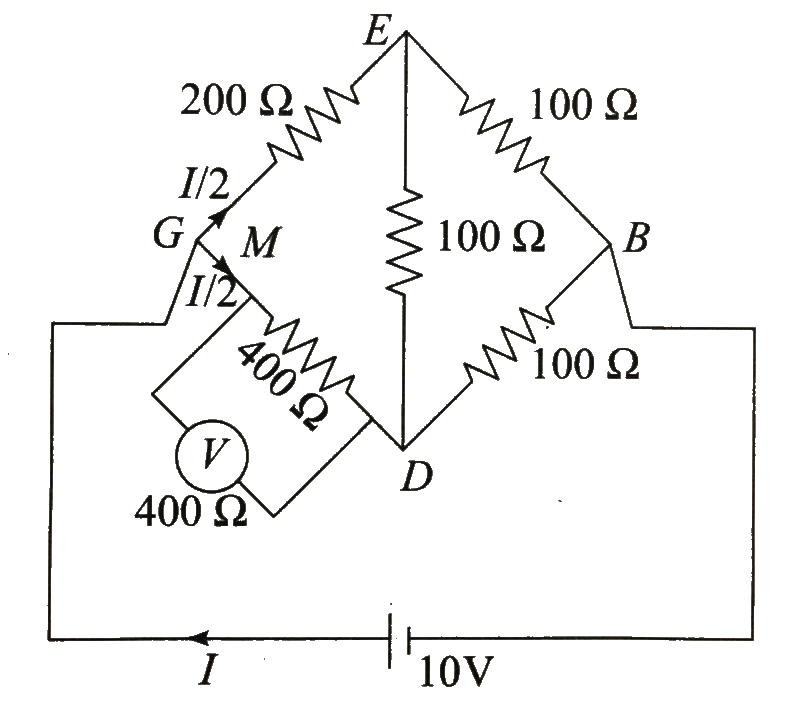
We can redraw the circuit as shows in Fig. `6.26`. The equivalent resistance between `G` and `D` is
`R_(GD) = (400 xx 400)/(400 + 400) = 200 Omega ("Since" (R_(GE))/(R_(GD)) = (R_(EB))/(R_(DB))) `
Therefore, it is a case of a balanced wheatstone bridge. The equivalent resistance across `G` and `B` is
`R_(GB) = (300 xx 300)/(300 + 300) = 150 Omega`
Therefore, current is
`I = (V)/(R_(GB)) = (10)/(150) = (1)/(15) A`

Since `RGEB = RGDB`, the current is divided at `G` into two equal
parts. The current `I//2` is further divided into two equal parts at
`M`. Therefore, the potential difference across the voltmeter is
`(1)/(4) xx 400 = (1)/(15) xx 100 = (20)/(3) V`
Promotional Banner

Topper's Solved these Questions

  • ELECTRICAL MEASURING INSTRUMENTS

    CENGAGE PHYSICS ENGLISH|Exercise Exercise 6.1|15 Videos
  • ELECTRICAL MEASURING INSTRUMENTS

    CENGAGE PHYSICS ENGLISH|Exercise Subjective|18 Videos
  • ELECTRICAL MEASURING INSTRUMENTS

    CENGAGE PHYSICS ENGLISH|Exercise M.C.Q|2 Videos
  • ELECTRIC POTENTIAL

    CENGAGE PHYSICS ENGLISH|Exercise DPP 3.5|15 Videos
  • ELECTROMAGNETIC INDUCTION

    CENGAGE PHYSICS ENGLISH|Exercise compression type|7 Videos

Similar Questions

Explore conceptually related problems

Find potential difference across the resistance 300 Omega in A and B.

For the circuit shown in figure, determine the voltage across 4 Omega resistors in volt ?

In the electrical network shown in the figure, What will be the potential difference (in volt) across 3Omega resistance ?

In the circuit shown in figure switch S is closed at time t=0 Potential difference across 3Omega resistance at time t is given by

In the circuit shown in Fig. 4.41, calculate the current in each resistor and potential difference across each resistor.

Calculate the potential difference across the ends of a wire of resistance 2 Omega' when a current of 1.5 A passes through it.

In the circuit diagram shown in figure, potential difference across 3Omega resistance is 20 V. Then, match the following two columns.

In the given circuit diagram find the potential difference across 2 Omega resistance (in volts).

100 J of heat are produced each second in a 4 Omega resistance. Find the potential difference across the resistor.

Calculate the potential difference required across a conductor of resistance 5 Omega to pass a current of 1.5 A through it.