Home
Class 12
PHYSICS
An unknown resistance X is to be determi...

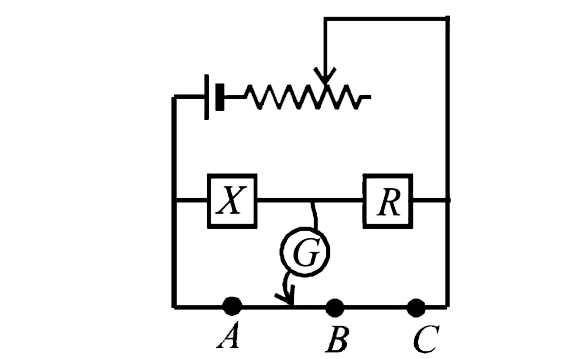
An unknown resistance X is to be determined using resistances `R_1, R_2 or R_3`. Their corresponding null points are A, B and C. Find which of the above will give the most accurate reading and why?
. `R= R_1 or R_2 or R_3`.

Text Solution

Verified by Experts
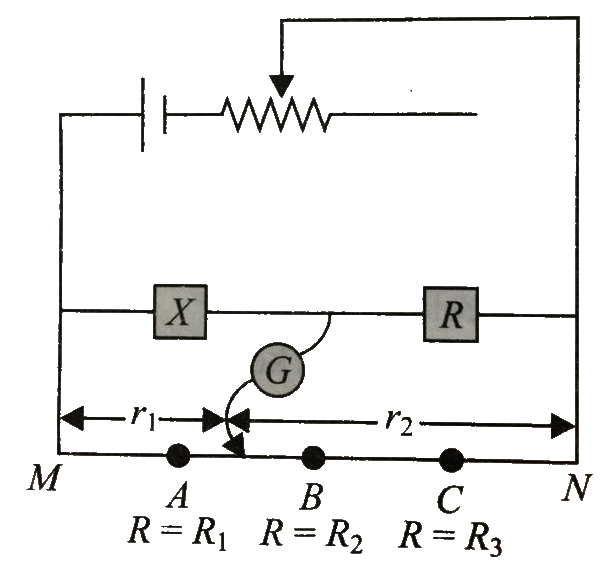
At all null points, the wheatstone bridge will be
balanced. Therefore,
`(X)/(r_(1)) = (R)/(r_(2))` or `X = R (r_(1))/(r_(2))`
where `R` is aconstant and `R_(1)` and `r_(2)` are varibles. The maximum faction error is
`(Delta X)/(X) = (Deltar_(1))/(r_(1)) + (Deltar_(2))(r_(2))`
Here `Deltar_(1) = Deltar_(2) = y` (say),
then
`(Delta X)/(X) = y[(r_(2) + r_(1))/(r_(1)r_(2))]`
For `Delta X//X` to be minimum,
`r_(1) xx r_(2)` should be maximum
`["since" r_(1) + r_(2) = c ("constant")]`.
Let `E = r_(1) xx r_(2) = r_(1) xx (c - r_(1))`
`= r_(1) c - r_(1)^(2)`
`:. (dE)/(dr_(1)) = c - 2r_(1) = 0` or `r_(1) = (c)/(2)`
or `r_(2) = (c)/(2)` or `r_(1) = r_(2)`
Thus, `R_(2)` gives the most accurate value.
Promotional Banner

Topper's Solved these Questions

  • ELECTRICAL MEASURING INSTRUMENTS

    CENGAGE PHYSICS ENGLISH|Exercise Exercise 6.1|15 Videos
  • ELECTRICAL MEASURING INSTRUMENTS

    CENGAGE PHYSICS ENGLISH|Exercise Subjective|18 Videos
  • ELECTRICAL MEASURING INSTRUMENTS

    CENGAGE PHYSICS ENGLISH|Exercise M.C.Q|2 Videos
  • ELECTRIC POTENTIAL

    CENGAGE PHYSICS ENGLISH|Exercise DPP 3.5|15 Videos
  • ELECTROMAGNETIC INDUCTION

    CENGAGE PHYSICS ENGLISH|Exercise compression type|7 Videos

Similar Questions

Explore conceptually related problems

R_1, R_2, R_3 are different values of R, A, B and C are the null points obtained corresponding to R_1, R_2 and R_3 respectively. For which resistor, the value of X will be the most accurate and why?

r + r_3 + r_1 - r_2 =

For the batteries shown in fig. R_1, R_2 and R_3 are the internal resistance of E_1, E_2, and E_3, respectively Then, which of the following is / are correct?

R_(1),R_(2),R_(3) are different values R, A,B and C are the null points obtained corresponding to R_(1),R_(2) and R_(3) respectively. For which resistor, the value of X will be the most accurate and why? .

In the situation shown, resistance R_(1),R_(2) and R_(3) are in the ratio 3:2:1 , then

An unknown resistance r si determined in terms of a standared resistance R = 100 Omega by using potentiometer. The potential difference across r is balanced againt 45 cm length of the wire and that (r + R) is obtained at 70 cm of the wire. Find the value of the unknown resistance.

Write the expressions for the equivalent resistance R of three resistors R_1, R_2 , and R_3 joined in (a) parallel, and (b) series.

Two ideal batteries of emf V_1 and V_2 and three resistances R_1, R_2 and R_3 are connected as shown in the figure. The current in resistance R_2 would be zero if

Three resistors R_1, R_2 and R_3 are to be combined to form an electrical circuit as shown in the figure. It is found that when R_1 R_2 and R_3 are put respectively in positions A, B and C, the effective resistance of the circuit is 70 Omega When R_2, R_3 and R_1 are put respectively in position A, B and C the effective resistance is 35 Omega and when R_3, R_1 and R_2 are respectively put in the position A, B and C, the effective resistance is 42 Omega The resistance R_(1): R_(2): R_(3 ) are in the ratio

Three resistors R_1, R_2 and R_3 are to be combined to form an electrical circuit as shown in the figure. It is found that when R_1 R_2 and R_3 are put respectively in positions A, B and C, the effective resistance of the circuit is 70 Omega When R_2, R_3 and R_1 are put respectively in position A, B and C the effective resistance is 35 Omega and when R_3, R_1 and R_2 are respectively put in the position A, B and C, the effective resistance is 42 Omega If R_(1), R_(2) and R_(3) are put in series, the effective resistance will be

