Home
Class 12
PHYSICS
Let V and I respresent, respectively, th...

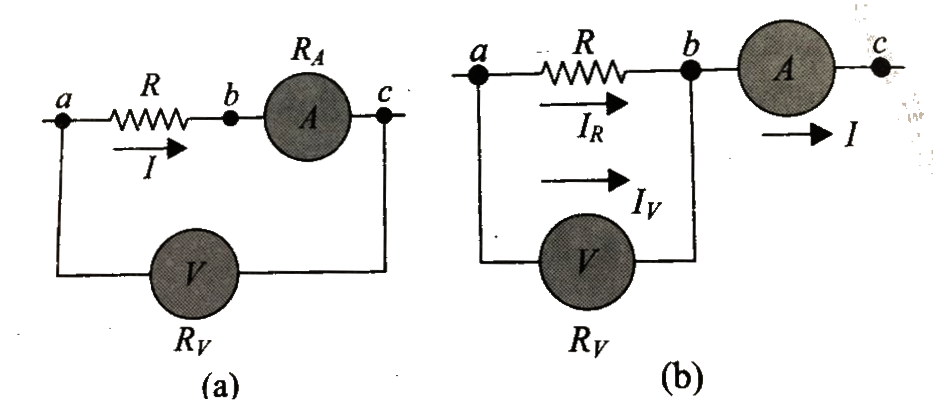
Let `V` and `I` respresent, respectively, the readings of the voltmeter and ammetre shows in Fig. `6.34`, and let `R_(V)` and `R_(V)` be their equivalent resistances. Because of the resistances of the meters, the resistnce `R` is not simply equal to `V//I`.
(a) When the circuit is connected as shows in Fig. `6.34` (a), shows that `R = (V)/(I) - R_(A)`
Explain why the true resistance `R` is always less than `V//I`.
(b) When the connections are as shows in Fig.`6.34` (b)
Show that `R = (V)/(I - (V//R_(V)))`

Explain why the true resistance `R` is always greater than `V//I`.
(c ) Show that the power delivered to the resistor in part
(i) is `IV - I^(2) R_(A)` and that in part (ii) is `IV - (V^(2)//R_(V))`

Text Solution

Verified by Experts

`V = IR + IR_(A)` or `R = (V)/(I) - R_(A)`
The true resistance `R` is always less then the reading `(V//I)` because in the circuit, the ammeter's resistance causes the current to be less than the actual. Thus, the smaller current required resistance `R` to be calculated larger than what it should be.
(b) `I = (V)/(R ) + (V)/(R_(V))` or `R = (VR_(V))/(IR_(V) - V) = (V)/(I - V//R_(V))`
Now the current measured is greater than that through the resistor, so `R = V//I_(R)` is always greater than `V//I`.
(c ) (i) `P = I^(2)R = I^(2)(V//I - R_(A)) = IV - I^(2)R_(A)`
(ii) `P = V^(2)//R = V (I- V//R_(V)) = IV - V^(2)//R_(V)`
Promotional Banner

Topper's Solved these Questions

  • ELECTRICAL MEASURING INSTRUMENTS

    CENGAGE PHYSICS ENGLISH|Exercise Single Correct|94 Videos
  • ELECTRICAL MEASURING INSTRUMENTS

    CENGAGE PHYSICS ENGLISH|Exercise Multiple Correct|7 Videos
  • ELECTRICAL MEASURING INSTRUMENTS

    CENGAGE PHYSICS ENGLISH|Exercise Exercise 6.1|15 Videos
  • ELECTRIC POTENTIAL

    CENGAGE PHYSICS ENGLISH|Exercise DPP 3.5|15 Videos
  • ELECTROMAGNETIC INDUCTION

    CENGAGE PHYSICS ENGLISH|Exercise compression type|7 Videos

Similar Questions

Explore conceptually related problems

Let V and I be the readings of the voltmeter and the ammeter respectively as shown in the figure. Let R_(V) " and "R_(A) be their corresponding resistancce Therefore,

The ammeter A reads 2A and the voltmeter V reads 20V, the value of resistance R is (Assuming finite resistance's of ammeter and voltmeter)

In the circuit shows in Fig. 6.42 , resistors X and Y , each with resistance R , are connected to a 6 V battery of negligible internal resistance. A voltmeter, also of resistance R , is connected across Y . What is the reading of the voltmeter?

Determine the resistance r if an ammeter shows a current of I = 5 A and a voltmeter 100 V . The internal resistance of the voltmeter is R=2,500Omega

In the circuit shown alongside, the ammeter and the voltmeter redings are 3A and 6V, respectively. Then, the value of the resistance R is

In the circuit shown, R_1=2 Omega,R_2=R_3=10Omega, R_4=20Omega and E=6V . Work out the equivalent resistance of the circuit and the current in each resistor.

An ammeter and a voltmeter of resistance R connected in seires to an electric cell of negligible internal resistance. Their readings are A and V respecitvely. If another resistance R is connected in parallel with the voltmeter

An ammeter and a voltmeter of resistance R connected in seires to an electric cell of negligible internal resistance. Their readings are A and V respecitvely. If another resistance R is connected in parallel with the voltmeter

In the adjoining circuit diagram, the readings of ammeter and voltmeter are 2 A and 120 V, respectively. If the value of R is 75Omega , then the voltmeter resistance will be

Five equal resistances each of resistance R are connected as shown in the figure. A battery of V volts is connected between A and B . The current flowing in AFCEB will be (a) (3V)/(R) (b) (V)/(R) (c) (V)/(2R) (d) (2V)/(R)

CENGAGE PHYSICS ENGLISH-ELECTRICAL MEASURING INSTRUMENTS-Subjective
  1. The potentiometer wire AB is 600 cm long. a. At what distance from ...

    Text Solution

    |

  2. Figure 6.32 shows a meter bridge in the (which is nothing but a partic...

    Text Solution

    |

  3. The circuit shows in Fig . 6.33 shows the use of potentiometer to meas...

    Text Solution

    |

  4. Let V and I respresent, respectively, the readings of the voltmeter an...

    Text Solution

    |

  5. You are given two resistors X and Y whose resistances are to be determ...

    Text Solution

    |

  6. Figure 6.36 shows a potentiometer with a cell of emf 2.0 V and interna...

    Text Solution

    |

  7. In a meter bridge circuit, the two resistances in the gap are 5 Omega ...

    Text Solution

    |

  8. In the gives circuit, a meter bridge is shows in a balanced state. The...

    Text Solution

    |

  9. In an experiment with a post office box, the radio of arms are 1000 : ...

    Text Solution

    |

  10. A galvanometer reads 5*0V at full scale deflection and is graded accor...

    Text Solution

    |

  11. A battery of emf 1.4 V and internal resistance 2 Omega is connected to...

    Text Solution

    |

  12. A potentiometer wire has a length of 10 m and resistance 4 Omega m^(-1...

    Text Solution

    |

  13. In an experiment with a potentiometer, VB=10 V. R is adjusted to be 50...

    Text Solution

    |

  14. What is the advantage of using thick metallic strips to join wires in ...

    Text Solution

    |

  15. AB is a potentiometer wire (figure). If the value of R is increased, i...

    Text Solution

    |

  16. While doing an experiment with potentiometer (see figure) it was found...

    Text Solution

    |

  17. A battery of e.m.f. 10 V and internal resistance 2 Omega is connected ...

    Text Solution

    |

  18. What are the advantages of the nll-point method in a Wheatstone bridge...

    Text Solution

    |
