Home
Class 12
PHYSICS
Capacitor C1 is connected to a battery a...

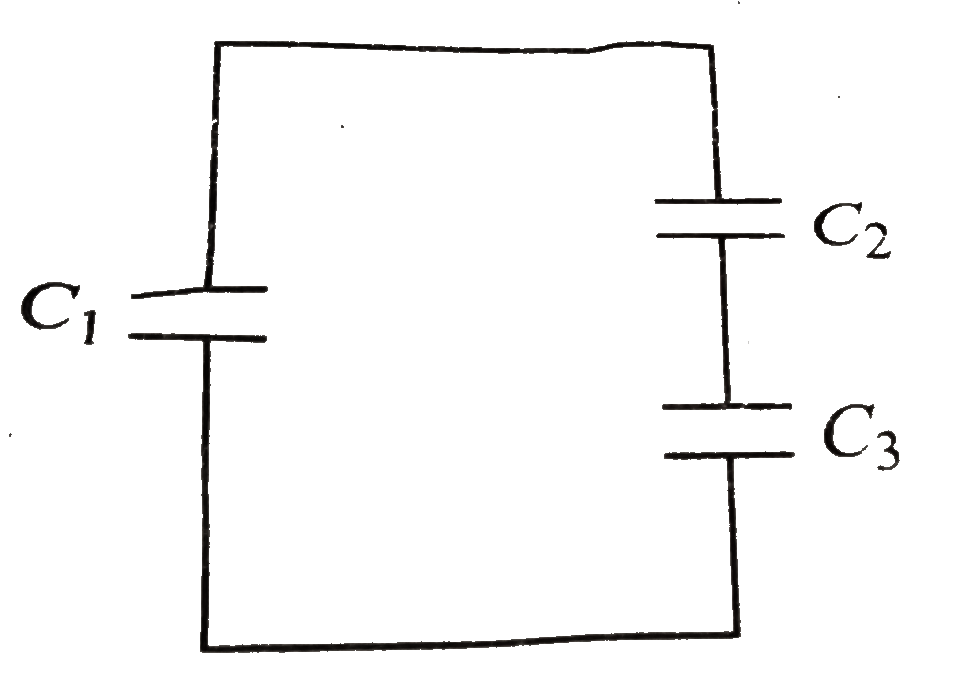
Capacitor `C_1` is connected to a battery and charged till the magnitude of the charge on each plate is `q_0`. Then, the battery is disconnected and `C_1` is connected to two other uncharged capacitors `C_2 and C_3` as shown in figure. Final charges on the capacitors `(q_1,q_2 and q_3)` are related by .

A

`q_0 = q_1+q_2+q_3`

B

`q_1+q_2+q_3=0`

C

`q_0 = q_3+q_2,q_1=0`

D

`q_0 = q_1+q_2,q_2 = q_3`

Text Solution

Verified by Experts

The correct Answer is:
D


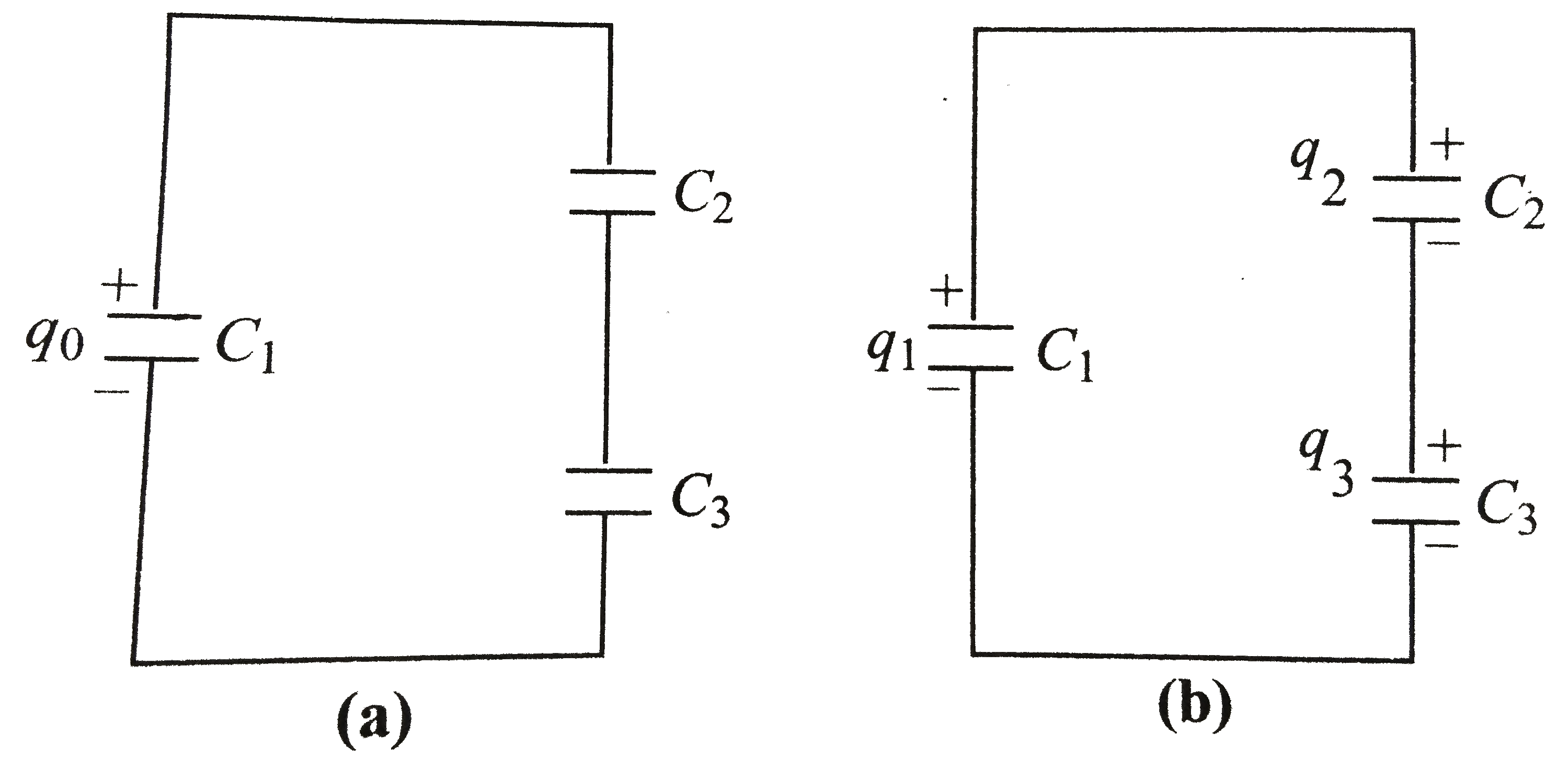
Initial situation after the reconnection is shown in figureSA 1.1 (a) and the final situation in fig. SA 1.1 (b). The charge transferred by `C_(1)` is `q_(0)-q_(1)` and the capacitors `C_(2)` and `C_(3)` are in series so `q_(2)=q_(3)`, other way to solve the quesions is to equilize the potentials across `C_(1)` and series combination of `C_(2)` and `C_(3)`.
Promotional Banner

Topper's Solved these Questions

  • MISCELLANEOUS VOLUME 3

    CENGAGE PHYSICS ENGLISH|Exercise Assertion and Reason Type|8 Videos
  • MISCELLANEOUS VOLUME 3

    CENGAGE PHYSICS ENGLISH|Exercise Comprehension Type|94 Videos
  • MAGNETIC FIELD AND MAGNETIC FORCES

    CENGAGE PHYSICS ENGLISH|Exercise Multiple Correct Answer type|2 Videos
  • MISCELLANEOUS VOLUME 5

    CENGAGE PHYSICS ENGLISH|Exercise Integer|12 Videos

Similar Questions

Explore conceptually related problems

Three uncharged capacitors A, B and C are connected as shown in the figure. The charge on capacitor B is , the steady state.

Three capacitors are connected as shwn in. Then, the charge on capacitor C_(1) is . .

A capacitor of capacity C_(1) = 1 muF is charged to a potential of 100 V. The charging battery is then removed and it is connected to another capacitor of capacity C_(2) = 2 muF . One plate of C_(2) is earthed as shown in figure. The charges on C_(1) and C_(2) in steady state will be

Find the electric charge Q_(1) on plates of capacitor C_(1), shown in figure below :

A capacitor of capacitance C is charged to a potential difference V_(0) . The charged battery is disconnected and the capacitor is connected to a capacitor of unknown capacitance C_(x) . The potential difference across the combination is V. The value of C_(x) should be

A parallel plate capacitor of capacitance C is connected to a battery and is charged to a potential difference V. Another capacitor of capacitance 2C is ismilarly charged to a potential difference 2V. The charging battery is now disconnected and the capacitors are connected in parallel to each other in such a way that the poistive terminal of one is connected to the negative terminal of the other. The final energy of the configuration is

An uncharged capacitor is connected to a battery. Show that half the energy supplied by the battery is lost as heat while charging the capacitor.

In the circuit shown in the adjacent figure, the batteries are ideal. The charge on the capacitor C is

Three capacitors C_1,C_2,andC_3 of capacitance 1muF, 2muF, and 3muF , respectively, are charged separately as shown in the figure. Now these charged capacitors are connected to a battery of epsilon = 20 V and an uncharged capacitor of C = 2muF as shown in figure. , The charge on capacitor marked C is

A Capacitor C and resister R are connected to a battery of 5V in series. Now battery is disconnected and a diode is connected as shown in figure (a) and (b) respectively. Then charge on the capacitor after time RC in (a) and (b) respectively is Q_A and Q_B . Their value are

