Home
Class 12
PHYSICS
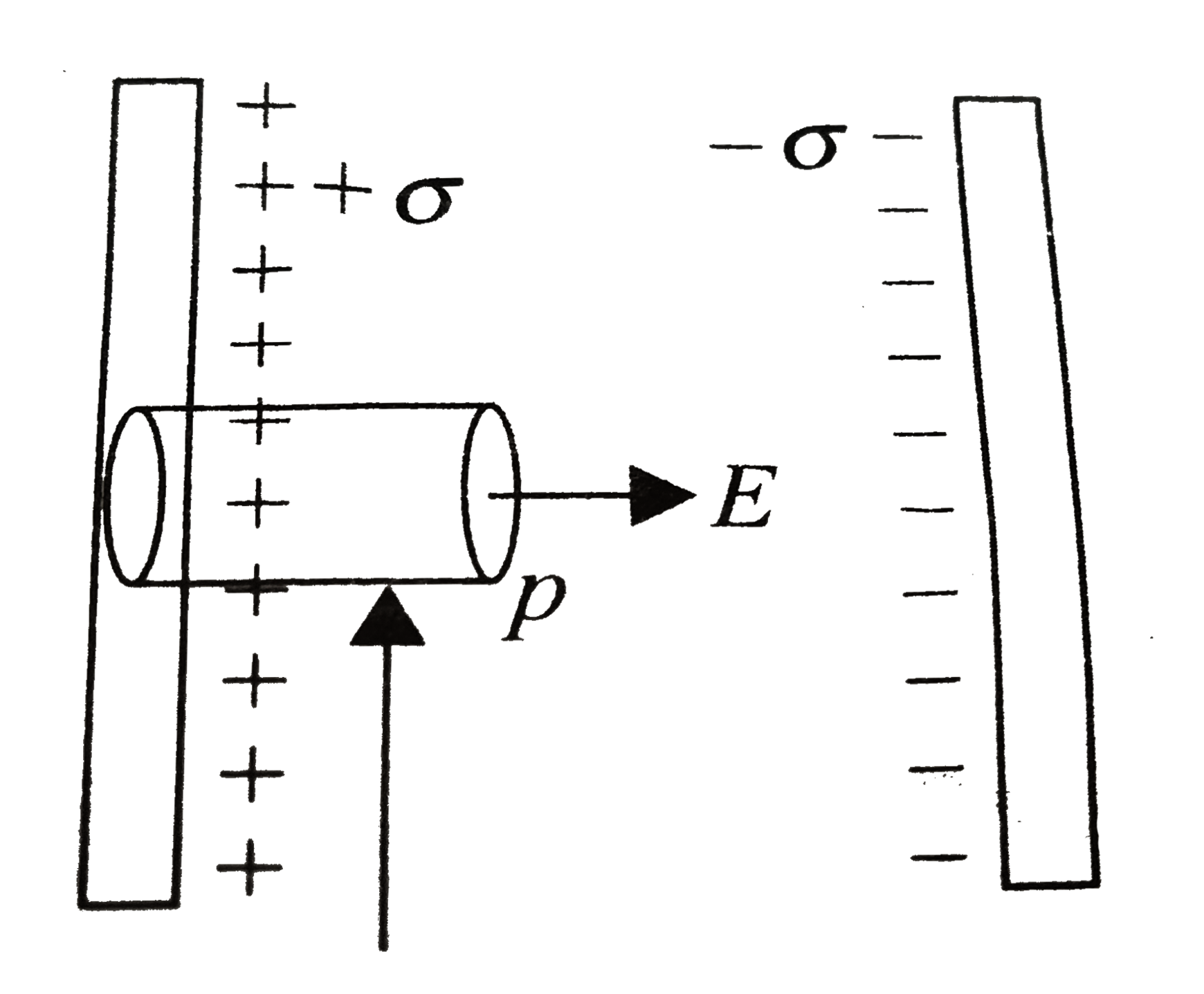
Consider the situation shown in figure. ...

Consider the situation shown in figure. We find electric field E at point P using Gauss's law and it comes out to be `E = sigma//epsilon_0`. This electric field is due to

A

all the amount of charges present on both the plates

B

all the charges present on positive plate only

C

positive charge present only inside the Gaussian surface.

D

positive charge present inside the Gaussian surface plus equal magnitude of negative charge present on negatice plate in front of Gaussian surface.

Text Solution

Verified by Experts

The correct Answer is:

A

According to gauss's law, electric field at any point on gaussian surface is due to all the charges present inside or outside.
Promotional Banner

Topper's Solved these Questions

  • MISCELLANEOUS VOLUME 3

    CENGAGE PHYSICS ENGLISH|Exercise Assertion and Reason Type|8 Videos
  • MISCELLANEOUS VOLUME 3

    CENGAGE PHYSICS ENGLISH|Exercise Comprehension Type|94 Videos
  • MAGNETIC FIELD AND MAGNETIC FORCES

    CENGAGE PHYSICS ENGLISH|Exercise Multiple Correct Answer type|2 Videos
  • MISCELLANEOUS VOLUME 5

    CENGAGE PHYSICS ENGLISH|Exercise Integer|12 Videos

Similar Questions

Explore conceptually related problems

In the uniform electric field shown in figure, find

Equipotential surfaces are shown in figure. Then the electric field strength will be

Three infinitely long charge sheets are placed as shown in figure. The electric field at point P is

Four charges are arranged on y axis as shown in figure. Then the electric field at point P is proportional to:

Figure shows the electric field lines around an electric dipole. Which of the arrows best represents the electric field at point P ?

Gauss's law and Coulomb's law , although expressed in different forms , are equivalent ways of describing the relation between charge and electric field in static conditions . Gauss's law is epsilon_(0) phi = q_(encl) ,when q(encl) is the net charge inside an imaginary closed surface called Gaussian surface. The two equations hold only when the net charge is in vaccum or air . A Gaussian surface encloses two of the four positively charged particles. The particles that contribute to the electric field at a point P on the surface are

Gauss's law and Coulomb's law , although expressed in different forms , are equivalent ways of describing the relation between charge and electric field in static conditions . Gauss's law is epsilon_(0) phi = q_(encl) ,when q(encl) is the net charge inside an imaginary closed surface called Gaussian surface. The two equations hold only when the net charge is in vaccum or air . The net flux of the electric field through the surface due to q_(3) and q_(4) is

Gauss's law and Coulomb's law , although expressed in different forms , are equivalent ways of describing the relation between charge and electric field in static conditions . Gauss's law is epsilon_(0) phi = q_(encl) ,when q(encl) is the net charge inside an imaginary closed surface called Gaussian surface. The two equations hold only when the net charge is in vaccum or air . If the charge q_(3) and q_(4) are displaced (always remaining outside the Gaussian surface), then consider the following two statements : A : Electric field at each point on the Gaussian surface will remain same . B : The value of oint vec(E ) .d vec(A) for the Gaussian surface will remain same.

Find the electric field at centre of semicircular ring shown in figure . .

Gauss's law and Coulomb's law , although expressed in different forms , are equivalent ways of describing the relation between charge and electric field in static conditions . Gauss's law is epsilon_(0) phi = q_(encl) ,when q_(encl) is the net charge inside an imaginary closed surface called Gaussian surface. The two equations hold only when the net charge is in vaccum or air . The net flux of the electric field through the surface is
