Home
Class 12
PHYSICS
In the given electric field vecE = [alph...

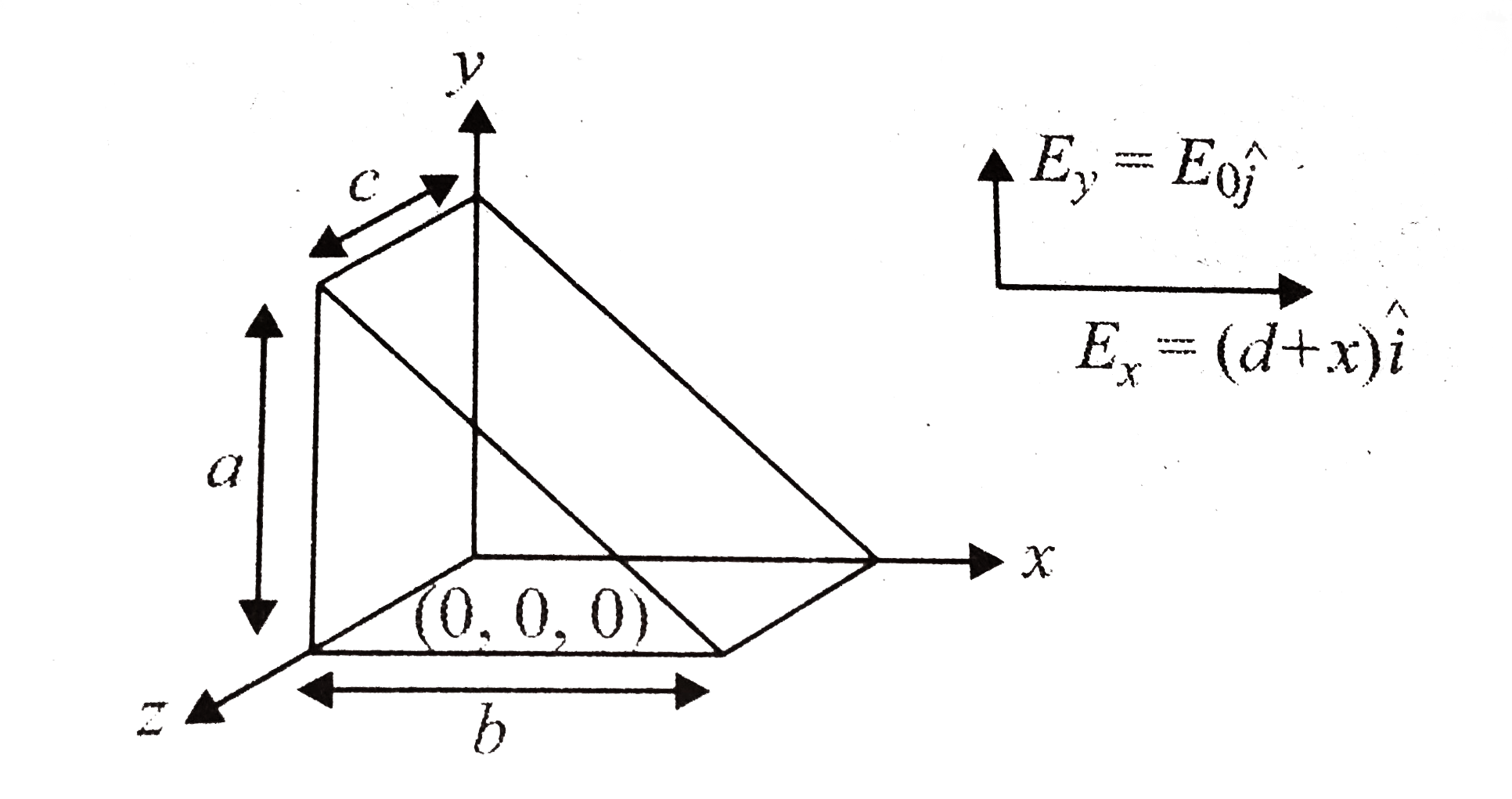
In the given electric field `vecE = [alpha(d+x)hati + E_0hatj] NC^(-1)`, where `alpha = 1NC^(-1)` hypothetical closed surface is taken as shown in figure .

The total charge enclosed within the close surface is

A

`(abcepsilon_0)/2`

B

`(acdepsilon_0)/2`

C

`(abdepsilon_0)/2`

D

none of these

Text Solution

Verified by Experts

The correct Answer is:
A

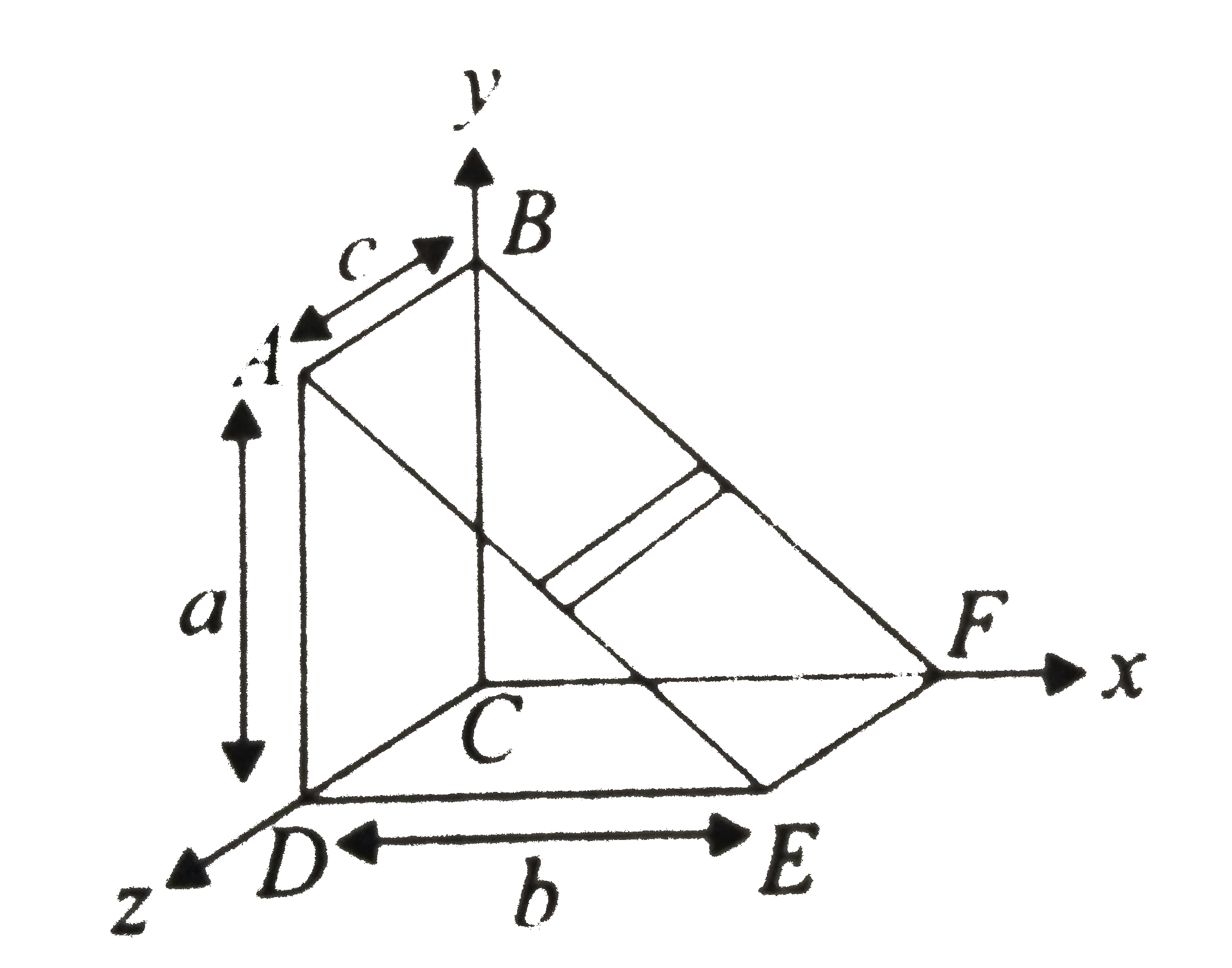
a. `phi_(ABCD)=-acd` unit
`phi_(CDEF)=-beE_(0)` unit
`phi_(ABEF)=bcE_(0)+cint_(0)^(a)(d+x)dy`
`=+bcE_(0)+acd+cint_(o)^(b)xdx`
[Since `(x)/(b)+(y)/(a)=1` or `(dx)/(b)=(-dy)/(a)`]

`=[+bcE_(0)+acd+(acb)/(2)]` unit
Using Gauss's law, we get
`phi_(set)=(q_("in"))/(epsilon_(0))` or `q_("in")=(abcepsilon_(0))/(2)`
Promotional Banner

Topper's Solved these Questions

  • MISCELLANEOUS VOLUME 3

    CENGAGE PHYSICS ENGLISH|Exercise Assertion and Reason Type|8 Videos
  • MISCELLANEOUS VOLUME 3

    CENGAGE PHYSICS ENGLISH|Exercise Comprehension Type|94 Videos
  • MAGNETIC FIELD AND MAGNETIC FORCES

    CENGAGE PHYSICS ENGLISH|Exercise Multiple Correct Answer type|2 Videos
  • MISCELLANEOUS VOLUME 5

    CENGAGE PHYSICS ENGLISH|Exercise Integer|12 Videos

Similar Questions

Explore conceptually related problems

In the given electric field vecE=[(d+x)hati+E_(0)hatj]N//Ca hypothetical closed surface is taken as shown in figure. The total charge enclosed within the closed surface is Kepsilon_(0) . Then, find the value of k . ( a=2m , b=3m and c=2m )

Find the flux of the electric field through each of the five surfaces of the inclined plane as shown in figure. What is the total flux through the entire closed surface?

An electric field vecE = vec(i20 + vecj30 ) NC^(-1) exists in the space. If the potential at the origin is taken to be zero find the potential at (2m, 2m).

A closed surface encloses a net charge of -3.60 muC . What is the net electric flux through the surface? (b) The electric flux through a closed surface is found to be 780 N-m^2//C . What quantity of charge is enclosed by the surface? (c) The closed surface in part (b) is a cube with sides of length 2.50 cm. From the information given in part (b), is it possible to tell where within the cube the charge is located? Explain.

Which of the following statement is correct ? If E = 0 , at all points of a closed surface. a. the electirc flux through the surface is zero. b. the total charge enclosed by the surface is zero.

Electric charge is uniformly distributed along a along straight wire of radius 1 mm . The charge per centimeter length of the wire is Q coulomb. Another cyclindrical surface of radius 50 cm and length 1 m symmetrically enclose the wire ask shown in figure. The total electric flux passing through the cyclindrical surface is

A charge Q is placed at a distance alpha/2 above the centre of a horizontal, square surface of edge a as shown in figure (30-E1). Find the flux of the electric field through the square surface.

The electric field vecE_1 at one face of a parallelopiped is uniform over the entire face and is directed out of the face. At the opposite face, the electric field vecE_2 is also uniform over the entire face and is directed into that face (as shown in figure). The two faces in question are inclined at 30^@ from the horizontal, vecE_1 and vecE_2 (both horizontal) have magnitudes of 2.50 xx 10^(4) NC^(-1) and 7.00 xx 10^(4)NC^(-1) . respectively. Assuming that no other electric field lines cross the surfacesof the parallelopiped, the net charge contained with in is

A charge Q is placed at a distance a/2 above the centre of a horizontal, spuare surface of edge a as shown in figure (30-E1). Find the flux of the electric field through the square surface.

A charged cork ball of mass m is suspended on a light sting in the presence of a uniform electric field as shown in fig. When E=(A hat i+B hat j)NC^(-1) , Where A and B positive numbers, the ball is in equilibirum at theta . Find (a) the charge on the ball and (b) the tension in the string.

