Home
Class 12
PHYSICS
Charges Q0 and 2Q0 are given to parallel...

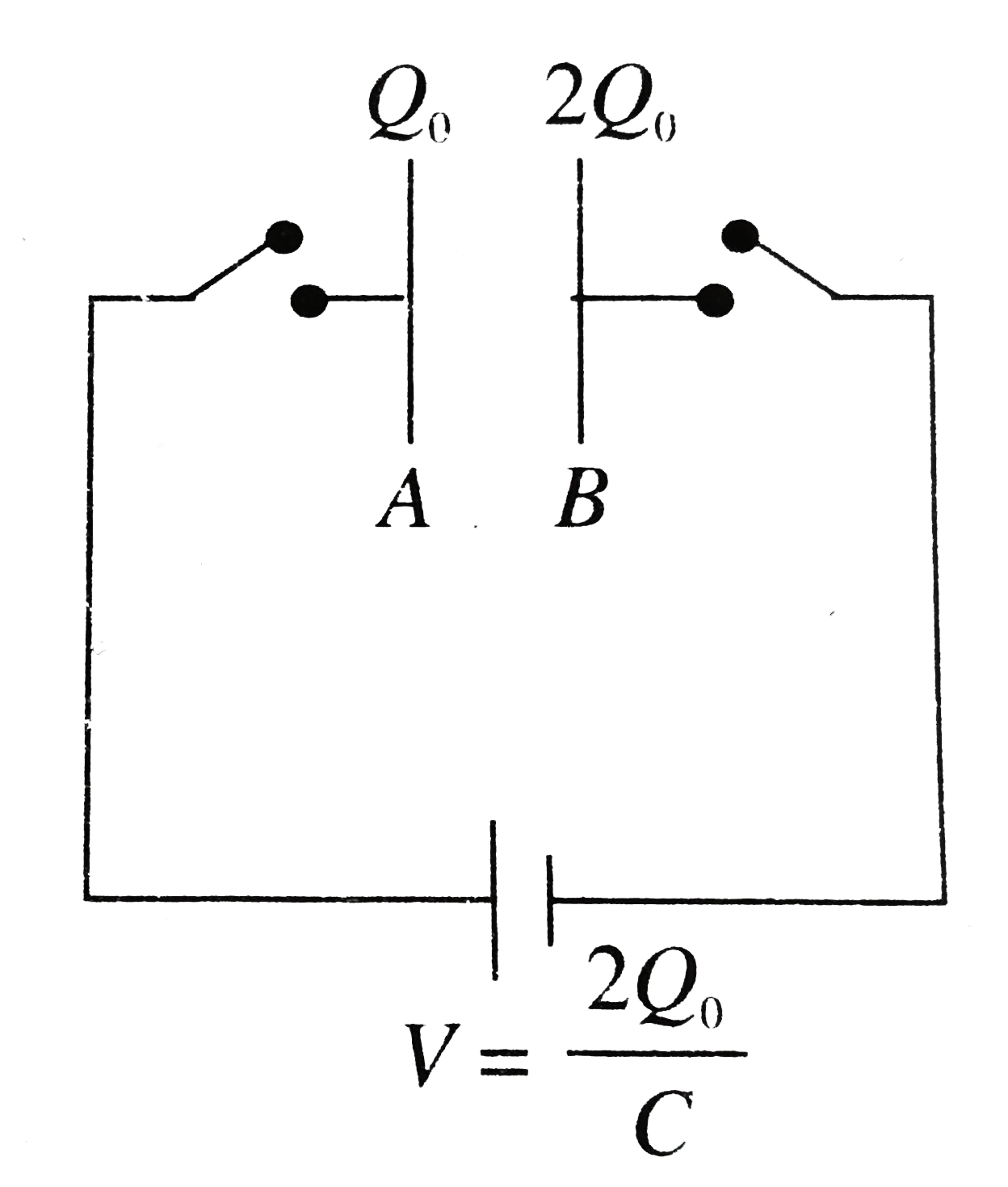
Charges `Q_0` and `2Q_0` are given to parallel plates A and B, respectively, and they are separated by a small distance. The capacitance of the given arrangement is C. Now, plates A and B are connected to positive and negative terminals of battery of potential difference `V = 2Q_0//C` respectively, as shown, then the work done by the battery is

A

`(2Q_(0)^(2))/C`

B

`(4Q_(0)^(2))/C`

C

`(5Q_(0)^(2))/C`

D

`(6Q_(0)^(2))/C`

Text Solution

Verified by Experts

The correct Answer is:

C

c. After connection the charge of capacitor `Q'=CV=C(2Q_(0))/(C)=2Q_(0)`
The final charge in inner plate of `A` will be `2Q_(0)`. Hence charge supplied by battery
`DeltaQ=(2Q-((-Q_(0))/(2)))=(5Q_(0))/(2)`
Hence work done by battery
`W=(DeltaQ)V=(5Q_(0))/(2)xx(2Q_(0))/(C)=(5Q_(0)^(2))/(C)`
Promotional Banner

Topper's Solved these Questions

  • MISCELLANEOUS VOLUME 3

    CENGAGE PHYSICS ENGLISH|Exercise Assertion and Reason Type|8 Videos
  • MISCELLANEOUS VOLUME 3

    CENGAGE PHYSICS ENGLISH|Exercise Comprehension Type|94 Videos
  • MAGNETIC FIELD AND MAGNETIC FORCES

    CENGAGE PHYSICS ENGLISH|Exercise Multiple Correct Answer type|2 Videos
  • MISCELLANEOUS VOLUME 5

    CENGAGE PHYSICS ENGLISH|Exercise Integer|12 Videos

Similar Questions

Explore conceptually related problems

Two identical pates P_(1) and P_(2) of cross sectional area A are separated at a very small disance, d , where (epsilon_(0)A)/d=2-SI unit. Initially charge on the plate P_(1) is -10C and charge on the plate P_(2) is +30C . Now plate P_(1) and P_(2) are connected to positive and negative terminals of battery of potential difference 10 Volts with the help of switches S_(1) and S_(2) respectively. Choose the correct option (s)

The two plates X and Y of a parallel plate capacitor of capacitance C are given a charge of amount Q each. X is now joined to the positive terminal and Y to the negative terminal of a cell of emf E = Q/C: -

Charges 2q and -3q are given to two identical metal plates of area of cross section A . the distance between the plates is d . Find the capacitance and potential difference between the plates.

In a circuit, 10 C of charge is passed through a battery in a given time. The plates of the battery are maintained at a potential difference of 12 V. How much work is done by the battery?.

T Two capacitors of capacitances 1 muF and 2 muF are charged to potential differnces 20 V and 15 V as shown in. If terminals B and C connected together and terminals A and D are connected with the positive and negative ends of the battery, respectively, then find the final charges on both the capacitors. .

Each plate of a parallel plate capacitor has a charge q on it. The capacitor is now connected to a battery. Now,

A 5.0muF capacitor is charged to 12V . The positive plate of this capacitor is now connected to the negative terminal of a 12V battery and vise versa . Calculate the heat developed in the connecting wires.

Four large identical metallic plates are placed as shown in the Figure. Plate 2 is given a charge Q. All other plates are neutral. Now plates 1 and 4 are earthed. Area of each plate is A. (a) Find charge appearing on right side of plate 3. (b) Find potential difference between plates 1 and 2.

A parallel-plate capacitor has plates of unequal area . The larger plates is connected to the positive terminal of the battery and the smaller plate to its nagative terminal. Let Q+ and Q-be the charges appearing on the positive and negative plates respectively
