Home
Class 12
PHYSICS
An electrically isolated hollow (initial...

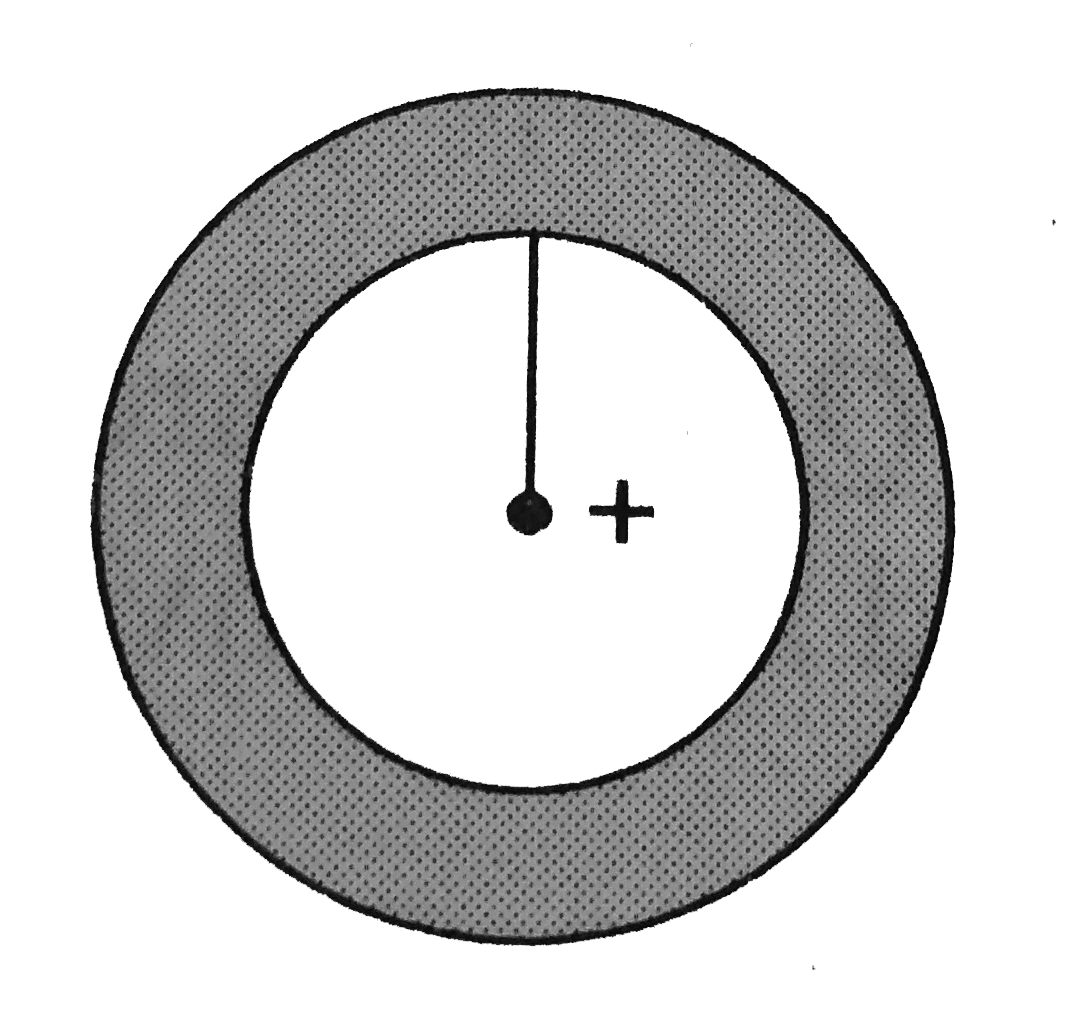
An electrically isolated hollow (initially uncharged), conducting sphere has a small positively charged ball suspended by an insulating rod from its inside surface, see diagram

This causes the inner surface of the sphere to become negatively charged. When the ball is centred in the sphere the electric field outside the conducting spehere is

A

zero

B

the same as if the sphere was not there

C

twice what it would be if the sphere was not there

D

equal in magnitude but opposite in direction to what it would be if the sphere was not there.

Text Solution

Verified by Experts

The correct Answer is:
B

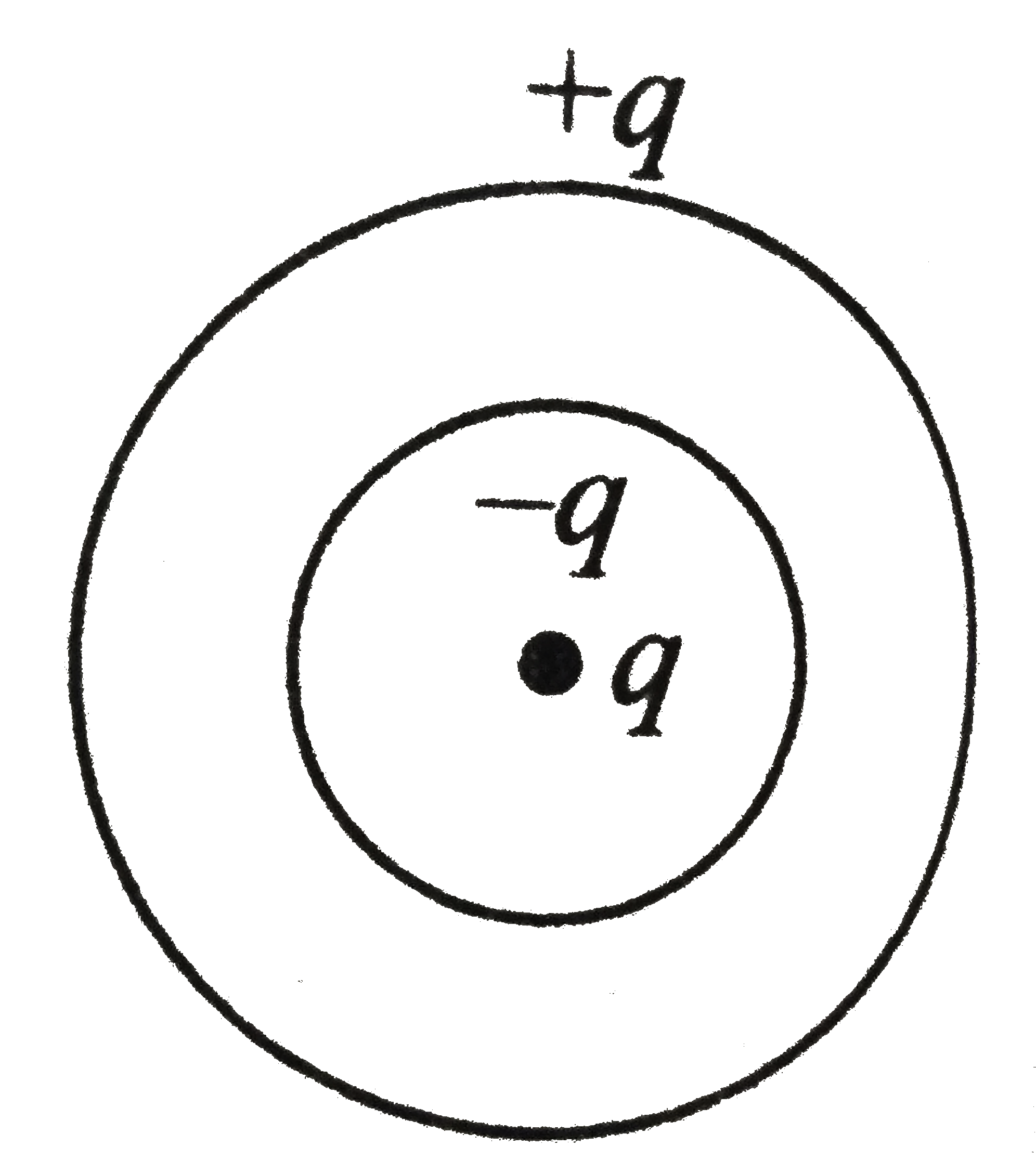
b. Let the charge on the ball at center is `q`, then`-q` charge will be induced on the inner surface and `+q` on the order surface. Electric field at any point outside the sphere due to inner charges `q` and `-q` will combinely be zero. Outer charge `q` will combinely be field at outside points as it would be produced by a charge at the center. Hence presence of sphere does not affect the electric field outside the sphere.
Promotional Banner

Topper's Solved these Questions

  • MISCELLANEOUS VOLUME 3

    CENGAGE PHYSICS ENGLISH|Exercise Assertion and Reason Type|8 Videos
  • MISCELLANEOUS VOLUME 3

    CENGAGE PHYSICS ENGLISH|Exercise Comprehension Type|94 Videos
  • MAGNETIC FIELD AND MAGNETIC FORCES

    CENGAGE PHYSICS ENGLISH|Exercise Multiple Correct Answer type|2 Videos
  • MISCELLANEOUS VOLUME 5

    CENGAGE PHYSICS ENGLISH|Exercise Integer|12 Videos

Similar Questions

Explore conceptually related problems

Charge density of the given surface is s. Then electric field stranght at the centre (of quarter sphere) is

A conducting sphere of radius R is given a charge Q . The electric potential and the electric field at the centre of the sphere respectively are

A conducting sphere of radius R is given a charge Q . The electric potential and the electric field at the centre of the sphere respectively are

A hollow insulated conducting sphere is given a positive charge of 10 mu C . What will be the electric field at the centre of the sphere it is radius is 2 metres ?

A charge Q is placed at the centre of an uncharged, hollow metallic sphere of radius a. (a) Find the surface charge density on the inner surface and on the outer surface. (b) If a charge q is put on the sphere, what would be the surface charge densities on the inner and the outer surface? (c) Find the electric field inside the sphere at a distance x from the centre in the situations (a) and (b).

A large hollow metallic sphere has a positive charge of 35.4muC at its centre. Find how much electric flux emanates from the sphere.

Figure shown a closed surface which intersects a conducting sphere. If a positive charge is placed at the point P, the flux of the electric field through the closed surface

Figure shown a closed surfce which intersects a conducting sphere. If a positive charge is placed at the point P, the flux of the electric field through the closed surface

A non-conducting sphere of radius R is given a charge Q. Charge is uniformly distributed in its volume. The electric potential at centre and at the surface of sphere respectively are

Consider two concentric conducting spheres. The outer sphere is hollow and initially has a charge -7Q on it. The inner sphere is solid and has a charge +2Q on it. a. How much charge is on the outer surface and inner surface of the outer sphere. b. If a wire is connected between the inner and outer sphere, after electrostatic equilibrium is established how much total charge is on the outer sphere? How much charge is on the outer surface and inner surface of the outer sphere? Does the electric field at the surface of the inside sphere change when the wire is connected? c. We return to original condition in (a). We now connect the outer sphere to ground with a wire and then disconnect it. How much total charge will be on the outer sphere? How much charge will be on the inner surface and outer surface of the outer sphere?

