Home
Class 12
PHYSICS
An insulating spherical shell of uniform...

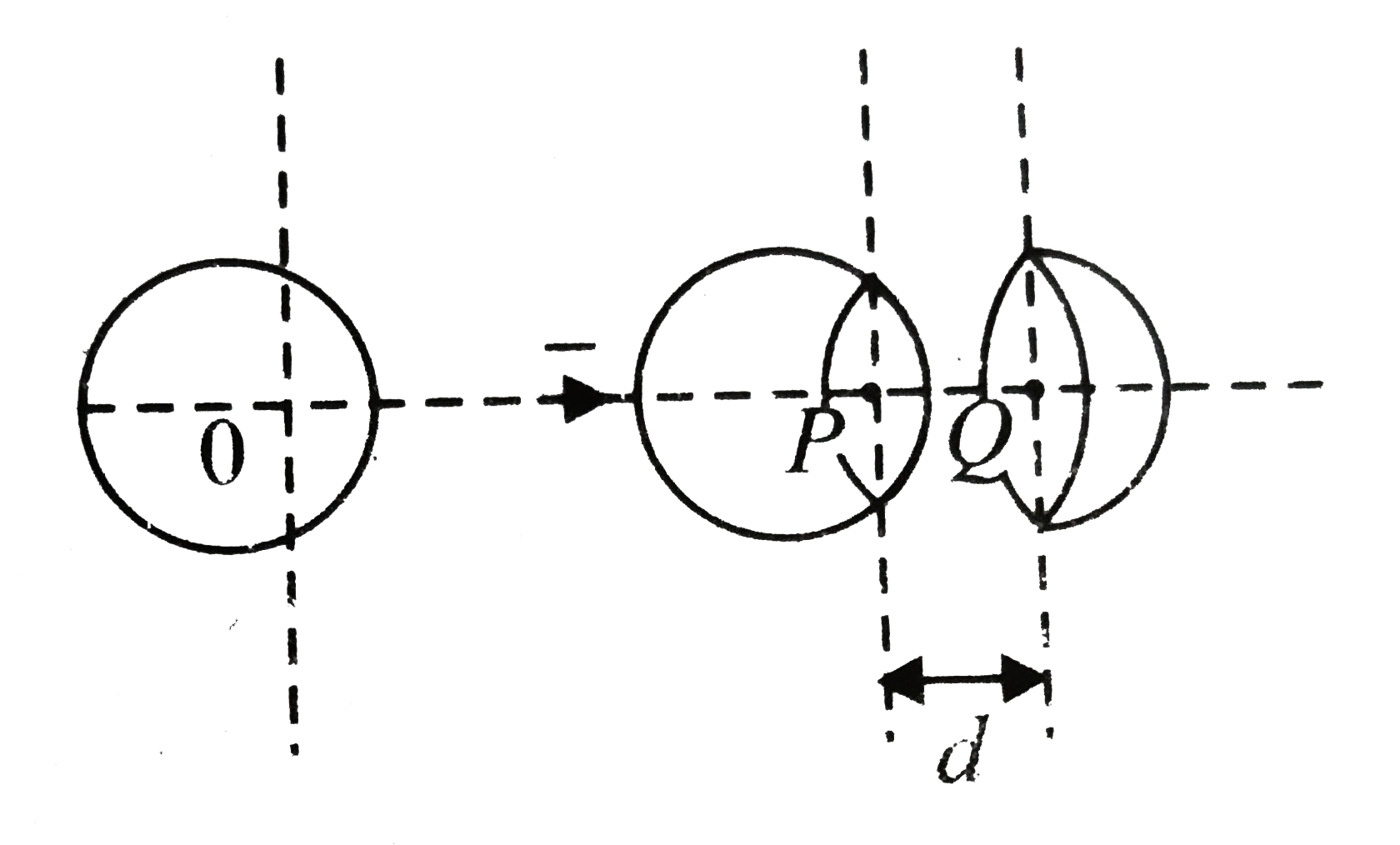
An insulating spherical shell of uniform surface charge density is cut into two parts and place at a distance d apart as shown in figure. `vecE_p and vecE_Q` denote the electric fields at P and Q, respectively. As `d (i.e. PQ) rarr oo`

A

`|vecE_(P)|gt|vecE_(Q)|`

B

`|vecE_(P)|=|vecE_(Q)|`

C

`|vecE_(P)|lt|vecE_(Q)|`

D

`vecE_(P) + vecE_(Q)=0`

Text Solution

Verified by Experts

The correct Answer is:

B, D

b.,d.
The electric field inside any point of the sphere is zero.
Promotional Banner

Similar Questions

Explore conceptually related problems

If three infinite charged sheets of uniform surface charge densities sigma, 2sigma and -4 sigma are placed as shown in figure, then find out electric field intensities at points A, B, C and D.

Consider a thin spherical shell of radius R consisting of uniform surface charge density sigma . The electric field at a point of distance x from its centre and outside the shell is

Arrangements of charges are shown in the figure. Flux linked with the closed surface P and Q respectively are ……….and ……….

Three conducting spherical shells have charges q,-2q and 3q as shown in figure. Find electric Potential at point P as shown in figure.

The point charges Q and -2Q are placed at some distance apart. If the electirc field at the location of Q is E , the electric field at the location of -2Q will be

There are two infinite plane sheets each having uniform surface charge density +sigma C//m ^(2) They are inclined to each other at an angle 30^(@ ) as shown in the figure. Electric field at any arbitrary point P is:

There are two infinite plane sheets each having uniform surface charge density +sigma C//m ^(2) They are inclined to each other at an angle 30^(@ ) as shown in the figure. Electric field at any arbitrary point P is:

An infinite, uniformly charged sheet with surface charge density sigma cuts through a spherical Gaussian surface of radius R at a distance X from its center, as shown in the figure. The electric flux Phi through the Gaussian surface is .

Consider a sphere of radius R which carries a uniform charge density rho . If a sphere of radius R/2 is carved out of it,as shown, the ratio (vecE_(A))/(vecE_(B)) of magnitude of electric field vecE_(a) and vecE_(B) , respectively, at points A and B due to the remaining portion is:

A charge Q is placed at a distance a/2 above the centre of a horizontal, spuare surface of edge a as shown in figure (30-E1). Find the flux of the electric field through the square surface.
