Home
Class 12
PHYSICS
A charge Q is imparted to two identical ...

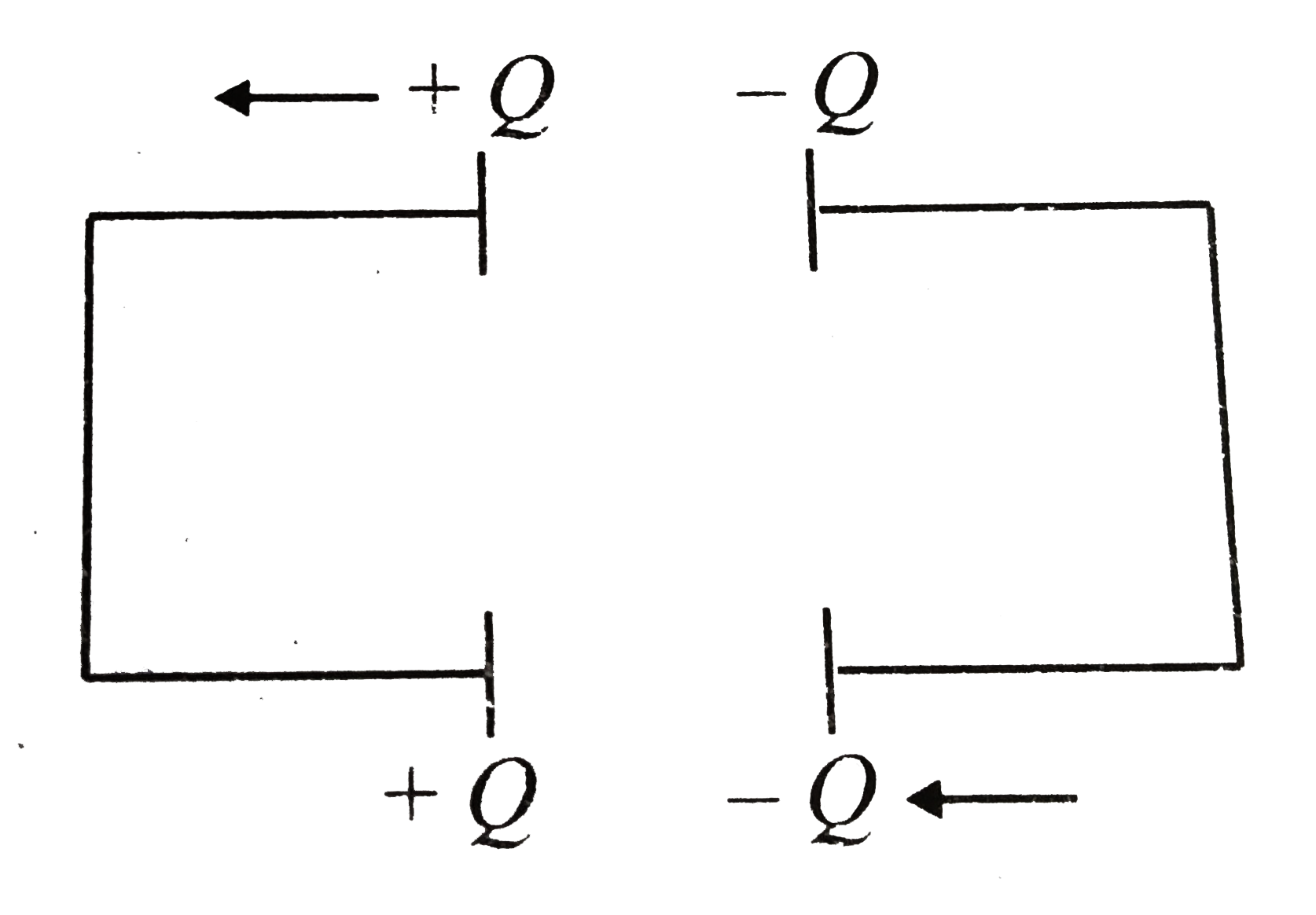
A charge Q is imparted to two identical capacitors in paralle. Separation of the plates in each capacitor is `d_0`. Suddenly, the first plate of the first capacitor and the second plate of the second capacitor start moving to the left with speed v, then

A

charges on the two capacitors as a function of time are `(Q(d_0-vt))/(2d_0), (Q(d_0+vt))/(2d_0)`.

B

charges on the two capacitors as a function of time are `(Qd_0)/(2(d_0-vt)), (Qd_0)/(2(d_0+vt))`.

C

current in the circuit will increase as time passes on

D

current in the circuit will be constant.

Text Solution

Verified by Experts

The correct Answer is:

A, D

a.,d.
Leq `q_(1)` and `q_(2)` be the instantaneous charges on capacitors. Since they are in parallel, then `(q_(1))/(C_(1))=(q_(2))/(C_(2))` and `q_(1)+q_(2)=Q`
`C_(1)=(epsilon_(0)A)/(d_(0)+vt),C_(2)=(epsilon_(0)A)/(d_(0)-vt)`
So `(q_(1))/(q_(2))=(C_(1))/(C_(2))=(d_(0)-vt)/(d_(0)+vt)` or `q_(2)((d_(0)-vt)/(d_(0)+vt))+q_(2)=0`
So `q_(2)=(Q(d_(0)+vt))/(2d_(0))` and `q_(1)=(Q(d_(0)-vt))/(2d_(0))`
Hence, option (a) is correct and option (b) is incorrect.
`i=(-dq_(1))/(dt)` or `(dq_(2))/(dt)` or `i=(Q_(v))/(2d_(0))`
Which does not depend on time. So option (d) is correct and option (c) is incorrect.
Promotional Banner

Similar Questions

Explore conceptually related problems

Charge Q is distributed on two identical capacitors in parallel. Seperation of the plates in each capacitor is d_0 . If the first plate of the capacitor C_1 and the second late of the capacitor C_2 start moving to the left with constant speed v, then match the options of Column I with those in Column II Match the column I and Column II

If the two plates of the charged capacitor are connected by a wire, then

Two identical capacitors haveng plate separation d_(0) are connected parallel to each other across the points A and B as shown in. A charge Q is imparted to the system by removed Now the first plate of the first capacitor and the second plate of the second capacitor start moving with constant velocity u_(0) toward left. Find the magnitude of the current flouing in the loop during this process. .

If the separation between the plates of a capacitor is 5 mm , then area of the plate of a 3 F parallel plate capacitor is

The potentials of the two plates of capacitor are +10V and -10 V . The charge on one of the plate is 40 C . The capacitance of the capacitor is

A capacitor of capacitor 5.00 muF is charged to 24.0 V and another capacitor of capacitance 6.0muF is charged to 12.0V (a) Find the energy stored in each capacitor .(b)The positive plates of the first capacitor is now connected to the negative plate of the second and vice versa . Find the new charges on the capacitors .(c)Find the loss of electrostatic energy during the process .(d)Where does this energy go?

A capacitor of 0.75 muF is charged to a voltage of 16 V. What is the magnitude of the charge on each plate of the capacitor ?

Two similar parallel plate capacitors each of capaciti C_0 are connected in series The combination is connected with a voltage source of V_0 . Now, seperation between the plates of one capacitor is increased by a distance d and the separation between the plates of another capacitor is decreased by the distance d/2 . The distance between the plates of each capacitor was d before the chane in sepration. Then select the correct choice.

A capacitor of capacity C is charged to a potential difference V and another capacitor of capacity 2C is charged to a potential difference 4V . The charged batteries are disconnected and the two capacitors are connected with reverse polarity (i.e. positive plate of first capacitor is connected to negative plate of second capacitor). The heat produced during the redistribution of charge between the capacitors will be

A parallel plate capacitor is charged and then the battery is disconnected. When the plates of the capacitor are brought closer, then
