Home
Class 12
PHYSICS
A ball at O is in equilibrium as it is a...

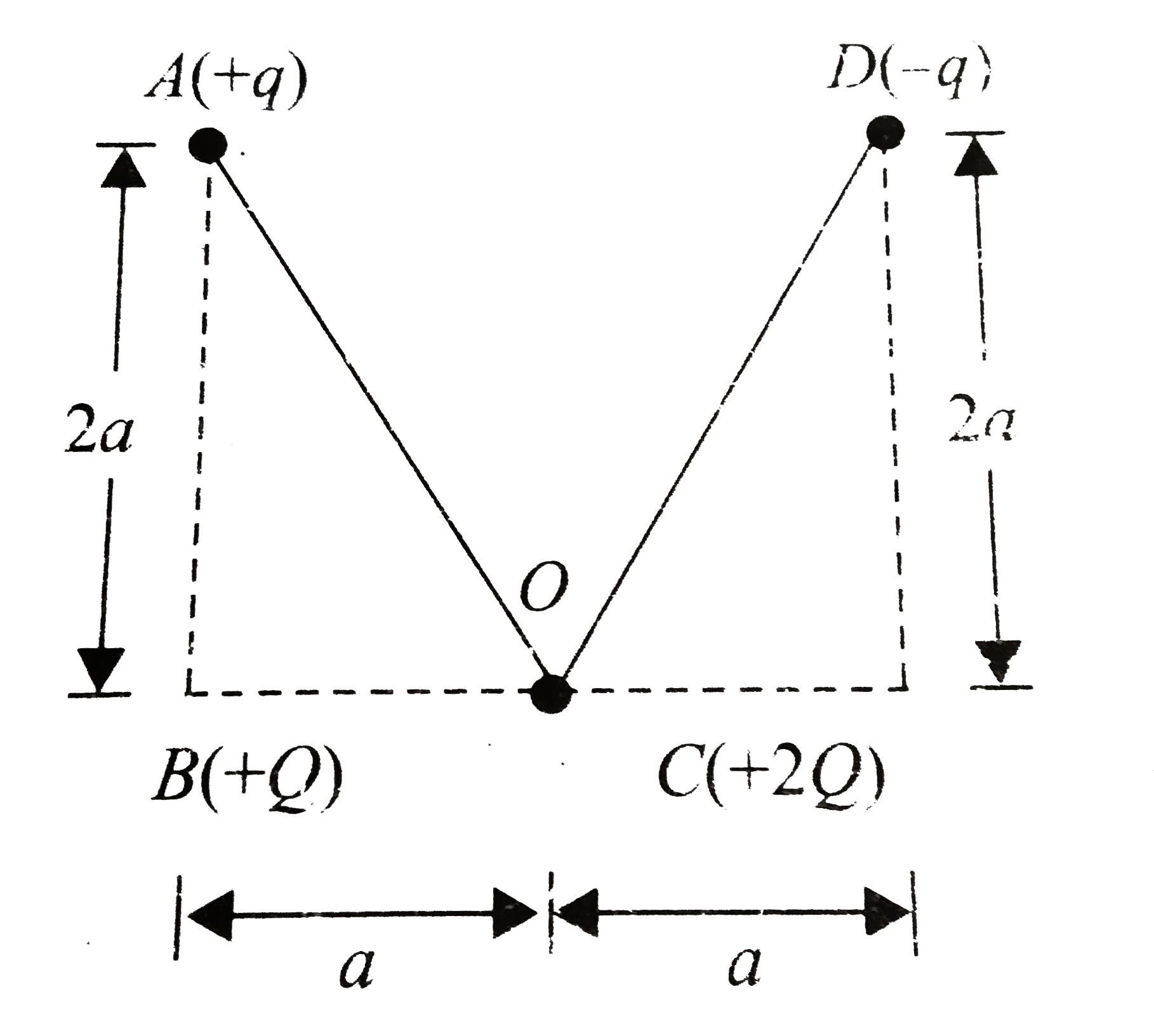
A ball at O is in equilibrium as it is attached with two strings AO and DO, which are tied at A and D. `AO = DO= a(sqrt5)`. The charges at A, B, C, abd D are `+q, +Q, +2Q, and -q`, respectively. Find the correct options. The ball at O is positively charged.

A

The ball O cannot remain in equilibrium.

B

If the charge at C is `+Q`, the ball will remain in equilibrium.

C

The ball O will remain in equilibrium

D

If the charge at A and D and charge at B and C are interchanged, the ball will remain in equilibrium.

Text Solution

Verified by Experts

The correct Answer is:
C, D

c.,d.
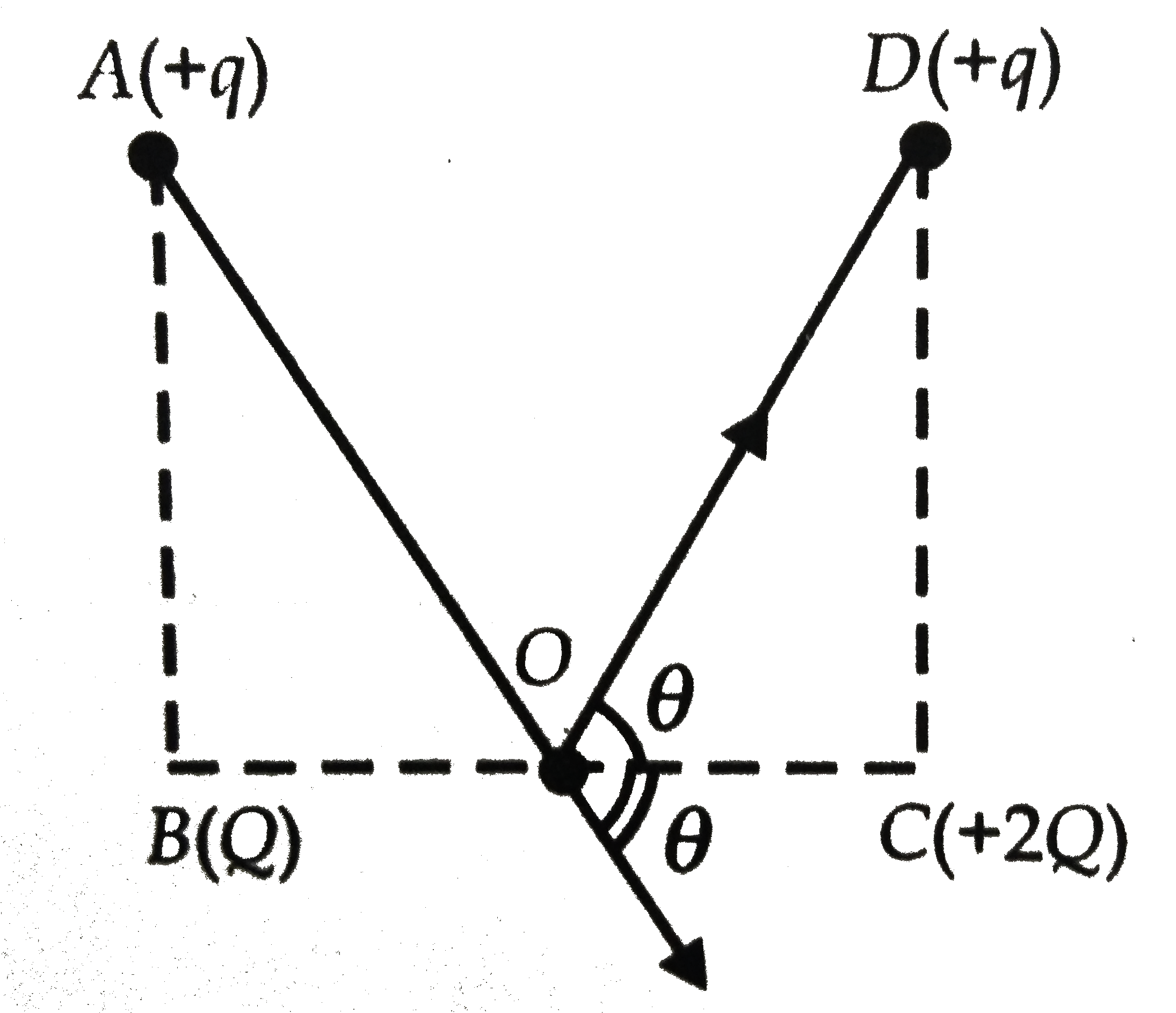
For ball `O` (positively charged) to be in equilibrium at the middle of `BC`

`[(q)/(4piepsilon_(0)(asqrt(5))^(2))+(q)/(4piepsilon_(0)(asqrt(5))^(2))]cos theta+(Q)/(4piepsilona^(2))`
`=(2Q)/(3piepsilon_(0)a^(2))`
`q=(5sqrt(5)Q)/(2)` (as `cos theta=(a)/(asqrt(5)`)
If `q=5sqrt(5)Q//2,` ball will be in equilibrium , even if charge are interchanged (a) is wrong and (c) and (d) are correct. If charge as `C` is `+Q`, then
`(2qcostheta)/(5)+Q=Q`
or `(2qcostheta)/(5)=0`
`Qcancel=0,theta=90^(@)`, which is not possible (b) is wrong.
Promotional Banner

Similar Questions

Explore conceptually related problems

Two charges q_(1) and q_(2) are placed at (0,0,d) and (0,0,-d) respectively. Find locus of points where the potential is zero.

In figure, the charges on C_(1),C_(2) , and C_(3) , are Q_(1), Q_(2) , and Q_(3) , respectively. .

Two point charges q and –q are at positions (0,0,d) and (0,0, –d) respectively . What is the electric field at (a,0,0 ) ?

Two point charges q and –q are at positions (0,0,d) and (0,0, –d) respectively . What is the electric field at (a,0,0 ) ?

Four charges of +q, +q, +q and +q are placed at the corners A, B, C and D of a square of side a. Find the resultant force on the charge at D

Three large conducting sheets placed parallel to each other at a finite distance contain charges Q,-2Q, and 3Q , respectively. Find the electric fields at points A, B, C, and D.

The positions of two point charges q_(1) and q_(2) are vecr_(1) and vecr_(2) , respectively. Find the position of the point where the net field is zero due to thses charges.

Two concentric spherical shells have charges +q and -q as shown in figure. Choose the correct options.

Four charges of +q, +q +q and +q are placed at the corners A, B, C and D of s square. The resultant force on the charge at D

The corners A, B, C, and D of a square are occupied by charges q,-q,2Q , and Q, respectively. The side of square is 2b. The field at the midpoint of side CD is zero. What is the value of q//Q ?

