Home
Class 12
PHYSICS
A charged particle is suspended at the c...

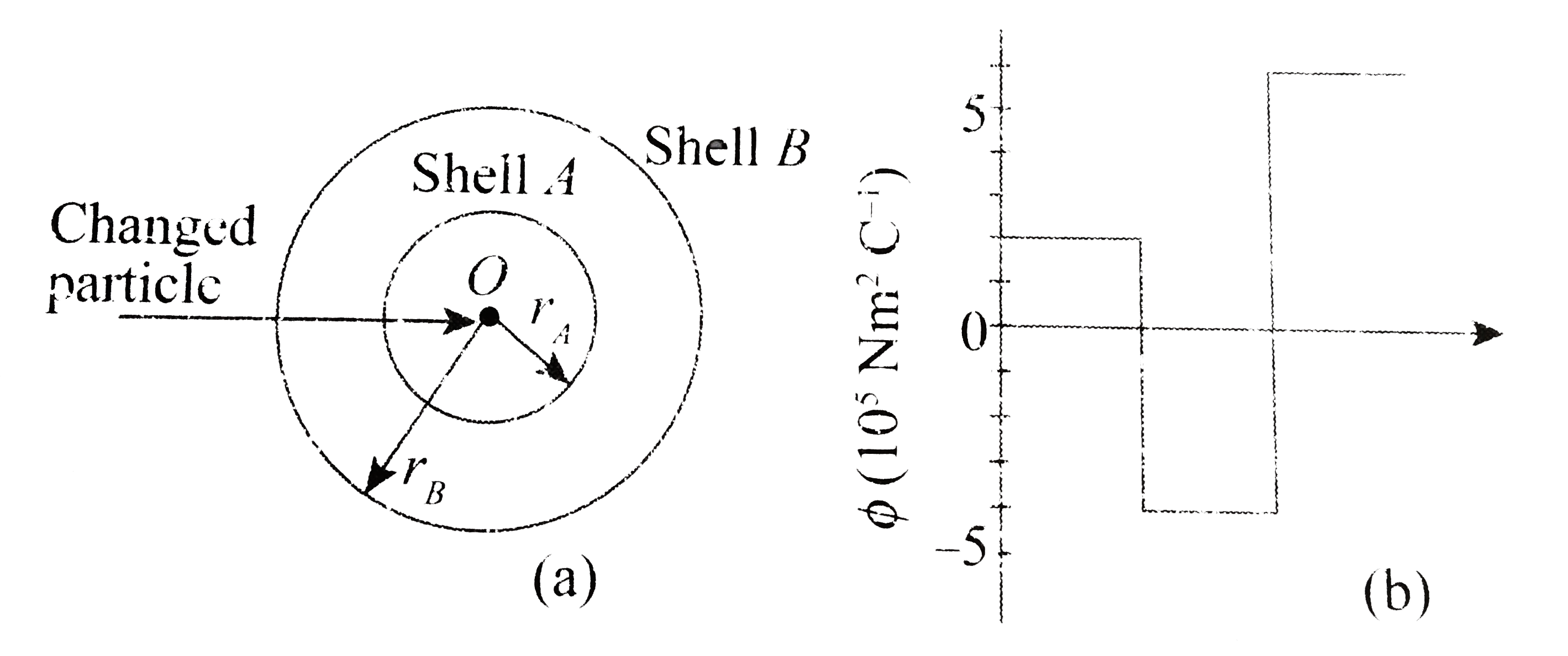
A charged particle is suspended at the center of two thin concentric spherical charged shells, made of nonconducting material. Figure shows cross section of the arrangement. Figure (b) gives the net flux `phi` through a Gaussian sphere centered on the particle, as a function of the radius r of the sphere.
,
In which range of the values of r is the electric field zero?

A

`0 to r_A`

B

`r_A to r_B`

C

for `rgtr_B`

D

for no range of r, electric field is zero.

Text Solution

Verified by Experts

The correct Answer is:
D

We see that `phi` remains constant up to `r_(1)`. So `r_(1)ltr_(A)`. Let q be the charge at centre than
`phi=(q_("in"))/(epsilon_(0))` or `2xx10^(5)=(q)/(8.85xx10^(-12))` or `q=1.77muC` ltBrgt Similarly `phi=-4xx10^(5)=(q+q_(A))/(epsilon_(0))" " q_(A)=-5.31muC`
Where `q_(A)` is the charge on A. electric field is zero nowhere as `phi` is not zero anywhere.
Promotional Banner

Topper's Solved these Questions

  • MISCELLANEOUS VOLUME 3

    CENGAGE PHYSICS ENGLISH|Exercise Interger Answer type|20 Videos
  • MISCELLANEOUS VOLUME 3

    CENGAGE PHYSICS ENGLISH|Exercise Fill in the blanks|10 Videos
  • MISCELLANEOUS VOLUME 3

    CENGAGE PHYSICS ENGLISH|Exercise Assertion and Reason Type|8 Videos
  • MAGNETIC FIELD AND MAGNETIC FORCES

    CENGAGE PHYSICS ENGLISH|Exercise Multiple Correct Answer type|2 Videos
  • MISCELLANEOUS VOLUME 5

    CENGAGE PHYSICS ENGLISH|Exercise Integer|12 Videos

Similar Questions

Explore conceptually related problems

A charged particle is suspended at the center of two thin concentric spherical charged shells, made of nonconducting material. Figure shows cross section of the arrangement. Figure (b) gives the net flux phi through a Gaussian sphere centered on the particle, as a function of the radius r of the sphere. , What is the charge on shell A?

A charged particle is suspended at the center of two thin concentric spherical charged shells, made of nonconducting material. Figure shows cross section of the arrangement. Figure (b) gives the net flux phi through a Gaussian sphere centered on the particle, as a function of the radius r of the sphere. , What is the charge on the central particle?

A non-conducting spherical shell of radius R surrounds a point charge q (q at center). The electric flux through a cap of the shell of half angle theta is:

A non-conducting spherical shell of radius R surrounds a point charge q (q at center). The electric flux through a cap of the shell of half angle theta is:

A charged particle is held a the centre foa sperical shell. The following figure gives the magnitude E of the electric field versus radial distance r. what is the net charge on the shell ?

An infinite, uniformly charged sheet with surface charge density sigma cuts through a spherical Gaussian surface of radius R at a distance X from its center, as shown in the figure. The electric flux Phi through the Gaussian surface is .

Graph shows magnitude of electric field (E) , charge enclosed (q_("enclosed:)) within the concentic sphere and net flux (phi) through a concentric spherical Gaussian surface as a function of distance (r) from centre of a uniformly positive charged solid sphere of radius R. Choose the correct option (s):

figure shows, in cross section, two Gaussian spheres and two Gaussian cubes that are centered on a positively charged particle on a positively charged partical . Rank greatest first, and indicate whether the manitudes are unifrom or variable along each surface.

A conducting sphere of radius R and a concentric thick spherical shell of inner radius 2R and outer radius 3R is shown in figure. A charge +10Q is given to the shell and inner sphere is earthed. Then charge on inner sphere is

The region between two concentric spheres of radii 'a' and 'b', respectively (see figure), have volume charge density rho=A/r , where A is a constant and r is the distance from the centre. At the centre of the spheres is a point charge Q. The value of A such that the electric field in the region between the spheres will be constant, is:

CENGAGE PHYSICS ENGLISH-MISCELLANEOUS VOLUME 3-Comprehension Type
  1. A charged particle is suspended at the center of two thin concentric s...

    Text Solution

    |

  2. A charged particle is suspended at the center of two thin concentric s...

    Text Solution

    |

  3. A charged particle is suspended at the center of two thin concentric s...

    Text Solution

    |

  4. Capacitor C(3) in the circuit is a veriable capacitor (its capacitance...

    Text Solution

    |

  5. Capacitor C(3) in the circuit is a variable capacitor (its capacitance...

    Text Solution

    |

  6. Capacitor C(3) in the circuit is a variable capacitor (its capacitance...

    Text Solution

    |

  7. In a region , an electroc field E = 10NC^(-1) making an angle of theta...

    Text Solution

    |

  8. In a region , an electroc field E = 10NC^(-1) making an angle of theta...

    Text Solution

    |

  9. Two circular rings A and B each of radius a = 30 cm are placed coaxial...

    Text Solution

    |

  10. Two circular rings A and B each of radius a = 30 cm are placed coaxial...

    Text Solution

    |

  11. Figure shows four plates each of plate area A and separated between pl...

    Text Solution

    |

  12. Figure shows four plates each of plate area A and separated between pl...

    Text Solution

    |

  13. Figure shows four plates each of plate area A and separated between pl...

    Text Solution

    |

  14. Three capacitors C1,C2,andC3 of capacitance 1muF, 2muF, and 3muF, resp...

    Text Solution

    |

  15. Three capacitors C1,C2,andC3 of capacitance 1muF, 2muF, and 3muF, resp...

    Text Solution

    |

  16. Two points charges are placed on x-axis as shown, a = 1 cm, q = 1muC ...

    Text Solution

    |

  17. Two points charges are placed on x-axis as shown, a = 1 cm, q = 1muC ...

    Text Solution

    |

  18. Two points charges are placed on x-axis as shown, a = 1 cm, q = 1muC ...

    Text Solution

    |

  19. Two nonconducting plates A and B of radii 2R and 4R, respectively, are...

    Text Solution

    |

  20. Two nonconducting plates A and B of radii 2R and 4R, respectively, are...

    Text Solution

    |

