Home
Class 12
PHYSICS
An electron (mass m(e ))falls through a ...

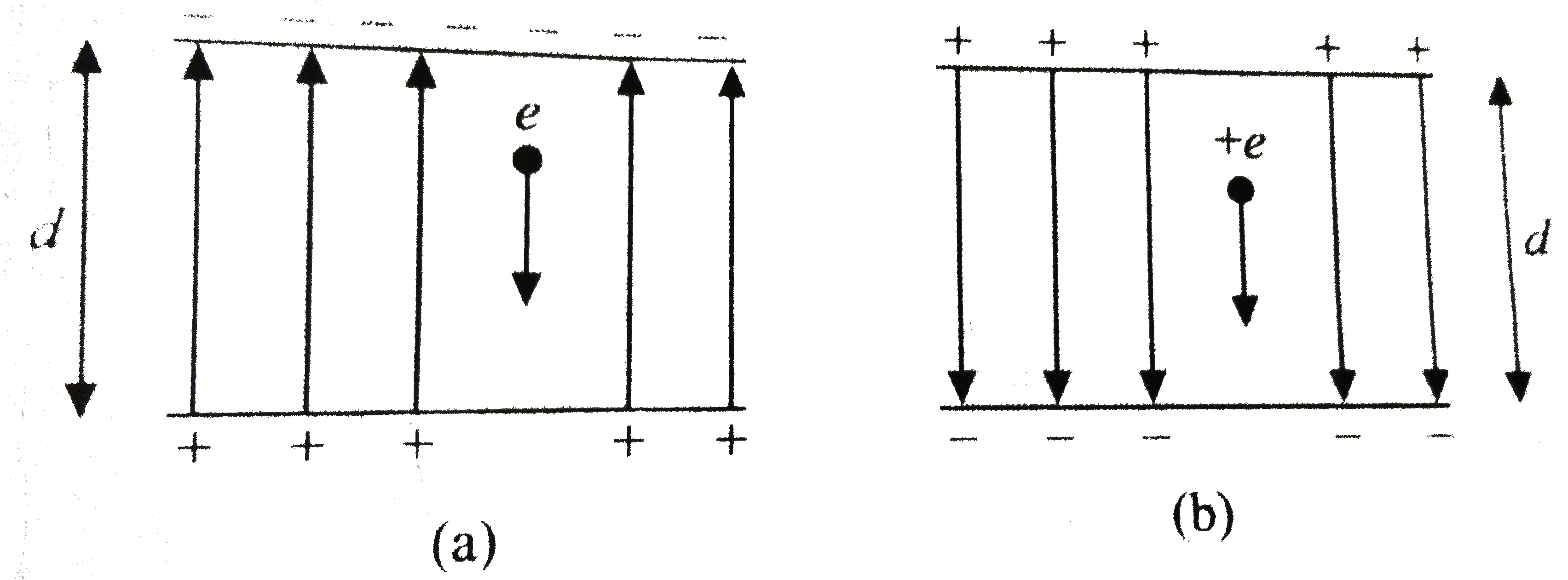
An electron (mass `m_(e )`)falls through a distance d in a uniform electric field of magnitude E.
,
The direction of the field is reversed keeping its magnitudes unchanged, and a proton(mass `m_(p)`) falls through the same distance. If the times taken by the electrons and the protons to fall the distance d is `t_("electron")` and `t_("proton")` respectively, then the ratio `t_("electron")//t_("proton")`.

A

1

B

`(m_p//m_e)^(1//2)`

C

`(m_e//m_p)^(1//2)`

D

1836

Text Solution

Verified by Experts

Let the distance to be traveled be `x`. Let the strength of uniform electric field be `E`. For the electron.
`u=0,S=x,a=(eF)/(m_(e)),t=t_(1)`
`S=ut+(1)/(2)at^(2)` or `x=(1)/(2)(eF)/(m_(e))xxt_(1)^(2)` (i)
For the proton,
`u=-0,s=x,a=(eF)/(mp),t=t_(1)`
`S=ut+(1)/(2)at^(2)` or `x=(1)/(2)(eF)/(m_(p))xxt_(2)^(2)` (ii)
From Eqs. (i) and (ii),
`(t_(2)^(2))/(t_(1)^(2))=(m_(p))/(m_(e))` or `(t_(2))/(t_(1))=[(m_(p))/(m_(e))]^(1//2)`
Promotional Banner

Topper's Solved these Questions

  • MISCELLANEOUS VOLUME 3

    CENGAGE PHYSICS ENGLISH|Exercise Assertion and Reason Type|8 Videos
  • MISCELLANEOUS VOLUME 3

    CENGAGE PHYSICS ENGLISH|Exercise Comprehension Type|94 Videos
  • MAGNETIC FIELD AND MAGNETIC FORCES

    CENGAGE PHYSICS ENGLISH|Exercise Multiple Correct Answer type|2 Videos
  • MISCELLANEOUS VOLUME 5

    CENGAGE PHYSICS ENGLISH|Exercise Integer|12 Videos

Similar Questions

Explore conceptually related problems

An electron falls through a small distance in a uniform electric field of magnitude 2xx10^(4)NC^(-1) . The direction of the field reversed keeping the magnitude unchanged and a proton falls through the same distance. The time of fall will be

An electron falls through a small distance in a uniform electric field of magnitude 2xx10^(4)NC^(-1) . The direction of the field reversed keeping the magnitude unchanged and a proton falls through the same distance. The time of fall will be

An electron falls through a distance of 1.5 cm in a uniform electric field of magnitude 2.4xx10^(4) NC^(-1) [Fig.1.12 (a)] . The direction of the field is reversed keeping its magnitude unchagned and a proton falls through the same distance [Fig. 1.12 (b) ]. Complute the time of fall in each case. Contrast the situation (a) with that of free fall under gravity.

An electron falls from rest through a vertical distance h in a uniform and vertically upward directed electric field E. the direction of electric field is now reversed, keeping its magnitude the same. A proton is allowed to fall from rest in it through the same vertical distance h.The time of fall of the electron, in comparison to the time of flal of the proton is

An electron initially at rest falls a distance of 1.5 cm in a uniform electric field of magnitude 2 xx10^(4) N//C . The time taken by the electron to fall this distance is

An electron initially at rest falls a distance of 1.5 cm in a uniform electric field of magnitude 2 xx10^(4) N//C . The time taken by the electron to fall this distance is

An electron falls through a distance of 1.5 cm in a uniform electric field of magnitude 2.0xx10^(4)N//C(Fig.a) Calculate the time it takes to fall through this distance starting from rest. If the direction of the field is reversed (fig .b) keeping its magnitude unchanged , calculate the time taken by a proton to fall through this distance starting from rest.

A charged particle of mass m and charge q is released from rest in an electric field of constant magnitude E . The kinetic energy of the particle after time t is

An electron of mass m_(e ) initially at rest moves through a certain distance in a uniform electric field in time t_(1) . A proton of mass m_(p) also initially at rest takes time t_(2) to move through an equal distance in this uniform electric field.Neglecting the effect of gravity, the ratio of t_(2)//t_(1) is nearly equal to

An electron of mass m_(e ) initially at rest moves through a certain distance in a uniform electric field in time t_(1) . A proton of mass m_(p) also initially at rest takes time t_(2) to move through an equal distance in this uniform electric field.Neglecting the effect of gravity, the ratio of t_(2)//t_(1) is nearly equal to

