Home
Class 12
PHYSICS
A wooden block performs SHM on a frictio...

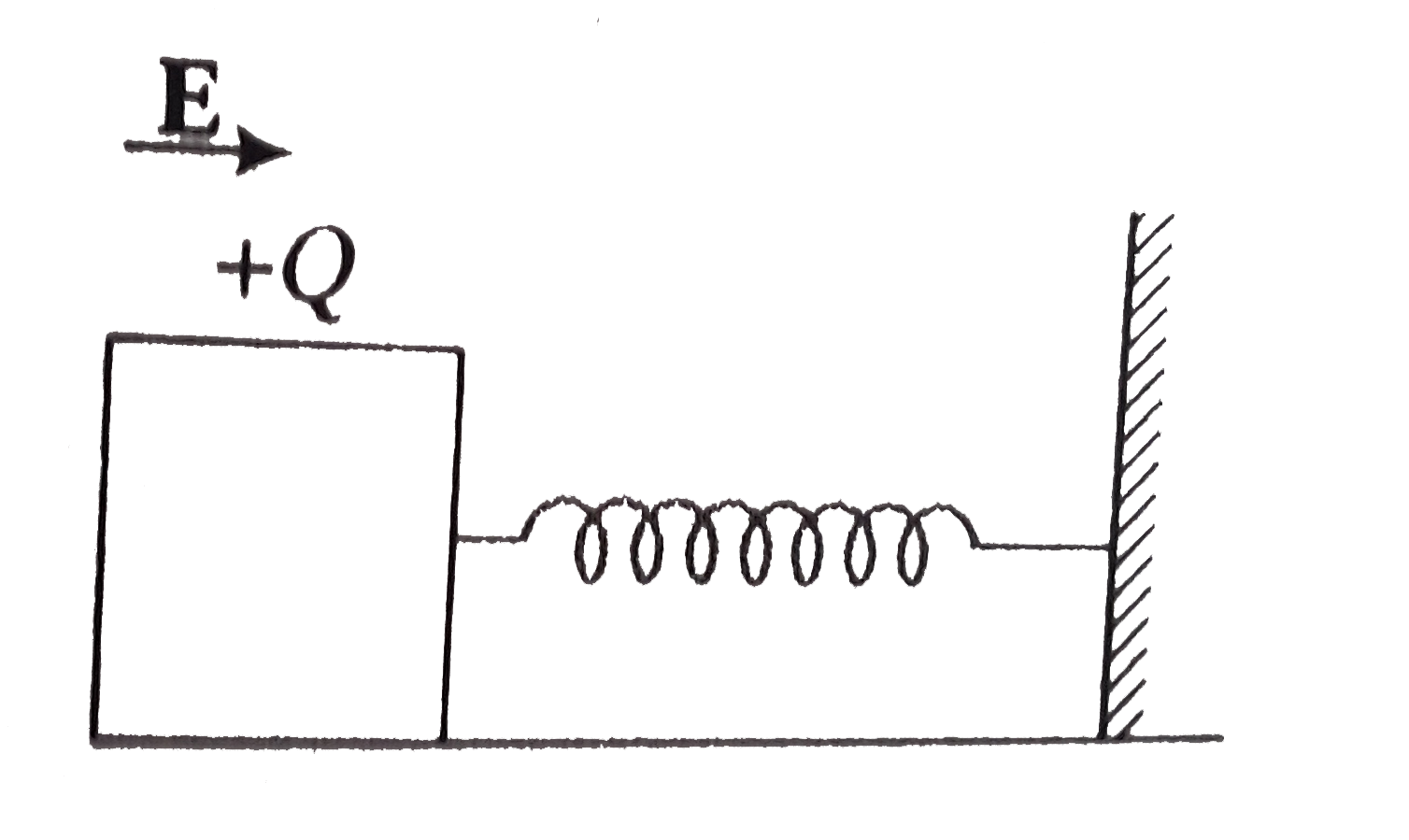
A wooden block performs SHM on a frictionless surface with frequency `v_(0)`. The block carries a charge `+Q` on its surface. If now a uniform electric field E is switched on as shown, then SHM of the block will be

A

of the same frequency and with shifted mean position

B

of the same frequency and with the same mean position

C

of changed frequency and with shifted mean position

D

of changed frequency and with the same mean position

Text Solution

Verified by Experts

The frequency will be the same `v=sqrt(k//m)//2pi`. Frequency is independent of any external constant. But due to the constant foce `q//E` toward right, the equilibrium position gets shifted by `qE//K` in forward direction.
Promotional Banner

Topper's Solved these Questions

  • MISCELLANEOUS VOLUME 3

    CENGAGE PHYSICS ENGLISH|Exercise Assertion and Reason Type|8 Videos
  • MISCELLANEOUS VOLUME 3

    CENGAGE PHYSICS ENGLISH|Exercise Comprehension Type|94 Videos
  • MAGNETIC FIELD AND MAGNETIC FORCES

    CENGAGE PHYSICS ENGLISH|Exercise Multiple Correct Answer type|2 Videos
  • MISCELLANEOUS VOLUME 5

    CENGAGE PHYSICS ENGLISH|Exercise Integer|12 Videos

Similar Questions

Explore conceptually related problems

A wooden block performs SHM on a frictionless surface with frequency, v_(0) . The block carries a charge +Q on its surface. If now a uniform electric field vec (E) is switched on as shwon in figure., then the SHM of the block will be

A spring block system undergoes SHM on a smooth horizontal surface, the block is now given some charge and a uniform horizontal electric field E is switched on as shown in Fig. As a result

In Fig. A is a large block which executes shm by sliding across a frictionless surface with a frequency n. The block B is at rest on the surface of the block mu_s The coefficient of static friction between the two is H. Find the maximum amplitude of oscillation of the system so that the block B does not slip.

A 4.00 kg block carrying a charge Q = 50.0muC is connected to a spring for which k = 100 N/ m. The block lies on a frictionless horizontal track, and the system is immersed in a uniform electric field of magnitude E = 5.00 xx 10^5 V/m , directed as shown in figure. If the block is released from rest when the spring is unstretched (at x = 0). (a) By what maximum amount does the spring expand? (b) What is the equilibrium position of the block? (c) Show that the block's motion is simple harmonic and determine its period. (d) Repeat part (a) if the coefficient of kinetic friction between block and surface is 0.2.

A block having mass 'm' and charge q is resting on a frictionless plane at distance L from the wall as shown in fig.Discuss the motion of the block when a uniform electric field E is applied horizontally towards the wall assuming that collision of the block with the wall is perfectly elastic.

A hemispherical surface of radius R is kept in a uniform electric field E as shown in figure. The flux through the curved surface is

A block of mass M has a circular cut with a frictionless surface as shown. The block rests on the horizontal frictionless surface of a fixed table. Initially the right edge of the block is at x = 0, in a co-ordinate system fixed to the table. A point mass m is released from rest at the topmost point of the path as shown and it slides down. When the mass loses contact with the block, its position is x and the velocity is v. At that instant, which of the following options is/are correct?

The block shown in the diagram has a mass of 2mug and a charge of 2xx10^(-9)C . If the block is given an initial velocity of 2ms^(-1) in the x - direction at t = 0 and an electric field of 2NC^(-1) is switched on in the x - direction, then the range (R) of the block on the ground will be

A block of mass m slides along a frictionless surface as shown in the figure. If it is releases from rest from A what is its speed at B?

A wooden block of mass 0.8 kg is dragged along a level frictionless surface by a hanging block of mass 0.2 kg as shown in the figure. Calculate the tension in the string and the acceleration of blocks.

