Home
Class 12
PHYSICS
Two non-conducting spheres of radii R1 a...

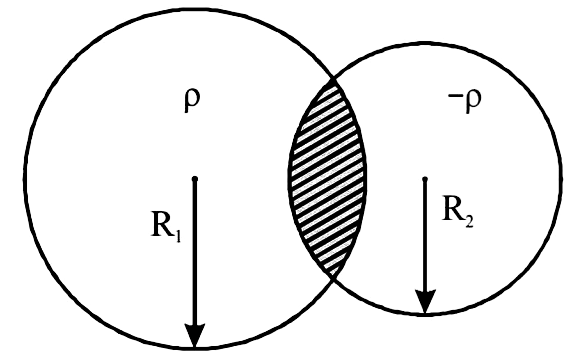
Two non-conducting spheres of radii `R_1` and `R_2` and carrying uniform volume charge densities `+rho` and `-rho`, respectively, are placed such that they partially overlap, as shown in the figure. At all points in the overlapping region

A

the electrostatic field is zero

B

the electrostatic potential is constant

C

the electrostatic field is constant in magnitude

D

the electrostatic field has same direction.

Text Solution

Verified by Experts

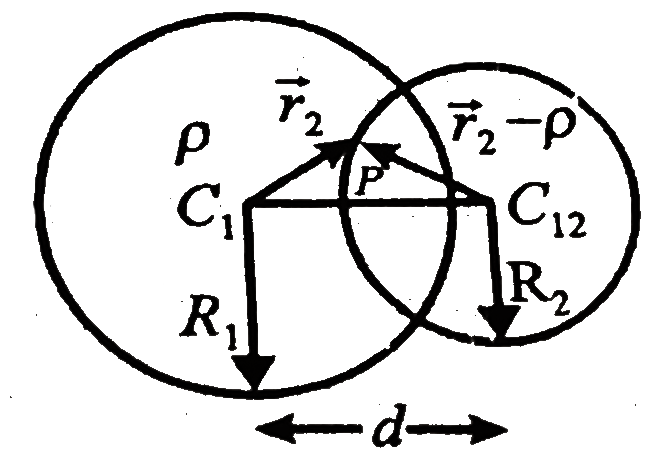
In triangle `PC_(1)C_(2), vec(r)_(2)=vec(d) +vec(r)_(1)`
The electrostatic field at point P is
`vec(E)=(K(rho 4/3pi R_(1)^(3))vec(r)_(2))/(R_(1)^(3))+(K(rho4/3 piR_(2)^(3))(vec(r)_(1))/(R_(2)^(3))`
`=K rho 4/3 pi(vec(r)_(2)-vec(r)_(1))=(rho)/(3epsilon_(0)) vec(d)`
Promotional Banner

Similar Questions

Explore conceptually related problems

Two non-conducting solid spheres of radii R and 2R, having uniform volume charge densities rho_1 and rho_2 respectively, touch each other. The net electric field at a distance 2R from the centre of the smaller sphere, along the line joining the centres of the spheres, is zero. The ratio rho_1/rho_2 can be

Two charged spheres of radii R_(1) and R_(2) having equal surface charge density. The ratio of their potential is

There are two nonconducting spheres having uniform volume charge densities rho and - rho . Both spheres have equal radius R . The spheres are now laid down such that they overlap as shown in Fig.2.125. Take vec(d) = O_(1) vec(O_(2)) . The electric field vec(E) in the overlapped region is

There are two nonconducting spheres having uniform volume charge densities rho and - rho . Both spheres have equal radius R . The spheres are now laid down such that they overlap as shown in Fig.2.125. Take vec(d) = O_(1) vec(O_(2)) . The electric field vec(E) in the overlapped region is

There are two nonconducting spheres having uniform volume charge densities rho and - rho . Both spheres have equal radius R . The spheres are now laid down such that they overlap as shown in Fig.2.125. Take vec(d) = O_(1) vec(O_(2)) . The potential difference Delta V between the centres of the two spheres for d = R is

Two concentric conducting shells of radii R and 2R are having charges Q and -2Q respectively.In a region r

Two concentric conducting spheres of radii R and 2R are crrying charges Q and -2Q , respectively. If the charge on inner sphere is doubled, the potetial differece between the two spheres will

Figure shows two concentric conducting shells of radii r_(1) and r_(2) carrying uniformly distributed charges q_(1) and q_(2) , respectively. Find an expression for the potential of each shell. .

A nonconducting sphere of radius R is filled with uniform volume charge density -rho . The center of this sphere is displaced from the origin by vecd . The electric field vecE at any point P having position vector inside the sphere is

Two non-conduction hollow uniformly charged spheres of radil R_(1) and R_(2) with charge Q_(1) and Q_(2) respectively are places at a distance r. Find out total energy of the system.