

Home
Class 12
PHYSICS
In the diagrams, all the light bulbs are...

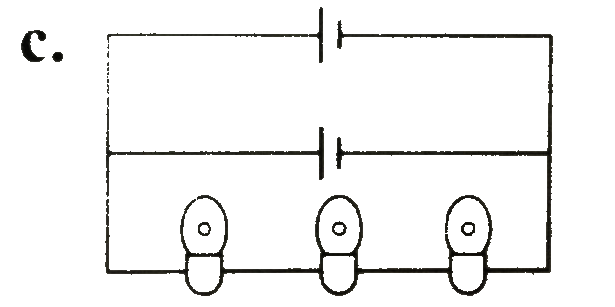
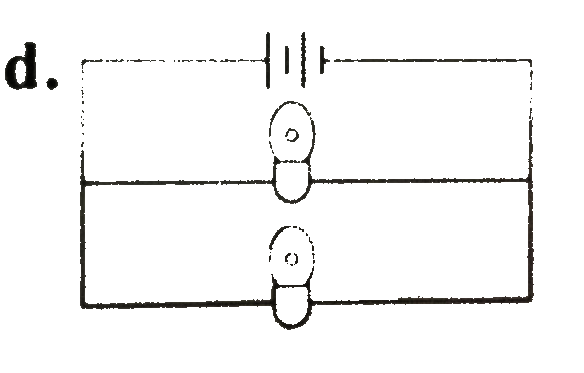
In the diagrams, all the light bulbs are identical, and all cells are ideal and identical. In which circuit (a,b, c,d) will the bulbs be dimmest ?

A

B

C

D

Text Solution

AI Generated Solution

The correct Answer is:

To determine which circuit (A, B, C, or D) has the dimmest bulbs, we will analyze the power delivered to the bulbs in each circuit. The power (P) of a bulb can be expressed as: \[ P = \frac{V^2}{R} \] where \( V \) is the voltage across the bulb and \( R \) is the resistance of the bulb. Since all bulbs are identical, we can focus on the voltage across each bulb in each circuit. ### Step 1: Analyze Circuit A - In Circuit A, there are 2 cells connected in series providing a total voltage of \( 2\epsilon \). - There are 2 bulbs connected in series, so the voltage across each bulb is \( \frac{2\epsilon}{2} = \epsilon \). - The power for each bulb is: \[ P_A = \frac{\epsilon^2}{R} \] ### Step 2: Analyze Circuit B - In Circuit B, there are 3 cells connected in series providing a total voltage of \( 2\epsilon \). - There are 3 bulbs connected in series, so the voltage across each bulb is \( \frac{2\epsilon}{3} \). - The power for each bulb is: \[ P_B = \frac{\left(\frac{2\epsilon}{3}\right)^2}{R} = \frac{4\epsilon^2}{9R} \] ### Step 3: Analyze Circuit C - In Circuit C, there are 3 cells connected in parallel providing a total voltage of \( \epsilon \). - The voltage across each bulb is \( \frac{\epsilon}{3} \) (since they are in parallel). - The power for each bulb is: \[ P_C = \frac{\left(\frac{\epsilon}{3}\right)^2}{R} = \frac{\epsilon^2}{9R} \] ### Step 4: Analyze Circuit D - In Circuit D, there are 2 cells connected in parallel providing a total voltage of \( 2\epsilon \). - The voltage across each bulb is \( 2\epsilon \). - The power for each bulb is: \[ P_D = \frac{(2\epsilon)^2}{R} = \frac{4\epsilon^2}{R} \] ### Step 5: Compare the Powers Now we compare the powers calculated for each circuit: - \( P_A = \frac{\epsilon^2}{R} \) - \( P_B = \frac{4\epsilon^2}{9R} \) - \( P_C = \frac{\epsilon^2}{9R} \) - \( P_D = \frac{4\epsilon^2}{R} \) From the calculations: - \( P_A > P_B > P_C < P_D \) ### Conclusion The circuit with the dimmest bulbs is Circuit C, as it has the least power delivered to each bulb. ### Final Answer The bulbs will be dimmest in Circuit C. ---

To determine which circuit (A, B, C, or D) has the dimmest bulbs, we will analyze the power delivered to the bulbs in each circuit. The power (P) of a bulb can be expressed as: \[ P = \frac{V^2}{R} \] where \( V \) is the voltage across the bulb and \( R \) is the resistance of the bulb. Since all bulbs are identical, we can focus on the voltage across each bulb in each circuit. ### Step 1: Analyze Circuit A - In Circuit A, there are 2 cells connected in series providing a total voltage of \( 2\epsilon \). ...
Promotional Banner

Similar Questions

Explore conceptually related problems

In the diagrams, all light bulbs are identical and all emf sources are ideal and identical. In which circuit (given in option) will each bulb glow with the same brightness as in the circuit shown?

In the circuit diagram, all the bulbs are identical. Which bulb will be the brightest?

All eukaryotic cells are not identical

All atoms of an element are identical.

If all the resistors are identical , select the correct alternative (s).

The light bulb A & B in the following circuits are identical. When the switch is closed

In these circuits all the batteries are indentical and have negllgible internal resistance, and all the light bulbs are indentical. Rank all 5 light bulbs (A, B, C, D, E) in order of brightness from brightness to dimmet.

Assuming all bulbs are identical, rank the brightness of the bulbs, from brightest to dimmest.

All the bulbs below are identical. Which bulb(s) shine(s) most brightly?

n identical bulbs are connected in series and illuminated by a power supply . One of the bulbs gets fused. The fused bulb is removed , and the remaining bulbs are again illuminated by the same power supply. Find the fractional change in the illuminated of (a) all the bulbs and (b) one bulb.
