Home
Class 12
PHYSICS
A sperical shell , made of material of e...

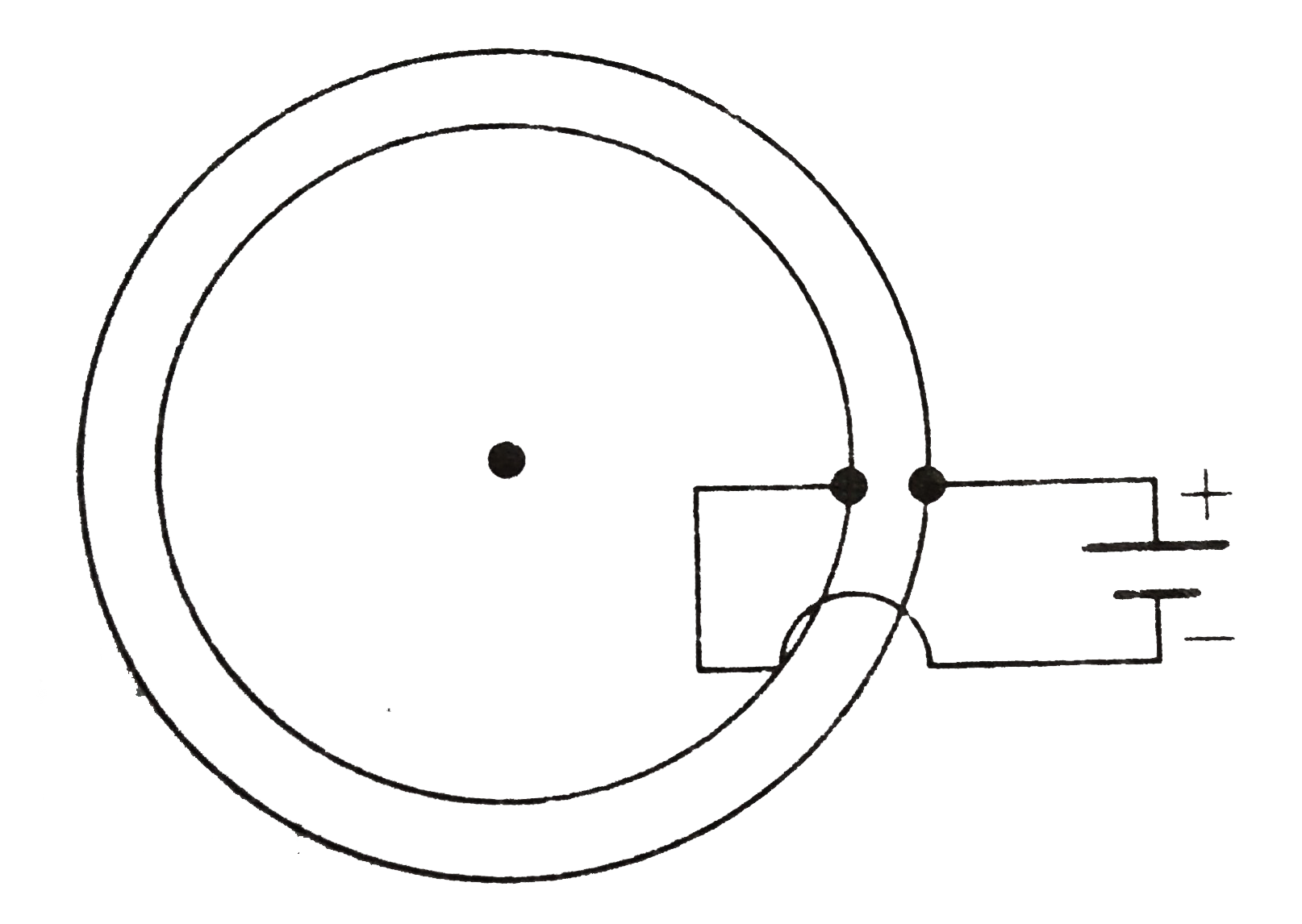
A sperical shell , made of material of electrical conductivity `10^9//pi(Omegam)^(-1)`, has thickness t = 2 mm and radius R = 10 cm. In an arrangement, its inside surface is kept at a lower potential than its outside surface. The resistance offered by the shell is equal to

A

`5pi xx 10^(-12) Omega`

B

`2.5 xx 10^(-11)Omega`

C

`5 xx 10^(-12)Omega`

D

`5 xx 10^(-11)Omega`

Text Solution

Verified by Experts

The correct Answer is:

D

d. `R = 1/sigma xx t/(4piR^2)`
Using values ` R = 5 xx 10^(-11) Omega` .
Promotional Banner

Similar Questions

Explore conceptually related problems

A point charge q is kept inside an electrically neutral shell with its outer surface spherical in shape then the potential at point P would be

A hollow conducting sphere of radius R has a charge (+Q) on its surface. What is the electric potential within the sphere at a distance r = (R )/(3) from its centre ?

A point source of heat is placed at the centre of a spherical shell of mean radius 10 cm. the material of the shell has thermal conductivity 9.5 xx10^(-2) kcal/ m-s^(@)C . Calculate the power of point source of heat, when the temperature difference between the outer and inner surface of the shell is 50^(@)C in steady state. the thickness of shell is 2 cm.

For a plane convex lens (mu = 1.5) has radius of curvature 10 cm. It is slivered on its plane surface. Find focal length after silvering:

A sphere made of transparent material of refractive index ( mu =3/2 )and of radius 50 cm has a small air bubble 10 cm below the surface. The apparent depth of the bubble if viewed from outside normally is

A cylinder of radius R made of a material of thermal conductivity K_1 is surrounded by a cylindrical shell of inner radius R and outer radius 2R made of a material of thermal conductivity K_2 . The two ends of the combined system are maintained at two different temperatures. There is no loss of heat across the cylindrical surface and the system is in steady state. The effective thermal conductivity of the system is

A cylinder of radius R made of a material of thermal conductivity K_(1) is surrounded by cylindrical shell of inner radius R and outer radius 2R made of a material of thermal con-ductivity K_(2) The two ends of the combined system are maintained at two differnet tem-peratures There is no loss of heat across the cylindrical surface and system is in steady state What is the effective thermal conductivity of the system .

A cylinder of radius R made of a material of thermal conductivity K_1 is surrounded by a cylindrical shell of inner radius R and outer radius 2R made of a material of thermal conductivity K_2 . The two ends of the combined system are maintained at two different temperatures. There is no loss of heat across the cylindrical surface and the system is in steady state. The effective thermal conductivity of the system is (a) K_1 + K_2 (b) K_1K_2//(K_1+K_2) (c ) (K_1 + 3K_2)//4 (d) (3K_1 + K_2)//4 .

The walls of a closed cubical box of edge 40 cm are made of a material of thickness 1 mm and thermal conductivity 4 xx 10^(-4) cals^(-1@) C^(-1) . The interior of the box is maintained at 100 ^(@) C above the outside temperature by a heater placed inside the box and connected across 400 V dc . Calculate the resistance of the heater.

A point source of heat of power P is placed at the centre of a spherical shell of mean radius R. The material of the shell has thermal conductivity K. If the temperature difference between the outer and inner surface of the shell in not to exceed T, the thickness of the shell should not be less than .......
