Home
Class 12
PHYSICS
Two cylindrical rods of uniform cross-se...

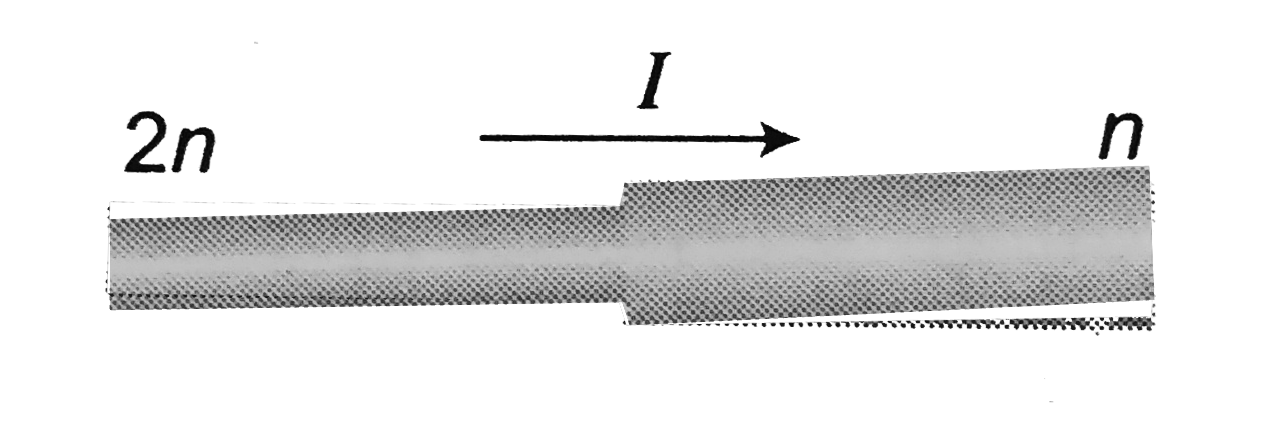
Two cylindrical rods of uniform cross-section area `A` and `2A`, having free electrons per unit volume `2n` and `n` respectively are joined in series. A current `I` flows through them in steady state. Then the ratio of drift velocity of free electron in left rod to drift velocity of electron in the
right rod is `((v_(L))/(v_(R)))` is

A

`1//2`

B

1

C

2

D

4

Text Solution

Verified by Experts

The correct Answer is:

B

b. Since current `In eAV_(d)` through both the rods is the same, i.e.,
`2(n) eAv_(L) = n e(2A)v_(R)`
`v_(L)/v_(R) = 1 ` .
Promotional Banner

Similar Questions

Explore conceptually related problems

Two conductors of equal volumes having non-uniform cross-section are joined as show in figure. The number density of free electrons is more in conductor 2. As current passes through the system. Which of the following option is correct ?

Two wires each of radius of cross section r but of different materials are connected together end to end (in series). If the densities of charge carries in the two wires are in the ratio 1:4 , the drift velocity of electrons in the two wires will be in the ratio:

Two wires each of radius of cross section r but of different materials are connected together end to end (in series). If the densities of charge carries in the two wires are in the ratio 1:4 , the drift velocity of electrons in the two wires will be in the ratio:

A conductor wire having 10^29 free electrons / m^3 carries a current of 20A. If the cross-section of the wire is 1mm^2 , then the drift velocity of electrons will be :

Two cylindrical rods of same cross-section area and same length are connected in series to an ideal cell as shown.The resistivity of left rod is rho and that if right rod is 2 rho Then the variation of potential and electric field at any point P distant x from left end of combined rod system are given by

If n,e,A and v_(d) are free electron density inside conductor , charge of electron , area of cross-section of conductor and drift velocity of free electrons inside conductor, then current l through the conductor is

The drift velocity of free electrons in a conductor is v, when a current i is flowing in it, Ifboth the radius and current are doubled, then the drift velocity will be :

When the current i is flowing through a conductor, the drift velocity is v . If 2i current is flowed through the same metal but having double the area of cross-section, then the drift velocity will be

When the current i is flowing through a conductor, the drift velocity is v . If 2i current is flowed through the same metal but having double the area of cross-section, then the drift velocity will be

A current 0.5 amperes flows in a conductor of cross-sectional area of 10^(-2) m^2 . If the electron density is 0.3 * 10^(28) m^(-3) , then the drift velocity of free electrons is
