Home
Class 12
PHYSICS
Find the distance CQ if incident light r...

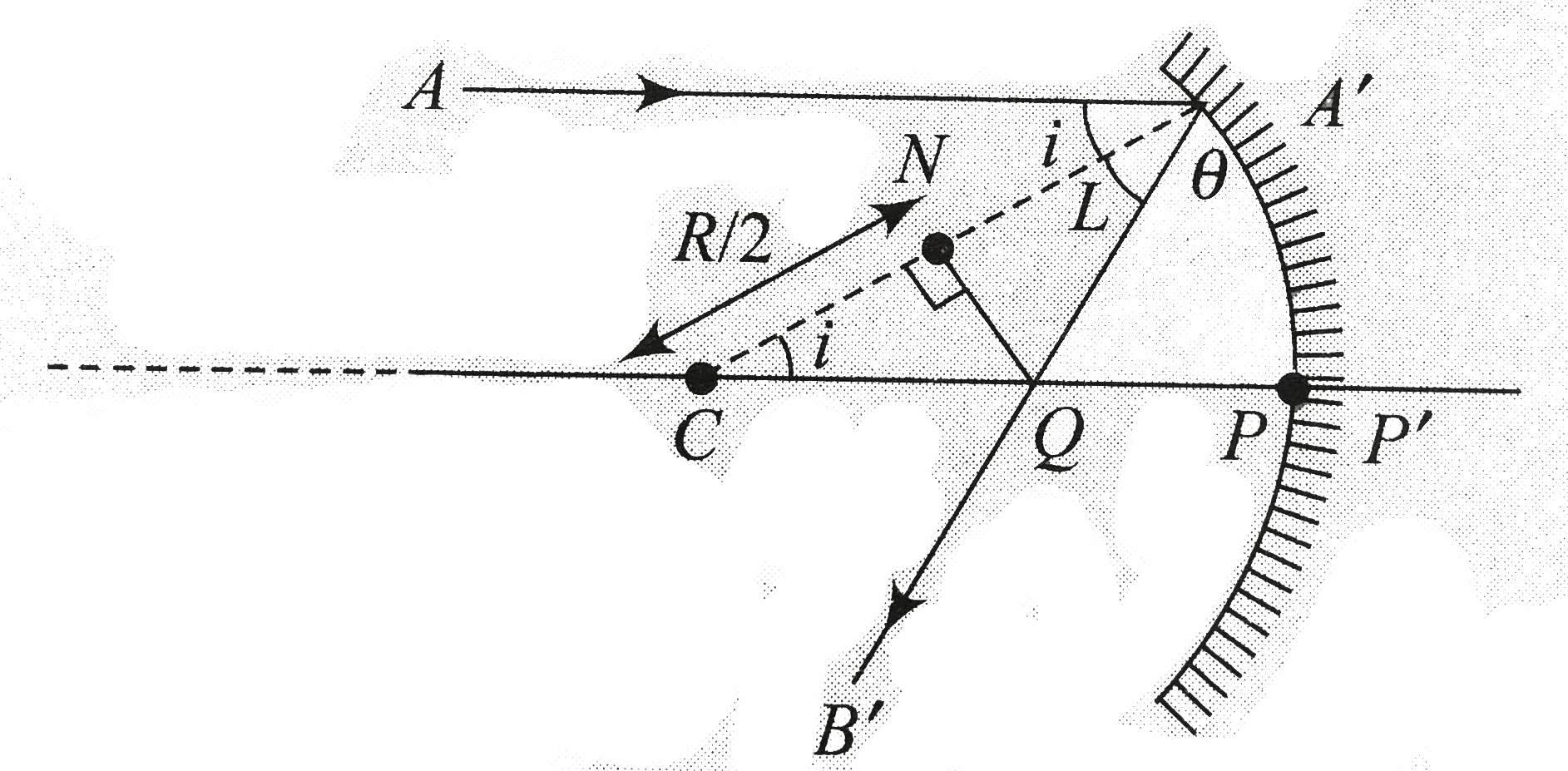
Find the distance CQ if incident light ray parallel to principal axis is incident at an angle i. Also, find the distance CQ if `irarr0` .

Text Solution

Verified by Experts

In triangle CNQ, cos `i= R//2CQ rArr CQ = R//2 cos i`
As `i` increases `cos i` decreases. Hence, CQ increases.
If `i` is a small angle, `cos i~~ 1` (see Fig. (b)).
`:. CQ= R//2`
So, paraxial rays meet at a distance equal to `R//2` from center of curvature, which is call focus.
Promotional Banner

Topper's Solved these Questions

  • GEOMETRICAL OPTICS

    CENGAGE PHYSICS ENGLISH|Exercise Solved Examples|15 Videos
  • GEOMETRICAL OPTICS

    CENGAGE PHYSICS ENGLISH|Exercise Exercise1.1|14 Videos
  • ELECTRON,PHONTS,PHOTOELECTRIC EFFECT & X-RAYS

    CENGAGE PHYSICS ENGLISH|Exercise dpp 3.3|15 Videos
  • HEATING EFFECT OF CURRENT

    CENGAGE PHYSICS ENGLISH|Exercise Thermal Power in Resistance Connected in Circuit|27 Videos

Similar Questions

Explore conceptually related problems

A light ray parallel to the principal axis is incident (as shown in the figure) on a thin planoconvex lens with radius of curvature of its curved part equal to 10 cm. Assuming that the refractive index of the material of the lens is 4//3 and medium on both sides of the lens is air, find the distance of the point from the lens where this ray meets the principal axis. Find your answer in the form (X)/(7)cm and fill value of X .

A ray of light is incident on a concave mirror . It is parallel to the principal axis and its height from principal axis is equal to the focal length of the mirror. The ratio of the distance of point B to the distance of the focus from the centre of curvature is (AB is the reflected ray)

Draw the incident ray and the reflected ray. if a light ray is incident on a plane mirror with the angle of incidence 30^@ .

A parabola mirror is kept along y^2=4x and two light rays parallel to its axis are reflected along one straight line. If one of the incident light rays is at 3 units distance from the axis, then find the distance of the other incident ray from the axis.

Figure, shown two converging lenses. Incident rays are parallel to the principal axis. What should be the value of d so that final rays are also parallel? Here, the diameter of ray beam become wider.

A parallel beam of light is incident on a converging lens parallel to its principal axis. As one moves away from the les on the other side on its principal axis, the intensity of light

Find the angle of incidence at which a ray of monochromatic light should be incident on the first surface AB of a regular glass prism ABC so that the emergent ray grazes the adjacent surface AC.(Refractive Index of glass = 1.56)

Find the angle of incidence at which a ray of monochromatic light should be incident on the first surface AB of a regular glass prism ABC so that the emergent ray grazes the adjacent surface AC. (Refractive index of glass =1.6.)

A double convex thin lens made of glass (refractive index mu = 1.5 ) has both radii of curvature of magnitude 20 cm . Incident light rays parallel to the axis of the lens will converge at a distance L such that

A double convex thin lens made of glass (refractive index mu = 1.5 ) has both radii of curvature of magnitude 20 cm . Incident light rays parallel to the axis of the lens will converge at a distance L such that
