Home
Class 12
PHYSICS
Monochromatic light is incident on plane...

Monochromatic light is incident on plane interference AB between two media of refractive indices `mu_1` and `mu_2 (mu_2gtmu_1)` at angle of incidence `theta` as shown in the figure.
The angle `theta` is infinitesimally greater than the critical angle for the two media so that total internal reflection takes places. Now if a transparent slab DEFG of uniform thickness and of refractive index `mu_3` is introduced on the interface (as shown in the figure), show that for any value of `mu_3` all light will ultimately be reflected back again into medium II. Consider separately the cases.
(a) `mu_3ltmu_1` , (b) `mu_3gtmu_1`

Text Solution

Verified by Experts
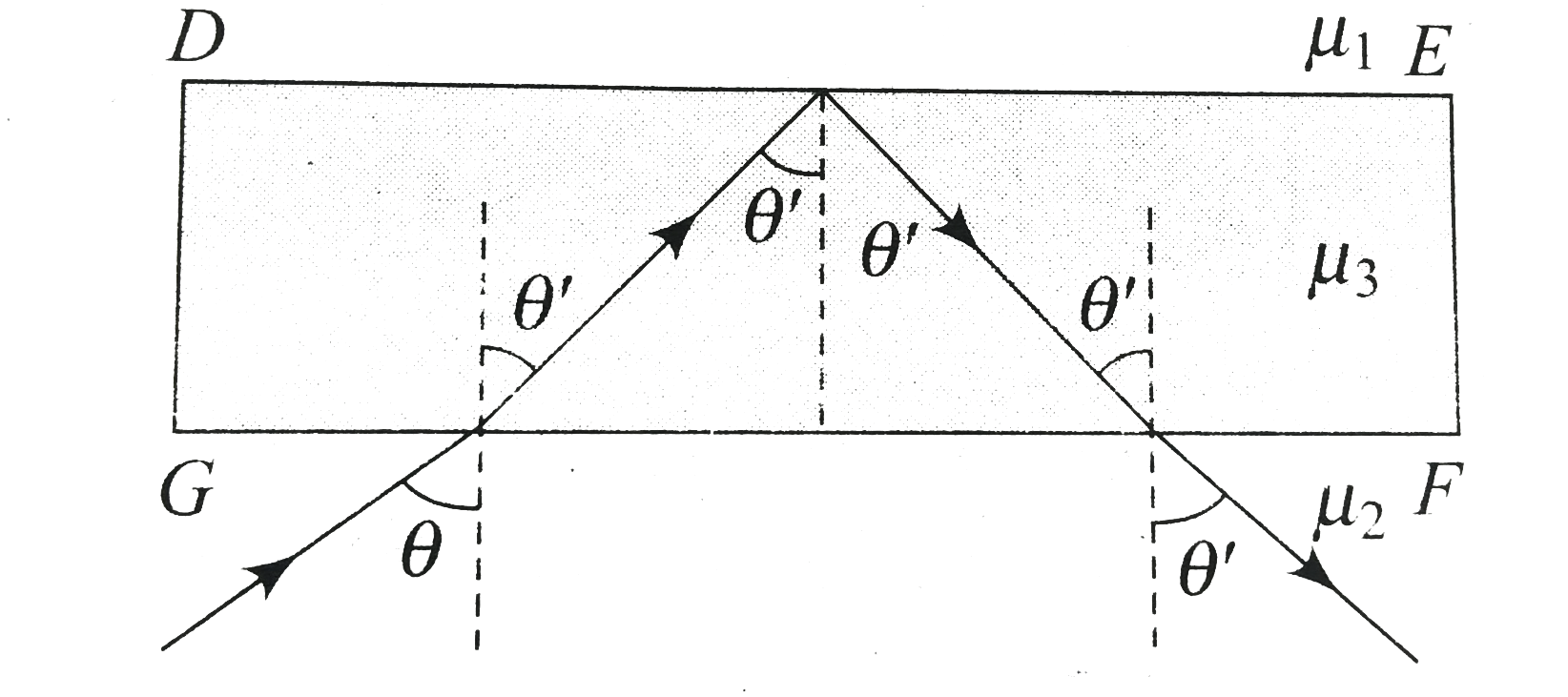
We will use the symbol `le` to mean 'infinitesimally greater than'.
When the slab is not inserted,
`thetaletheta_(c)= sin^(-1)(mu_(1)//mu_(2)) ` or `sinthetage mu_(1)//mu_(2)`
When the slab is inserted, we have two cases
`mu_(3)lemu_(1)` and `mu_(3)gt mu_(1)`.
Case I. `mu_(3)lt mu_(1)` . We have `sintheta gemu_(1)//mu_(2)gemu_(3)//mu_(2)`
Thus, the light is incident on AB at an angle greater than the critical angle `sin^(-1)(mu_(3)//mu_(2))`. It suffers total internal reflection and goes back to medium II.
Case II. `mu_(3)gtmu_(1)`
`sin theta ge mu_(1)//mu_(2) lt mu_(3)//mu_(2)`
Thus, the angle of incidence `theta` may be smaller than the critical angle `sin^(-1)(mu_(3)//mu_(2))` and hence it may enter medium III. The angle of refraction `theta` is given by (figure).
`(sintheta)/(sintheta^')= (mu_(3))/(mu_(2))` (i)
`rArr sintheta^(')= (mu_(2))/(mu_(3))sinthetale(mu_(2))/(mu_(3))*(mu_(1))/(mu_(2))`
Thus, `sintheta^(')ge(mu_(1))/(mu_(3)) rArr theta^(')ge sin^(-1)((mu_(1))/(mu_(3)))` (ii)
As the slab has parallel faces, the angle of refraction at the face FG is equal to the angle of incidence at the face DE. Equation (ii) shows that this angle is infinitesimally greater than the critical angle here. Hence, the light suffers total internal reflection and falls at the surface FG at an angle of incidence `theta^(')`. At this face, it will refract into medium II and teh angle or refraction will be `theta` as shown by Eq. (i). Thus, the total ligh energy is ultimately reflected back into medium II.
Promotional Banner

Topper's Solved these Questions

  • GEOMETRICAL OPTICS

    CENGAGE PHYSICS ENGLISH|Exercise Solved Examples|15 Videos
  • GEOMETRICAL OPTICS

    CENGAGE PHYSICS ENGLISH|Exercise Exercise1.1|14 Videos
  • ELECTRON,PHONTS,PHOTOELECTRIC EFFECT & X-RAYS

    CENGAGE PHYSICS ENGLISH|Exercise dpp 3.3|15 Videos
  • HEATING EFFECT OF CURRENT

    CENGAGE PHYSICS ENGLISH|Exercise Thermal Power in Resistance Connected in Circuit|27 Videos

Similar Questions

Explore conceptually related problems

Monochramatic light is incident on the pLane interface AB between two media of refractive indices mu_1 and mu_2(mu_2gtmu_1) at an angle of incidence theta as shown in figure. The angle theta is infinitesimally greater thannte critical angle for the two media so thast total internal reflection takes place. Now, if a transparent slab DEFG of uniform thickness and of refractive inde mu_2 is introduced on theinterface (as shown in figure ) , show that for any value of mu_2 all light will ultimately be reflected back into medium II.

What is the relation between the refractive indices mu,mu_(1) and mu_(2) if the behaviour of light rays is shown in Figure.

A ray is incident on interface of two media at critical angle as shown in the figure.

For total internal reflection to take place, the angle of incidence i and the refractive index mu of the medium must satisfy the inequality

A light ray is incident on a glass sphere of reflective index mu = sqrt3 at an angle of incidence 60^(@) as shown in Fig. Find the angles r, r^(') e and the total deviation after two refractions.

Under what conditions is the phenomenon of total internal reflection between the critical angle of incidence and the refractive index of the medium.

When a monochromatic light ray is incident on a medium of refracive index mu with angle of incidence theta_(1) ,the angle of refraction is theta_(r). if theta_(i) is changed slightly by Deltatheta_(i) ,then the corresponding change in theta_(r) will be-

The diagram shows a spherical surface which separates two media of refractive index, mu_(1) and mu_(2) . Respectively. Now, a point object is placed on the principal axis as shown in the figure. Then

Light ray is incident on a prism of angle A=60^(@) are refractive index mu=sqrt(2) . The angle of incidence which the emergent rays grazes the surface is given

A ray of light is incident on the left vertical face of glass cube of refractive index n_2, as shown in figure. The plane of incidence is the plane of the page, and the cube is surrounded by liquid (refractive index =n_1 ). What is the largest angle of incidence theta_1 for which total internal reflection occurs at the top surfaces?

