Home
Class 12
PHYSICS
In Fig., determine the apparent shift in...

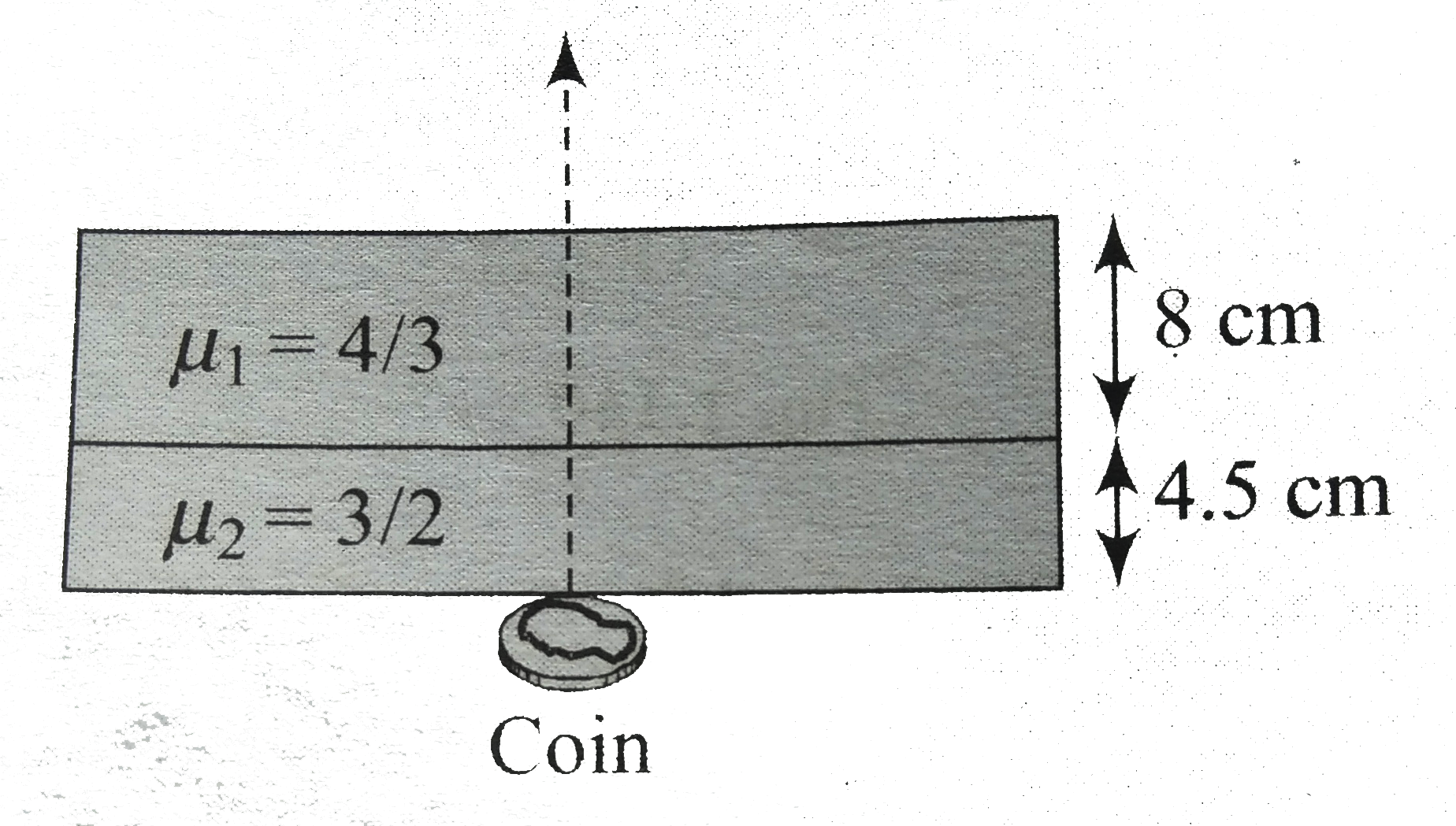
In Fig., determine the apparent shift in the position of the coin. Also, find the effective refractive index of the combinatino of the glass and water slab.

Text Solution

Verified by Experts

Total apparent shift is
`s=t_(1)(1-(1)/(mu_(1)))+t_(2)(1-(1)/(u_(2)))`
`=8(1-(1)/(4))+4.5(1-((1)/(3))/2)`
`=2+1.5=3.5cm`
The apparent depth of coin from the top is `t=(8+4.5)-3.5=9cm` and, the real depth of the coin is
`t_(1)+t_(2)=8+4.5=12.5`
Therefore, the effective refractive index is
`mu_(eff)=(" Real depth ")/(" Apparent depth ")`
`=(t_(1)+t_(2))/(t)=(12.5)/9`
`=1.39`
Promotional Banner

Topper's Solved these Questions

  • GEOMETRICAL OPTICS

    CENGAGE PHYSICS ENGLISH|Exercise Solved Examples|15 Videos
  • GEOMETRICAL OPTICS

    CENGAGE PHYSICS ENGLISH|Exercise Exercise1.1|14 Videos
  • ELECTRON,PHONTS,PHOTOELECTRIC EFFECT & X-RAYS

    CENGAGE PHYSICS ENGLISH|Exercise dpp 3.3|15 Videos
  • HEATING EFFECT OF CURRENT

    CENGAGE PHYSICS ENGLISH|Exercise Thermal Power in Resistance Connected in Circuit|27 Videos

Similar Questions

Explore conceptually related problems

A beaker contains water up to a height h_1 and K oil above water up to another height h_2. Find the apparent shift in the position of the bottom of the beaker when viewed from above. Refractive index of water is mu_1 and that of K.oil is mu_2 .

Considering normal incidence of ray, the equivalent refractive index of combination of two slabs shown in Fig. is. .

The critical angle for water is 48.2^@ . Find is refractive index.

A parallel bean of light travelling in water (refractive index = 4/3) is refracted by a spherical bubble of radius 2 mm situation in water. Assuming the light rays to be paraxial. i. find the position of the image due to refraction at the first surface and the position of the final image, and ii. draw a ray diagram showing the positions of the images.

The refractive index of glass is 1.5. Find the speed of light in glass.

The apparent depth of a liquid in a vessel is 15 cm, when its real depth is 20 cm. find the refractive index of the liquid.

A glass slab of thickness 2cm and refractive index 2 is placed in contact with a biconvex lens of focal length 20cm. The refractive index of the material of the lens 1.5 . The far side of the lens is silvered. Where should an object be placed in front of the slab so that it images on to itself?

A ray of light is incident on a glass slab at grazing incidence. The refractive index of the material of the slab is given by mu=sqrt((1+y) . If the thickness of the slab is d=2m , determing the equation of the trajectory of the ray inside the slab and the coordinates of the point where the ray exits from the slab. Take the origin to be at the point of entry of the ray.

In a double-slit experiment, fringes are produced using light of wavelength 4800A^(@) . One slit is covered by a thin plate of glass of refractive index 1.4 and the other slit by another plate of glass of double thickness and of refractive index 1.7. On doing so, the central bright fringe shifts to a position originally occupied by the fifth bright fringe from the center. find the thickness of the glass plates.

An object O is kept in air and a lens of focal length 10 cm (in air) is kept at the botton of a container which is filled upto a height 44 cm by water. The refractive index of water is 4//3 and that of glass is 3//2 . The botton of the container is closed by a thin glass slab of refractive index 3//2 . Find the distance (in cm ) of the final image formed by the system from botton of container (refer to figure shown below).
