Home
Class 12
PHYSICS
A concave mirror of focal length 20cm is...

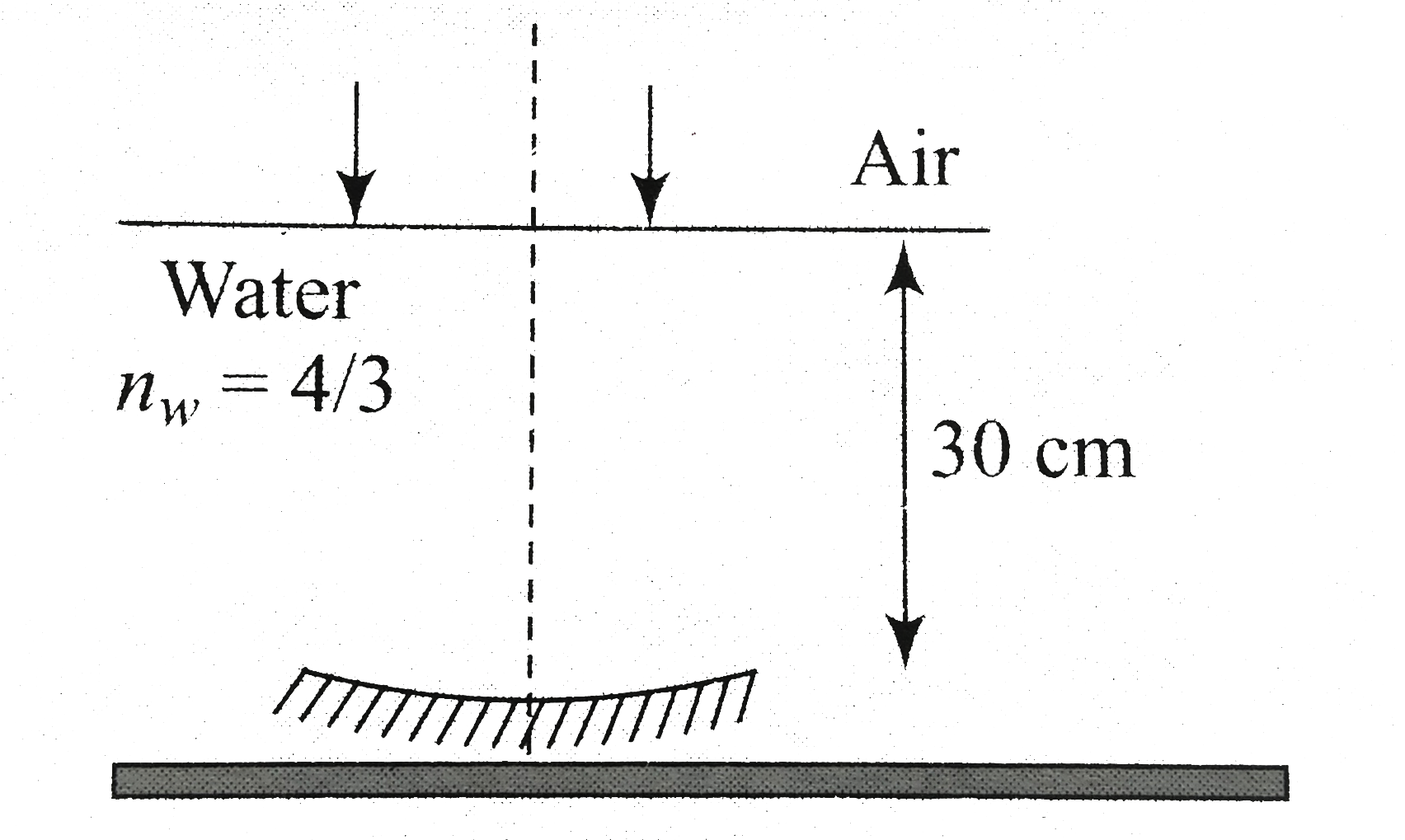
A concave mirror of focal length `20cm` is placed inside water with its shining surface upwards and principla axis vertical as shown in Fig. Rays are incident parallel to the principa, axis of concave mirror. Find the position of final image.

Text Solution

Verified by Experts
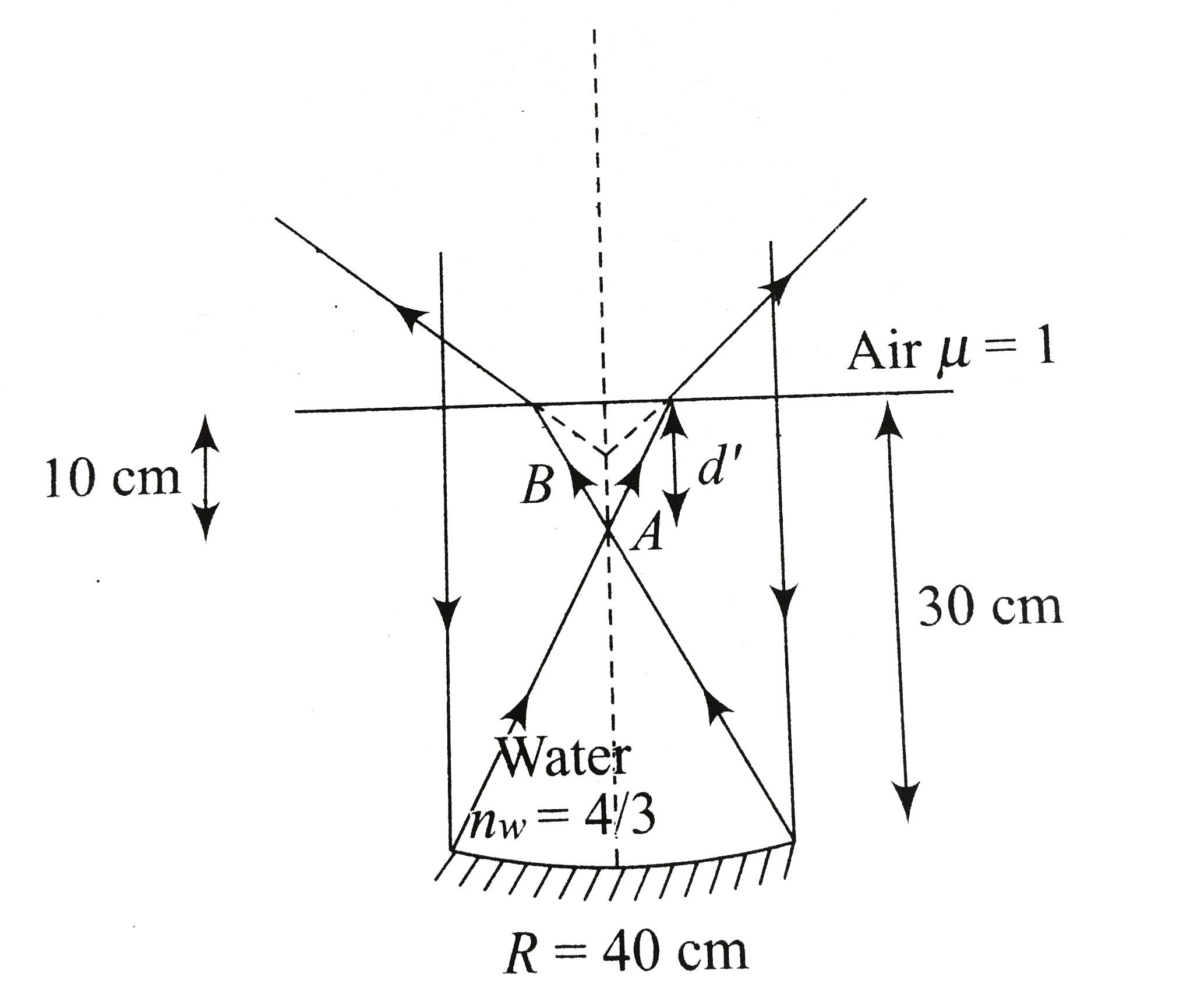
The incident rays will pass undeviated throught the water surface and strike the mirror parallel to its principal axis. Therefore, for the mirror, object is at `oo`. Its image A(in figure Fig.) will be formed at focus which is 20 cm from the mirror. Now, for the interface between water and air. For observer at air, the image formed by mirror will act as an object for observer with real depth `d=30-20=10cm`.
Apparent depth observed by observer,
`d^(')=(d)/((n_(w)/(n_(a))))=(10)/(((4//3)/(1)))=7.5cm`
Promotional Banner

Topper's Solved these Questions

  • GEOMETRICAL OPTICS

    CENGAGE PHYSICS ENGLISH|Exercise Solved Examples|15 Videos
  • GEOMETRICAL OPTICS

    CENGAGE PHYSICS ENGLISH|Exercise Exercise1.1|14 Videos
  • ELECTRON,PHONTS,PHOTOELECTRIC EFFECT & X-RAYS

    CENGAGE PHYSICS ENGLISH|Exercise dpp 3.3|15 Videos
  • HEATING EFFECT OF CURRENT

    CENGAGE PHYSICS ENGLISH|Exercise Thermal Power in Resistance Connected in Circuit|27 Videos

Similar Questions

Explore conceptually related problems

From a concave mirror of focal length 20 cm. match the following:

For a concave mirror of focal length 20 cm, match the following

Focal length of a convex lense in air is 20cm. and of concave lens 40cm. Find the position of final image.

A convex lens of focal length 20 cm and a convex mirror of focal length 10 cm are placed co-axially 50 cm apart from each other. An incident beam parallel to its principal axis is incideent on the convex lens. Locate the position of final image formed due to the combination.

A convex lens, of focal length 25 cm, and a concave mirror, of radius of curvature 20 cm. are placed co-axially 40 cm aprat from each other. An incident beam, parallel to the principal axis, is incident on the convex lens. Find the position and nature of the image formed by this combination.

A concave mirror of focal length 10cm and a convex mirror of focal length 15cm are placed facing each other 40cm apart. A point object is placed between the mirrors, on their common axis and 15cm from the concave mirror. Find the position and nature of the image produced by successive reflections, first at the concave mirror and then at the convex mirror.

A particle goes in a circle of radius 2.0 cm. A concave mirror of focal length 20 cm is placed with its principal axis passing through the centre of the circle and perpendicular to its plane. The distance between the pole of the mirror and the centre of the circle is 30 cm. Calculate the radius of the circle formed by the image.

Shown in Fig. is a vertically erect object placed on the optic axis at a distance (5//2)f from a concave mirror of focal length f. If a plane mirror is placed perpendicular to the optic axis at a distanc (4//3)f from the pole, facing concave mirror, find the position and nature of the final image formed.

Shown in Fig. is a vertically erect object placed on the optic axis at a distance (5//2)f from a concave mirror of focal length f. If a plane mirror is placed perpendicular to the optic axis at a distanc (4//3)f from the pole, facing concave mirror, find the position and nature of the final image formed.

A concave mirror of focal length 10cm is placed in front of a convex mirror of focal length 20 cm. The distance between the two mirrors is 20cm. A point object is placed 5cm from the concave mirror. Discuss the formation of image.

