Home
Class 12
PHYSICS
A thin biprism (see Fig..) of obtuse ang...

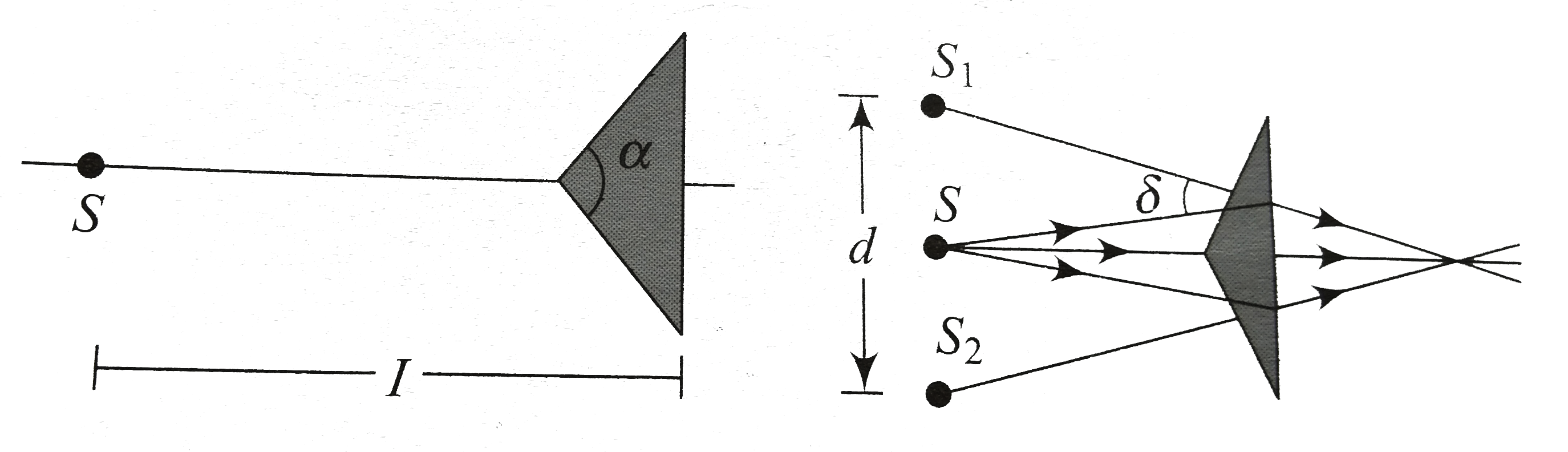
A thin biprism (see Fig..) of obtuse angle `alpha=178^(@)` is places at a distance `l=20cm` from a slit. How many images are formed and what is the separation between them? Refrative index of the material `mu=1.6` .

Text Solution

Verified by Experts

Two images are formed by the two thin prisms - one above the axis and the other below the axis by the same distance.
The refracting able of each thin prism is
`(pi-alpha)/(2)=(1)/(2)(pi-alpha)`
Then, `delta` (deviation of a ray) =`(mu-1)(1)/(2)(pi-alpha)`
`d/2=ldelta`
`d=2l(mu-1)(1)/(2)(pi-alpha)`
`d=(mu-1)l(pi-alpha)`
`d=(1.6-1)xx0.20(pi-178xx(pi)/(180))`
`= 0.6xx0.20xxpixx(1)/(90)=0.004m=4mm`
Promotional Banner

Topper's Solved these Questions

  • GEOMETRICAL OPTICS

    CENGAGE PHYSICS ENGLISH|Exercise Solved Examples|15 Videos
  • GEOMETRICAL OPTICS

    CENGAGE PHYSICS ENGLISH|Exercise Exercise1.1|14 Videos
  • ELECTRON,PHONTS,PHOTOELECTRIC EFFECT & X-RAYS

    CENGAGE PHYSICS ENGLISH|Exercise dpp 3.3|15 Videos
  • HEATING EFFECT OF CURRENT

    CENGAGE PHYSICS ENGLISH|Exercise Thermal Power in Resistance Connected in Circuit|27 Videos

Similar Questions

Explore conceptually related problems

For an object placed at a distance 20 cm from a concave mirror, the image is formed at the same position. What is the focal length of the mirror?

A thin prism of angle 5^(@) is placed at a distance of 10cm from object.What is the distance of the image from object?Given mu of prism= 1.5 ).

Two small angled transparent prisms (each or refracting angle A = 1^(@)) are so placed that their bases coincide, so that common base is BC. This device is called Fresnel's biprism and is used to obtain coherent sources of a point source S illuminated by monochromatic light of wavelength 6000 Å placed at a distance a = 20 cm. Calculate the separation between coherent sources. If a screen is placed at a distance b = 80 cm. from the device, what ist the finge which of fringes obtained (Refractive index of material of each prism = 1.5.)

The angular width of the central maximum in a single slit diffraction pattern is 60^(@) . The width of the slit is 1 mu m . The slit is illuminated by monochromatic plane waves. If another slit of same width is made near it, Young’s fringes can be observed on a screen placed at a distance 50 cm from the slits. If the observed fringe width is 1 cm, what is slit separation distance? (i.e. distance between the centres of each slit.)

The angular width of the central maximum in a single slit diffraction pattern is 60^(@) . The width of the slit is 1 mu m . The slit is illuminated by monochromatic plane waves. If another slit of same width is made near it, Young’s fringes can be observed on a screen placed at a distance 50 cm from the slits. If the observed fringe width is 1 cm, what is slit separation distance? (i.e. distance between the centres of each slit.)

Behind a thin converging lens having both the surfaces of the same radius 10cm, a plane mirror has been placed. The image of an object at a distance of 40 cm from the lens is formed at the same position. What is the refractive index of the lens?

Consider a concave mirror and a convex lens (refractive index 1.5) of focal length 10 cm each separated by a distance of 50 cm in air (refractive index = 1) as shown in the Fig. An object is placed at a distance of 15 cm from the mirror. Its erect image formed by this combination has magnification M_1 . When this set up is kept in a medium of refractive index 7//6 , the magnification becomes M_2 . The magnitude ((M_2)/(M_1)) is : .

An eye can distinguish between two points of an object if they are separated by more than 0.22 mm when the object is placed at 25 cm from the eye. The object is now seen by a compound microscope having a 20 D objective and 10 D eyepiece separated by a distance of 20 cm. The final image is formed at 25 cm from the eye. What is the minimum separation between two points of the object which can now be distinguished?

(i) A diverging lens of focal length 15 cm, forms an image at distance of 10 cm from the lens. How far is the object placed from the lens ? (ii) What is the linear magnification of the image?

A point object is placed at a distance of 20 cm from a glass slab, H=18cm, half immersed in water as shown in figure. The distance between two images when seen from the other side of the slab is (mu_(g) = (3)/(2) and mu_(w) = (4)/(3))
