Home
Class 12
PHYSICS
A glass shere of radius 2R, refractive i...

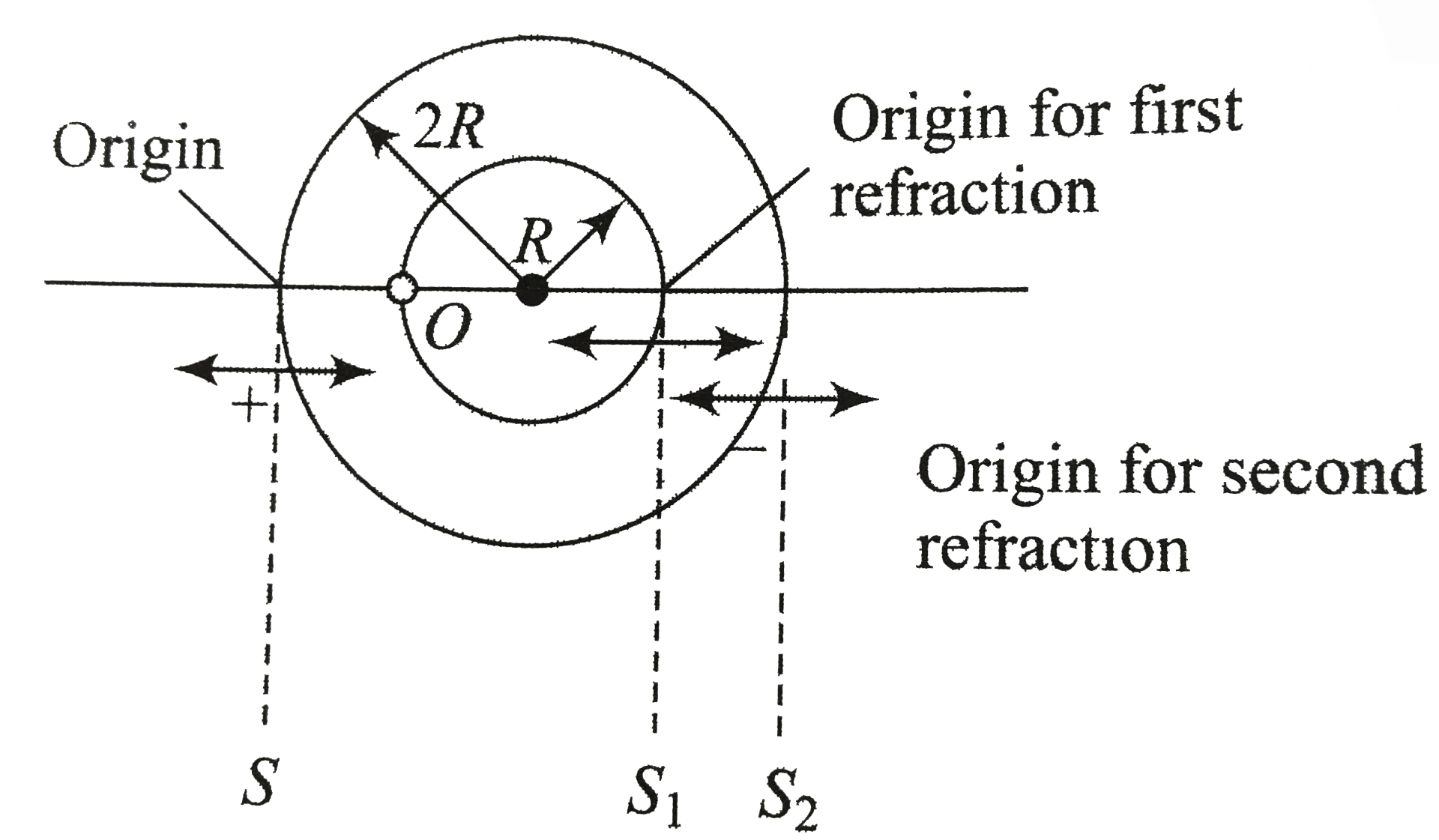
A glass shere of radius 2R, refractive index n has a spherical cavity of radius R, concentric with it. A black spot on the inner surface of the hollow sphere is viewed from the left as well as right. Obtain the shift in position of the object.

Text Solution

Verified by Experts
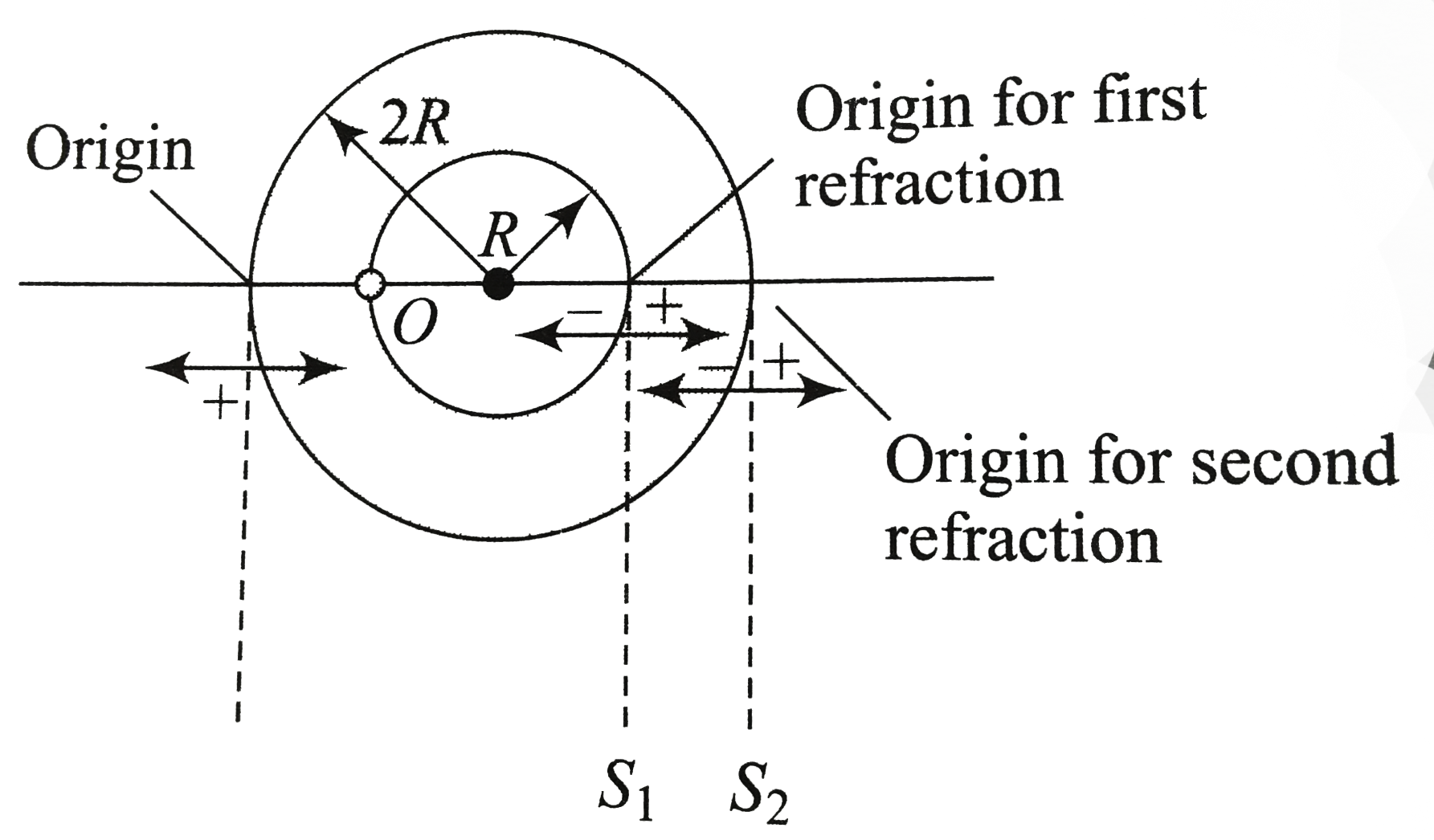
a. Viewer on the left of hollow sphere: Single refraction takes place at surface S.
From the single surface refraction equation, we have
`mu_(2)=1, mu_(1)=n, u=-R, and R=-2R`
`(1)/(v)-(n)/((-R))=((1-n))/((-2R))`
which on solving for v yields, `v=-((2R)/(n+1))`
Image is on the right of refracting surface S.
Shift= Real depth-Apparent depth
`R-((2R)/(n+1))=((n-1))/((n+1))R`
b. When the viewer is on the right, two rerfractions take place at surfaces `S_(1)` and `S_(2)`.
`mu_(2)=n, mu_(1)=1, u=-2R, and R=-R`
For refraction at surface `S_(1): (n)/(v_(1))-(1)/((-2R))=((n-1))/((-R))`
which on solving for `v_(1)=-(2nR)/(2n-1)` .
The first lies to the left of `S_(1) ` and acts as object for refraction at the second surface. We have to shift the origin of cartesian coordinate system to the vertex of `S_(2)`. The object distance for the second surface is
`u_(2)=-[(2nr)/(2n-1)+R]=-((4n-1)/(2n-1))R`
Here `mu_(2)=1, mu_(1)=n, R=-2R`
`rArr (1)/(v_(2))-(n)/(-[(4n-1)/(2n-1)]R)=(1-n)/(-2R)`
On solving for `v_(2)` , we get `v_(2)`=`-(2(4n-1))/((3n-1))R`
The minus sign shows that image is virtual and lies to the left of `S_(2)` .
Shift= Real depth-Apparent depth
`=3R-(2(4n-1)R)/((3n-1))`
`=((n-1))/((3n-1))R`
Promotional Banner

Topper's Solved these Questions

  • GEOMETRICAL OPTICS

    CENGAGE PHYSICS ENGLISH|Exercise Solved Examples|15 Videos
  • GEOMETRICAL OPTICS

    CENGAGE PHYSICS ENGLISH|Exercise Exercise1.1|14 Videos
  • ELECTRON,PHONTS,PHOTOELECTRIC EFFECT & X-RAYS

    CENGAGE PHYSICS ENGLISH|Exercise dpp 3.3|15 Videos
  • HEATING EFFECT OF CURRENT

    CENGAGE PHYSICS ENGLISH|Exercise Thermal Power in Resistance Connected in Circuit|27 Videos

Similar Questions

Explore conceptually related problems

A glass sphere of radius 2R and refractive index n has a spherical cavity of radius R, concentric with it. Q. When viewer is ono left side of the hollow sphere, what will be the shift in position of the object?

A glass sphere of radius 2R and refractive index n has a spherical cavity of radius R, concentric with it. Q. When viewer is on right side of the hollow sphere, what will be apparent change in position of the object?

A glass sphere, refractive index 1.5 and radius 10cm, has a spherical cavity of radius 5cm concentric with it. A narrow beam of parallel light is directed into the sphere. Find the final image and its nature.

A solid spherical conductor of radius R has a spherical cavity of radius at its centre. A charge is kept at the centre. The charge at the inner surface, outer surface are respectively.

A sphere of radius 2R and mas M has a spherical cavity of radius R as shown in the figure. Find the value of gravitational field at a point P at a distance of 6R from centre of the sphere.

A cubical block of glass, refractive index 1.5, has a spherical cavity of radius r=9cm inside it as shown in figure . A luminous point object O is at a distance of 18cm from the cube. What is the apparent position of O as seen from A?

A small object stuck on the surface of a glass sphere (n=1.5) is viewed from the diametrically opposite position. Find transverse magnification.

A conducting sphere of radius R_(2) has a spherical cavity of radius R_(1) which is non concentric with the sphere. A point charge q_(1) is placed at a distance r from the centre of the cavity. For this arrangement, answer the following questions. If q_(1) is shifted to the centre of the cavity, then: (choose the correct alternative)

A solid sphere of mass M and radius R has a spherical cavity of radius R/2 such that the centre of cavity is at a distance R/2 from the centre of the sphere. A point mass m is placed inside the cavity at a distance R/4 from the centre of sphere. The gravitational force on mass m is

A conducting sphere of radius R_(2) has a spherical cavity of radius R_(1) which is non concentric with the sphere. A point charge q_(1) is placed at a distance r from the centre of the cavity. For this arrangement, answer the following questions. Electric potential at the centre of the cavity will be :

