Home
Class 12
PHYSICS
There are two spherical surfaces of radi...

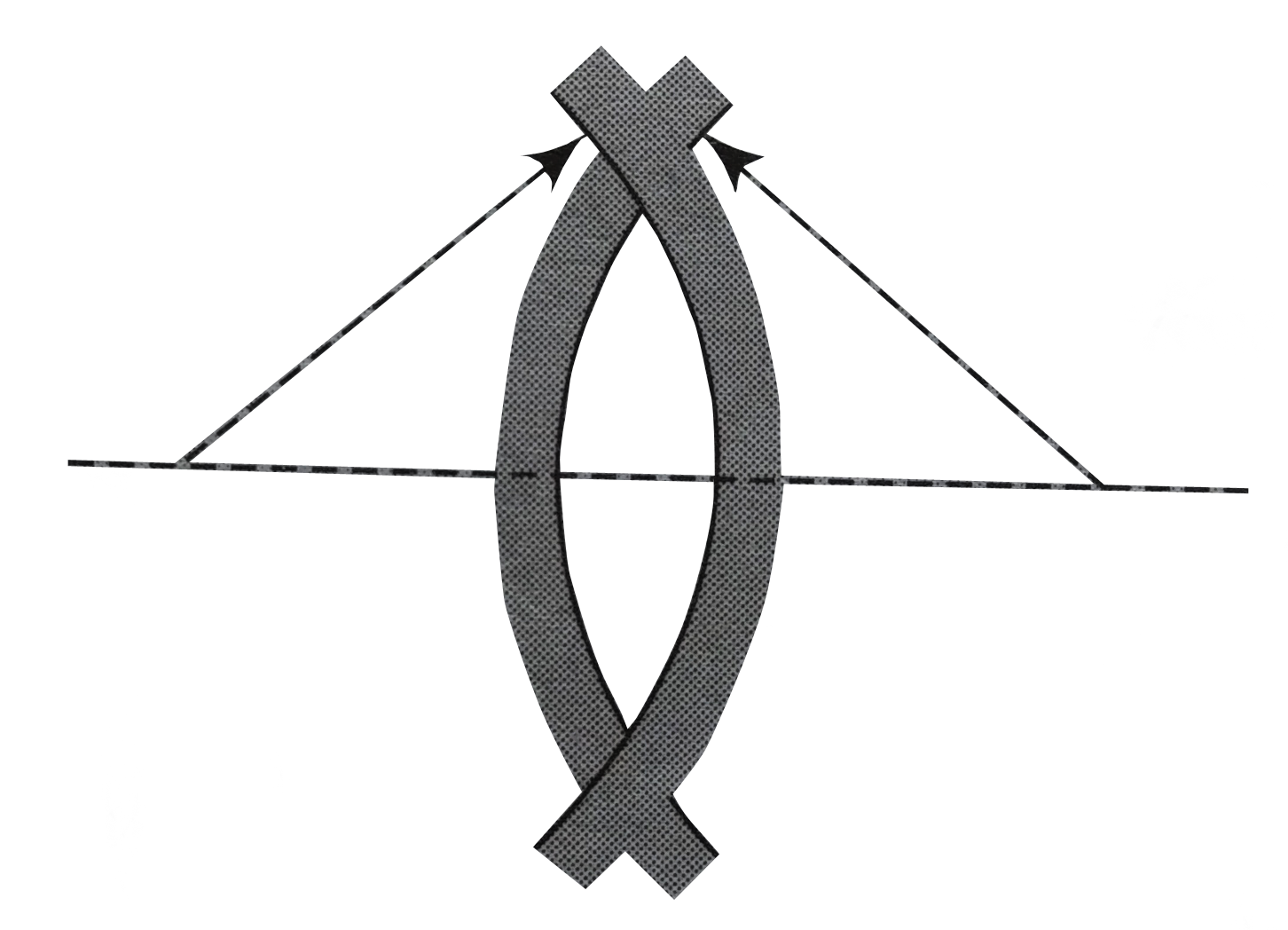
There are two spherical surfaces of radii `R_(1)=30cm` and `R_(2)=60cm`. In how many ways these surfaces may be arranged to get different lenses. If all the lenses are made of glass `(mu=1.5)` , find the focal length of each lens.

Text Solution

Verified by Experts

Two surfaces may be arranged in four different ways. Using lensmaker's formuls, we can obtain the focal length of each lens as
`(1)/(f)=(mu-1)((1)/(R_(1))-(1)/(R_(2)))`
a. `mu=1.5, R_(1)=+30CM, R_(2)=-60cm`
`:. (1)/(f_(1))=(1.5-1)((1)/(30)-(1)/(60))=(1)/(40)`
`rArr f_(1)=40cm` (converging)
b. `mu=1.5, R_(1)=+30cm, R_(2)=+60cm`
`:. (1)/(f_(2))=(1.5-1)((1)/(30)-(1)/(60))=(1)/(120)`
`rArrf_(2)=+120cm(conver i ng)`
c. `mu=1.5, R_(1)=-30cm, R_(2)=+60cm`
`:. 1/f_(3)=(1.5-1) (1/(-30)-1/60)=(-1)/4`
`rArrf_(3)=-40cm` (diverging)
d. `mu=1.5, R_(1)=-30cm, R_(2)=-60cm`
`:. (1)/(f_(4))=(1.5-1)((1)/(-30)-(1)/(-60))=(-1)/(120)`
`rArrf_(4)=-120cm` (diverging)
Promotional Banner

Topper's Solved these Questions

  • GEOMETRICAL OPTICS

    CENGAGE PHYSICS ENGLISH|Exercise Solved Examples|15 Videos
  • GEOMETRICAL OPTICS

    CENGAGE PHYSICS ENGLISH|Exercise Exercise1.1|14 Videos
  • ELECTRON,PHONTS,PHOTOELECTRIC EFFECT & X-RAYS

    CENGAGE PHYSICS ENGLISH|Exercise dpp 3.3|15 Videos
  • HEATING EFFECT OF CURRENT

    CENGAGE PHYSICS ENGLISH|Exercise Thermal Power in Resistance Connected in Circuit|27 Videos

Similar Questions

Explore conceptually related problems

Find focal lengths of lenses made of glass (mu=3//2) and placed in air.

A convex lens of glass (mu=1.5) is formed by combining two surfaces of radii R_(1)=60 cm and R_(2)=30cm . It is cut into two parts in two different ways as shown in Figure . Find: a. the focal length of the lens. b. in figure (a), the focal length of left portion and that of the right portion. c. in figure (b), the focal length of the upper part and that of the lower part.

The radii of curvature of the two surfaces of a lens are 20 cm and 30 cm and the refractive index of the material of the lens is 1.5. If the lens is concave -convex, then the focal length of the lens is

The radii of curvature of the two surfaces of a lens are 20 cm and 30 cm and the refractive index of the material of the lens is 1.5. If the lens is concave -convex, then the focal length of the lens is

Three diagrams are given each has equal radial of curvature of the curved surfaces. All the lenses have refractive index mu=1.5 . The ratio of focal lengths of P,Q,R is

A plano convex lens fits exactly into a plano concave lens. Their plane surfaces are parallel to each other. If lenses are made of different materials of refractive index mu_(1)=4//3 and mu_(2)=6//5 and R = 40 cm is the radius of curvature of the curved surface of the lenses, then the focal length of combination (in meters) is.

A plano convex lens fits exactly into a plano concave lens. Their plane surfaces are parallel to each other. If lenses are made of different materials of refractive index mu_(1)=4//3 and mu_(2)=6//5 and R = 40 cm is the radius of curvature of the curved surface of the lenses, then the focal length of combination (in meters) is.

Two plano-concave lenses of glass of refractive index 1.5 have radii of curvature of 20 and 30 cm. They are placed in contact with curved surface towards each other and the space between them is filled with a liquid of refractive index (4)/(3) , find the focal length of the system.

An equiconvex lens of glass (mu_(g) = 1.5) of focal length 10 cm is silvered on one side. It will behave like a

The radii of curvature of two spherical surfaces of a concave convex lens (mu=1.5) are 20 cm and 40 cm. (i) What is its focal length when it is in air? Also find its focal length when it is immersed in a liquid of refractive index (ii) mu=1.2 (iii) mu=2
