Home
Class 12
PHYSICS
A converging lens and a converging mirro...

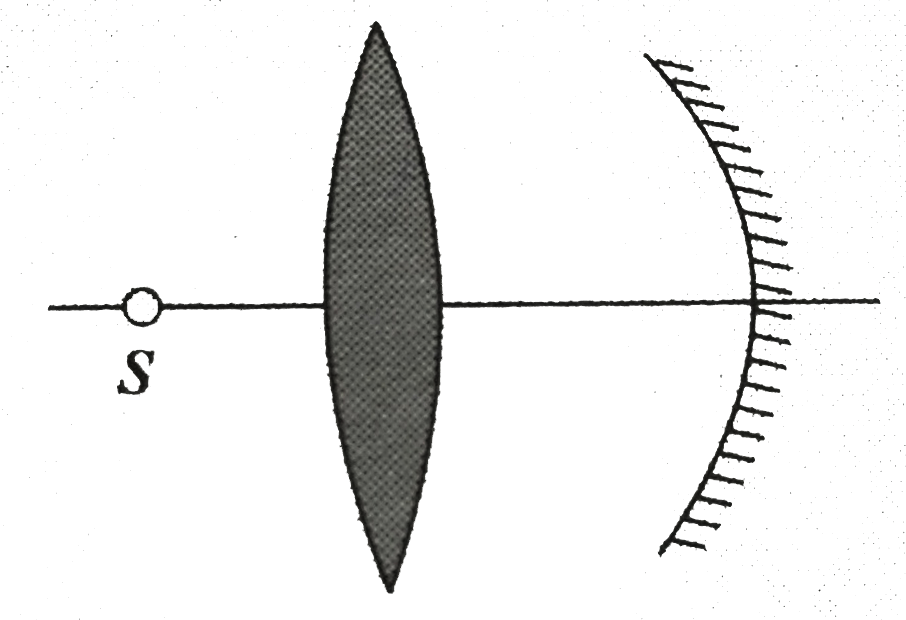
A converging lens and a converging mirror are placed with their principal axis coinciding. Their separation equals 40cm. A point source S is placed on the principal axis at a distance of 12 cm from the lens as shown in Fig. It is found that the final beam comes out parallel to the principal axis. Focal length of the lens equals 15 cm. Find the focal length of the mirror.

Text Solution

Verified by Experts
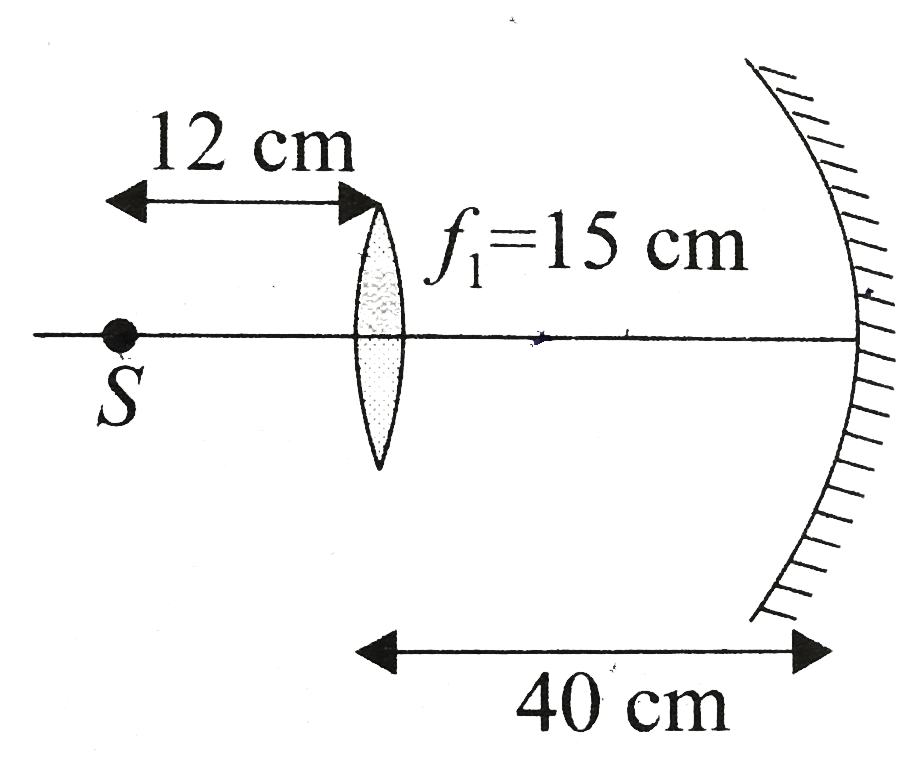
Refraction from lens ` (1)/(f_(L))=(1)/(v)-(1)/(u)`
`(1)/(15)=(1)/(v)+(1)/(12)[f_(L)=15, u=-12cm]`
`(1)/(15)-(1)/(12)=(1)/(v)rArrv_(1)=-60cm`
Reflection form mirror: `u_(1)` for mirror `u_(2)=-100 cm`
If finally rays come parallel to principal axis, then the object should be at focus between mirror and lens. Then image created by mirror will `v=-25 cm ` from the pole of mirror for mirror.
For mirror, `(1)/(f_(m))=(1)/(u)+(1)/(v)`
`(1)/(f_(m))=-(1)/(100)-(1)/(25)=-((1+u)/(100))`
`F_(m)=-20cm`
Promotional Banner

Topper's Solved these Questions

  • GEOMETRICAL OPTICS

    CENGAGE PHYSICS ENGLISH|Exercise Solved Examples|15 Videos
  • GEOMETRICAL OPTICS

    CENGAGE PHYSICS ENGLISH|Exercise Exercise1.1|14 Videos
  • ELECTRON,PHONTS,PHOTOELECTRIC EFFECT & X-RAYS

    CENGAGE PHYSICS ENGLISH|Exercise dpp 3.3|15 Videos
  • HEATING EFFECT OF CURRENT

    CENGAGE PHYSICS ENGLISH|Exercise Thermal Power in Resistance Connected in Circuit|27 Videos

Similar Questions

Explore conceptually related problems

A converging lens of focal length 15 cm and a converging mirror of focal length 20 cm are placed with their principal axes coinciding. A point source S is placed on the principal axis at a distance of 12 cm from the lens as shown in figure. It is found that the final beam comes out parallel to the principal axis. Find the separation between the mirror and the lens.

A beam of light converges to a point on a screen S. A mirror is placed in front of the screen at a distance of 10cm form the screen. It is found that the beam now converges at a point 20cm in front of the mirror. Find the focal length of the mirror.

A diverging lens of focal length 20 cm and a converging lens of focal length 30 cm are placed 15 cm apart with their principal axes coinciding. Where should an object be placed on the principal axis so that its image formed at infinity ?

A converging lens of focal length 15 cm and a converging mirror of focal length 10 cm are placed 50 cm apart with common principal axis. A point source is placed in between the lens and the mirror at a distance of 40 cm from the lens. Find the locations of the two images formed.

A converging lens of focal length 20 cm and a converging mirror of focal length 10 cm are placed 60 cm apart with common principal axis. A point source is placed in between the lens and the mirror at a distance of 50 cm from the lens. Find the locations of the images formed.

A convex lens has a focal length of 10 cm. Find the location and nature of the image if a point object is placed on the principal axis at a distance of (a) 9.8 cm, (b) 10.2 cm from the lens.

A converging lens of focal length 12 cm and a diverging mirror of focal length 7.5 cm are placed 5.0 cm apart with their principal axes coinciding. Where should an object be placed so that its image falls on itself ?

An object is placed on the principal axis of concave mirror of focal length 10 cm at a distance of 8.0 cm from the pole. Find the position and the nature of the image.

Figure shows an arrangement ofan equiconvex lens (f=20 cm in air) and a concave mirror (R=80cm). A point object O is placed on the principal axis at a distance 40 cm from the lens such that the final image is also formed at the position of object. Find d.

An object of length 2.0 cm is placed perpendicular to the principal axis of a convex lens of focal length 12 cm. Find the size of the image of the object is at a distance of 8.0 cm from the lens.

