Home
Class 12
PHYSICS
A convergent beam is incident on two sla...

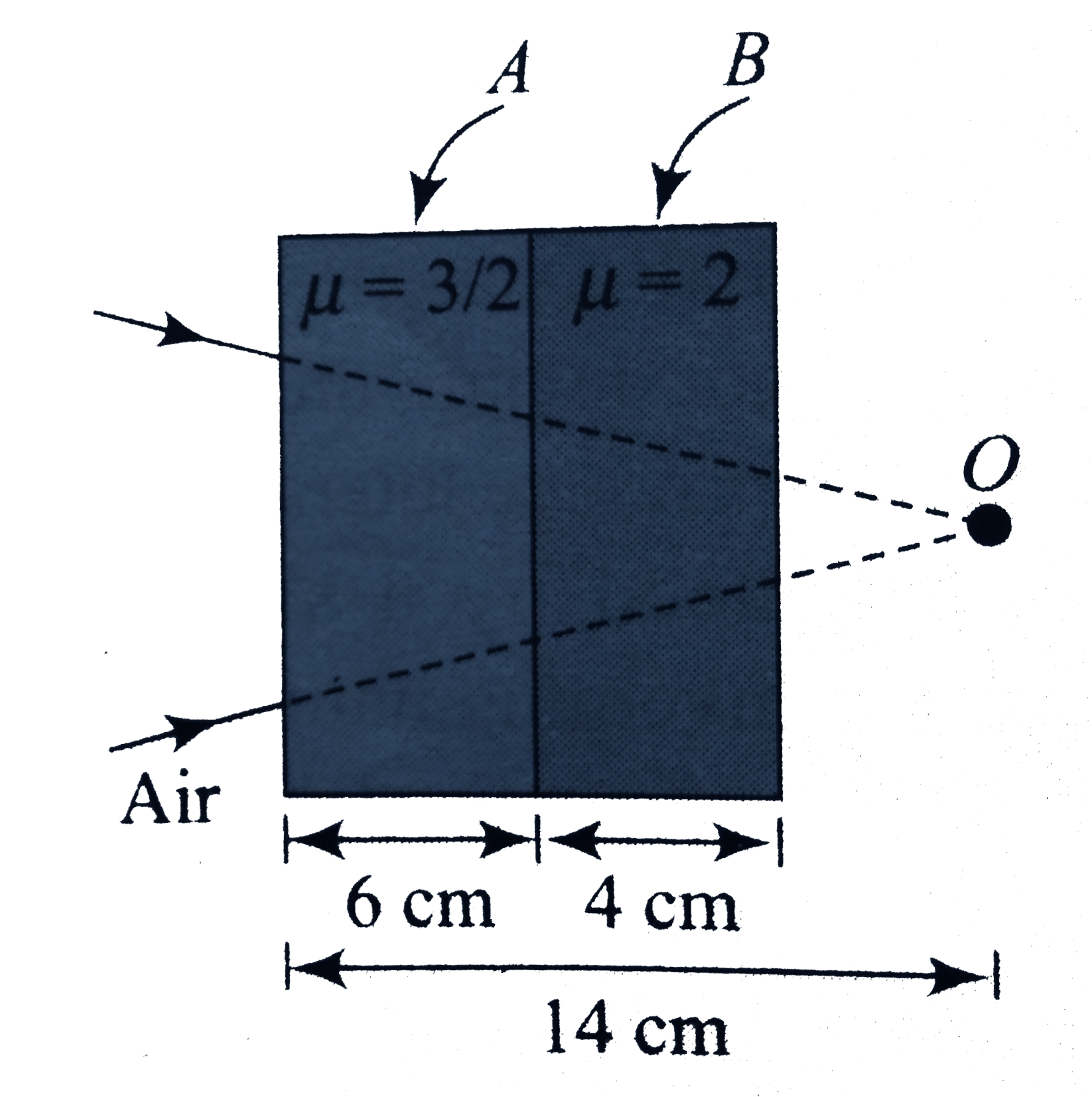
A convergent beam is incident on two slabs placed in contact as shownin figure. Where will the rays finally converge?

Text Solution

Verified by Experts
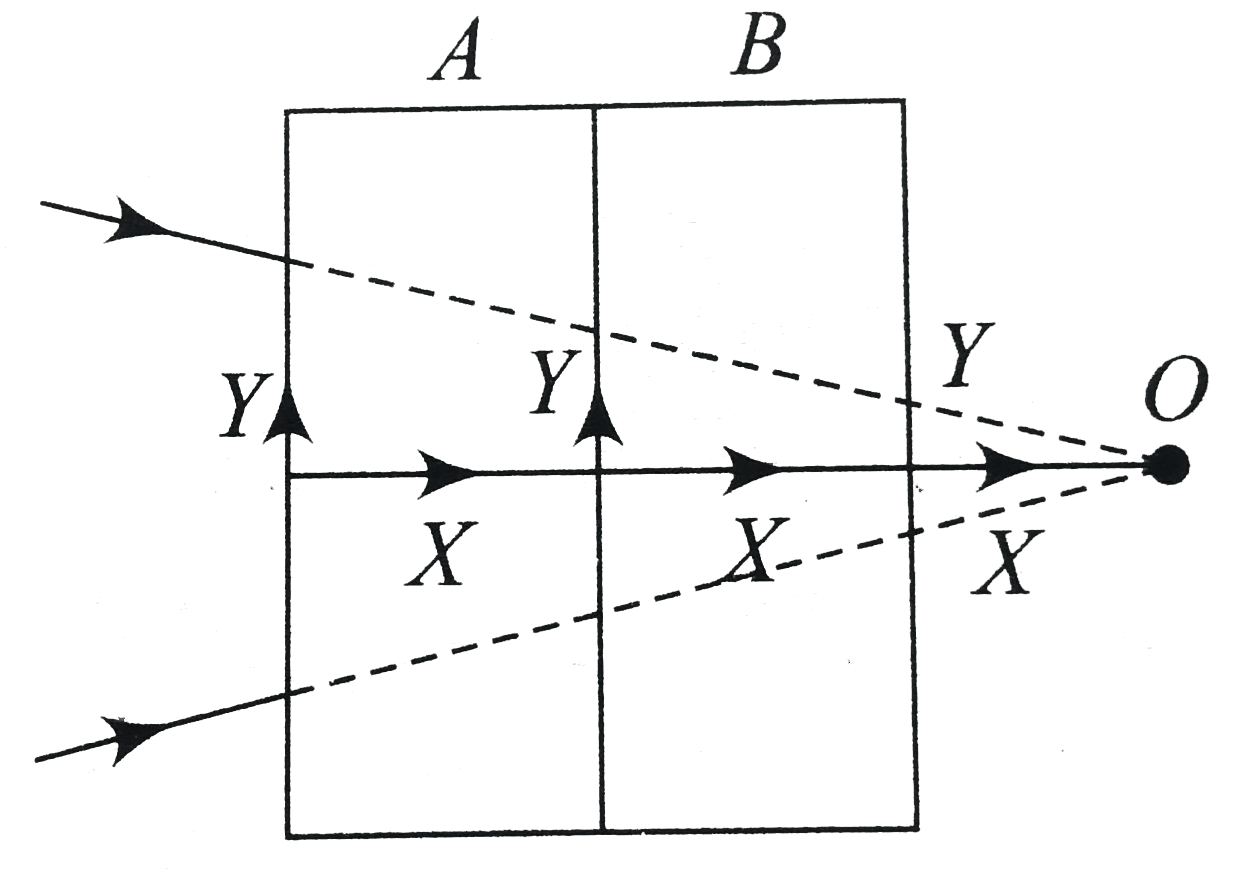
A ray of light from the object undergoes refraction at three interfaces: (1) Air-medium A, (2) Medium A-mudium B, (3) Medium B-air. The coordinate system for each of the interface is shown in the following figure.
Air-medium A interface:
`d_(1)=+14cm, mu_(1)=1, mu_(2)=1.5`
As `(mu_(1))/(d_(1))=(mu_(2))/(d_(2))` or `d_(2)=(mu_(2))/(mu_(1))d_(1)` , we get
`d_(2)=+21 cm`
Medium A-medium B interface:
`d_(1)=(21-6)=15 cm, mu_(1)=1.5, mu_(2)=2`
As `(mu_(1))/(d_(1))=(mu_(2))/(d_(2))` or ` d_(2)=(mu_(2))/(mu_(1))d_(1)` , we get
`d_(2)=+20cm`
Medium B-air interface:
`d_(1)=+(20-4)=+16cm, mu_(1)=2, mu_(2)=1`
As `(mu_(1))/(d_(1))=(mu_(2))/(d_(2))` or `d_(2)=(mu_(2))/(mu_(1))d_(1)` , we get
`d_(2)=+8cm`
Thus, the final image is 8cm in front of the medium B-air interface.
Method 2: Method of shifting
Net shifting `S=6(1-(1)/(3//2))+4(1-(1)/(2))`
`=4cm`
The shifting will be in the direction of ray travelling, i.e., towards right.
Hence, rays will coverge finally `=14+4=18 cm` from left surface or 8cm from right surface.
Promotional Banner

Topper's Solved these Questions

  • GEOMETRICAL OPTICS

    CENGAGE PHYSICS ENGLISH|Exercise Exercise1.4|12 Videos
  • GEOMETRICAL OPTICS

    CENGAGE PHYSICS ENGLISH|Exercise Exercise1.5|22 Videos
  • GEOMETRICAL OPTICS

    CENGAGE PHYSICS ENGLISH|Exercise Exercise1.2|20 Videos
  • ELECTRON,PHONTS,PHOTOELECTRIC EFFECT & X-RAYS

    CENGAGE PHYSICS ENGLISH|Exercise dpp 3.3|15 Videos
  • HEATING EFFECT OF CURRENT

    CENGAGE PHYSICS ENGLISH|Exercise Thermal Power in Resistance Connected in Circuit|27 Videos

Similar Questions

Explore conceptually related problems

A convergent beam is incident on two slabs placed in contact as shown in fig. Finally the rays are converge at a distance (from left face of slab A is )

A rays of light is incident on a thick slab of glass of thickness t as shown in figure. The emergent ray is parallel to the incident ray but displaced sideways by a distance d. If the angles are small then d is

Two identical thin isosceles prisms of refracting angle A and refractive index mu are placed with their bases touching each other and this system can collectively act as a crude converging lens. A parallel beam of light is incident on this system as shown in Figure. Find the focal length of this so called converging lens.

A ray is incident on interface of two media at critical angle as shown in the figure.

A converging beam of rays is incident on a diverging thin lens. Having passed through the lens the rays intersect at a point 15cm from the lens. If lens is removed the point where the rays meet will move 5cm closer towards the mounting that holds the lens. The focal length of lens is

A converging set of ray, traveling from water to air, is incident on a plane interface. In the absence of the interface, the rays would have converged to a point O, 60 cm above the interface. However, dur to refraction the rays will bend. At what distance above the interface will the rays actually converge?

A converging beam of rays is incident on a diverging lens. Having passed through the lens the rays intersect at a point 15 cm from the lens. If the lens is removed, the point where the rays meet, move 5 cm closer to the mounting that holds the lens. Find the focal length of the lens.

Consider a light beam incident from air to a glass slab at Brewster's angle as shown in figure. A polaroid is placed in the path of the emergent ray at point P and rotated about an axis passing through the centre and pependicular to the plane of the plaroid.

Consider a light beam incident from air to a glass slab at Brewster's angle as shown in figure. A polaroid is placed in the path of the emergent ray at point P and rotated about an axis passing through the centre and pependicular to the plane of the polaroid.

Consider a light beam incident from air to a glass slab at Brewster's angle as shown in figure. A polaroid is placed in the path of the emergent ray at point P and rotated about an axis passing through the centre and pependicular to the plane of the plaroid.

CENGAGE PHYSICS ENGLISH-GEOMETRICAL OPTICS-Exercise1.3
  1. A converging set of ray, traveling from water to air, is incident on a...

    Text Solution

    |

  2. A tank contains three layers of immiscible liquids. The first layer is...

    Text Solution

    |

  3. A convergent beam is incident on two slabs placed in contact as showni...

    Text Solution

    |

  4. A slab of water is on the top of a glass slab of refractive index 2. A...

    Text Solution

    |

  5. A ray of light ravels from a liquid of refractive index mu to air. If ...

    Text Solution

    |

  6. What should be the value of refractive index n of a glass rod placed ...

    Text Solution

    |

  7. An object is placed on the principle axis of a concave mirror of focal...

    Text Solution

    |

  8. The image of an object kept at a distance of 30 cm in front of a conca...

    Text Solution

    |

  9. In figure, a fish watcher watches a fish through a 3.0 cm thick glass ...

    Text Solution

    |

  10. An observer can see through a pin-hole the top end of a thin rod of...

    Text Solution

    |

  11. A vesserl contains a slab of glass 8cm thick and of refractive index 1...

    Text Solution

    |

  12. An object O is placed at 8cm in front of a glass slab, whose one face ...

    Text Solution

    |

  13. x-y plane separates two media, zge0 contains a medium of refractive i...

    Text Solution

    |

  14. The n transparent slabs of refractive index1.5 each having thickness 1...

    Text Solution

    |

  15. A concave mirror with its optic axis vertical and mirror facinig upwar...

    Text Solution

    |

  16. Consider the situation shown in figure. A plane mirror is fixed at a h...

    Text Solution

    |

  17. A concave mirror of radius 40 cm lies on a horizontal table and water ...

    Text Solution

    |

  18. A concave mirror of radius R is kept on a horizontal table. Water (ref...

    Text Solution

    |

  19. The refractive index of an anisotropic medium varies as mu=mu(0)sqrt((...

    Text Solution

    |

  20. A light beam of diameter sqrt(3R) is incident symmetrically on a glass...

    Text Solution

    |

