Home
Class 12
PHYSICS
A point object is located at a distance ...

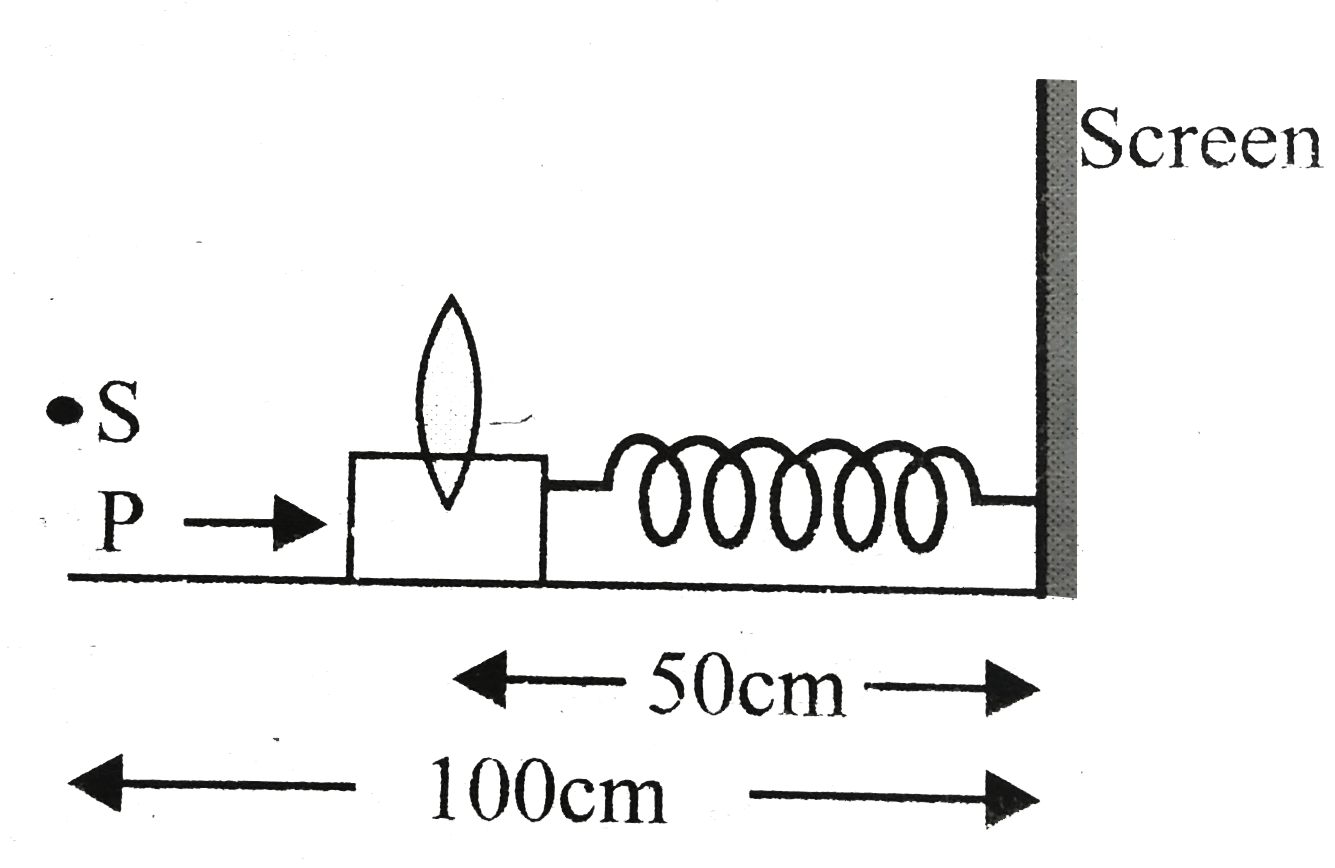
A point object is located at a distance of 100cm from a screen. A lens of focal length 23 cm mounted on a movable frictionless stad is kept between the source and the screen. The stand is attached to a spring of natureal length 50cm and spring constant `800N//m` as shown in Figure . Mass of the stand with lens is 2 kg. How much impulse P should be imparted to the stand so that a real image of the object is formed on the screen after a fixed time gap? Also find this time gap. (Neglect width width of the stand)

Text Solution

Verified by Experts

The correct Answer is:

`8km//s`

Let the difference of th elens from the object be `l` when a real image is formed on the screen.
Then, `(1)/(100-l)-(1)/(-l)=(1)/(23)`
On solving, we get `l=(50+-sqrt(2))cm`
Now, if the lens performs SHM and real image is formed after a fixed time gap then this time gap must be one fourth of the time period.
Therefore, phase difference between the two positions of real image must be `(pi)/(2)` . As the two positions are symmetrically located about the origin, phase difference of any of these positions from origin must be `(pi)/(4)`.
`rArr 10sqrt(2)cm=A "sin" (pi)/(5)rArr A=20cm`
To achieve this velocity at the mean position,
`v_(0)=A_(omega)=Asqrt((K)/(m))`
`:.` Required impulse `rho=mv_(0)=Asqrt(Km)=8kms^(-1)`
Promotional Banner

Topper's Solved these Questions

  • GEOMETRICAL OPTICS

    CENGAGE PHYSICS ENGLISH|Exercise Single Correct|221 Videos
  • GEOMETRICAL OPTICS

    CENGAGE PHYSICS ENGLISH|Exercise Assertion-Reasoninig|2 Videos
  • GEOMETRICAL OPTICS

    CENGAGE PHYSICS ENGLISH|Exercise Exercise1.7|21 Videos
  • ELECTRON,PHONTS,PHOTOELECTRIC EFFECT & X-RAYS

    CENGAGE PHYSICS ENGLISH|Exercise dpp 3.3|15 Videos
  • HEATING EFFECT OF CURRENT

    CENGAGE PHYSICS ENGLISH|Exercise Thermal Power in Resistance Connected in Circuit|27 Videos

Similar Questions

Explore conceptually related problems

A point is located at a distance 100 cm from the screen. A lens of focal length 23 cm mounted on a movable frictionless stand is kept between the object and screen. The stand is attached to massless spring of natural length 50 cm and spring constant 800(N)/(m) as shown in the figure. Mass of the stand with lens is 2 kg. Initially spring is in its natural length. Now a sharp impulse J is given to the stand. Answer the following questions. Q. Choose the correct options (s):

An object is placed at a distance of 12 cm from a convex lens of focal length 8 cm. Find : nature of the image

An object is placed at a distance of 12 cm from a convex lens of focal length 8 cm. Find : the position of the image

An object is kept at a distance of 15 cm from a convex lens of focal length 10 cm. Calculate the image distance and state the characteristics of the image formed.

An object is placed at a distance 24 cm in front of a convex lens of focal length 8 cm. Calculate the distance of the image from the lens.

An object is placed at a distance of 80 cm from a screen. Where should a convex lens of focal length 15 cm be placed from object such that a real image of object is formed?

An object is placed at a distance of 80 cm from a screen. Where should a convex lens of focal length of 15 cm will be placed so as to obtain a real image of an object?

In displacement method distance of object from convex lens of focal length 20 cm in one position 60 cm. Then

Distance of an object from a concave lens of focal length 20 cm is 40 cm. Then linear magnification of the image

A point object O is placed at a distance of 20 cm from a convex lens of focal length 10 cm as shown in the figure. At what distance x from the lens should a convex mirror of focal length 60 cm, be placed so that final image coincide with the object?

CENGAGE PHYSICS ENGLISH-GEOMETRICAL OPTICS-Subjective
  1. In figure, AB is the principal axis of the concave mirror. A point ob...

    Text Solution

    |

  2. If an observer sees the bottom of the vessel shown in Figure., at 8cm,...

    Text Solution

    |

  3. O is a point object kept on the principal axis of a concave mirror M o...

    Text Solution

    |

  4. In Figure ., L is a converging lens of focal length 10cm and M Iis a c...

    Text Solution

    |

  5. A stationary observer O looking at a fish F in water (mu(w)=4//3) thro...

    Text Solution

    |

  6. The back wall of an aqaurium is a mirror that is 30 cm away from the f...

    Text Solution

    |

  7. An object is placed 20cm to the left of a converging lens having focal...

    Text Solution

    |

  8. A composite slab consisting of different media is placed in front of a...

    Text Solution

    |

  9. A parallel beam of light falls on the surface of a convex lens whose r...

    Text Solution

    |

  10. A thin biconvex lens of refractive index 3//2 and radius of curvature...

    Text Solution

    |

  11. A convex lens of focal length f(1) is placed in front of a luminous po...

    Text Solution

    |

  12. A lens is made of three thin different mediums. Radius of curvature an...

    Text Solution

    |

  13. An equiconvex lens, f(1)=10cm, is placed 40 cm in front of a concave ...

    Text Solution

    |

  14. A biconvex lens, f(1)=20cm , is placed 5cm in front of a convex mirror...

    Text Solution

    |

  15. A transparent sphere of radius R ahs a cavity of radius R//2 as shown ...

    Text Solution

    |

  16. A stationary observer O looking at a fish (in water of mu=4//3 ) throu...

    Text Solution

    |

  17. The bottom of glass beaker is made of a thin equiconvex lens having bo...

    Text Solution

    |

  18. A thin convex lens of refractive index mu=1.5 is placed between a poi...

    Text Solution

    |

  19. A thin equi-convex glass lens (refractive index = 1.5) is being placed...

    Text Solution

    |

  20. A point object is located at a distance of 100cm from a screen. A lens...

    Text Solution

    |
