Home
Class 12
PHYSICS
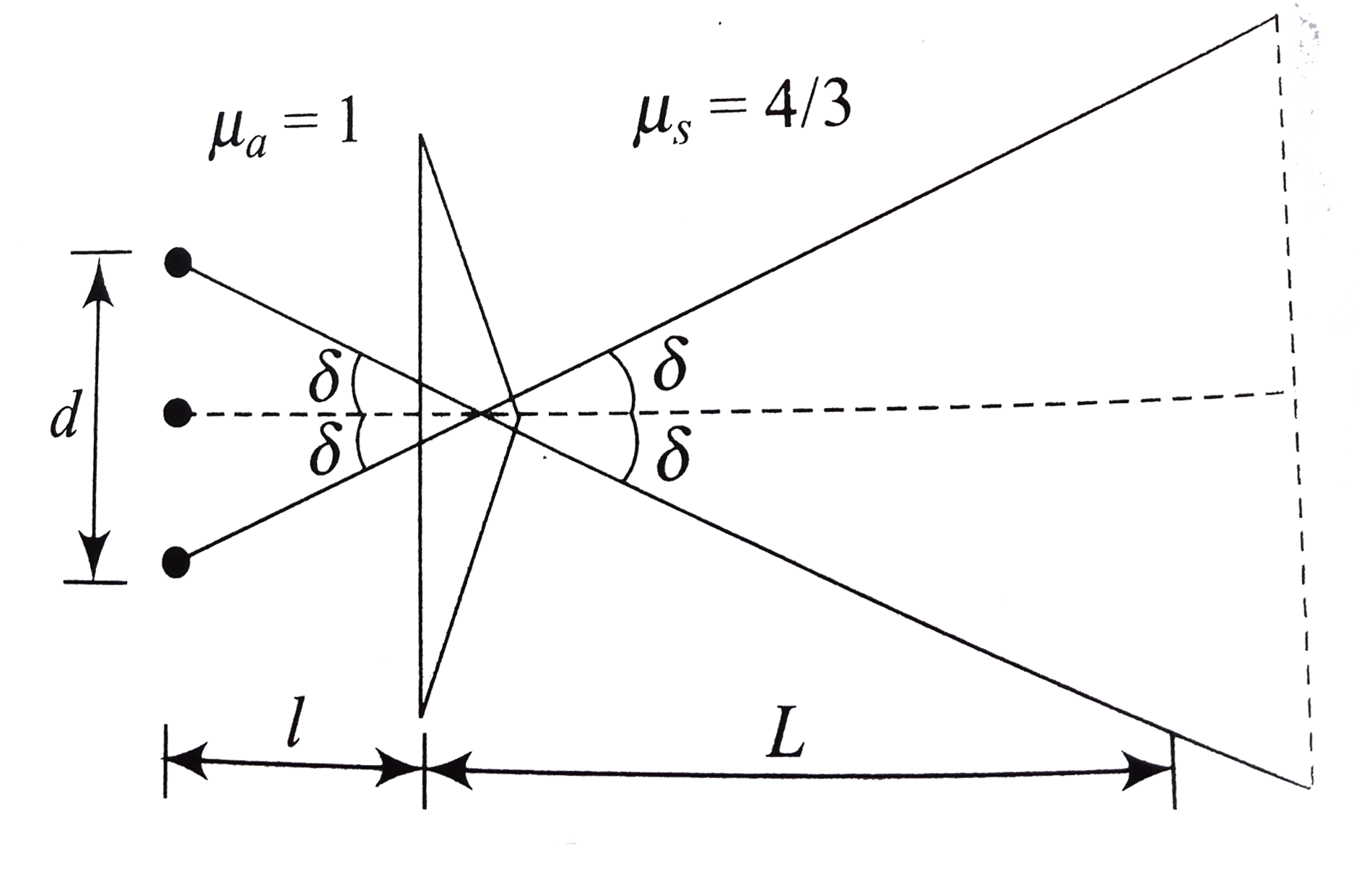
Figure shows a modified Fresnel biprism ...

Figure shows a modified Fresnel biprism experiment with monochromatic source of wavelength 500 nm. The refracting angle of glass prism is `2^(@)`. Find the fringe width.

Text Solution

Verified by Experts

The correct Answer is:
0.1125 mm

Angle of deviation of the prism with water on one side,
`delta = A [(mu_(g))/(mu_(m)) - 1] = (2)/(180) xx (22)/(7) [(3//2)/(4//3) - 1]`
`implies delta = (2 xx 11)/(90 xx 7) [(3)/(2) xx (3)/(4) - 1] = (2 xx 11 )/(90 xx 7) xx [(1)/(8)] = (11)/(90 xx 4 xx 7)`
`d = 2 delta l = (2 xx 11 xx 57.5)/(90 xx 4 xx 7) = (11 xx 115)/(90 xx 4 xx 7)`
`D = 1 + L = 150 cm`
Fringe width,
`beta = (11 xx 23)/(18 xx 4 xx 7) cm`
`0.1125 mm`
Promotional Banner

Topper's Solved these Questions

  • WAVE OPTICS

    CENGAGE PHYSICS ENGLISH|Exercise Single Correct|128 Videos
  • WAVE OPTICS

    CENGAGE PHYSICS ENGLISH|Exercise Multiple Correct|8 Videos
  • WAVE OPTICS

    CENGAGE PHYSICS ENGLISH|Exercise Exercise 2.2|22 Videos
  • SOURCES OF MAGNETIC FIELD

    CENGAGE PHYSICS ENGLISH|Exercise single correct Ansewer type|12 Videos

Similar Questions

Explore conceptually related problems

Yellow light of wavelength 6000 Ã… produces fringes of width 0.8 mm in Young's double slit experiment. If the source is replaced by another monochromatic source of wavelength 7500 Ã… and the separation between the slits is doubled then the fringe width becomes

What is effect on the interference fringes in a Young's double slit experiment due to each of the following operations : (a) the screen is moved away from the plane of the slits, (b) the monochromatic source is replaced by another monochromatic source of shorter wavelength, (c ) the separation between the two slits is increased, (d) the source slit is moved closer to the double slit plane, (e) the width of the source slit is increased. (f) the width of two slits are increased, (g) the monochromatic source is replaced by a source of white light ? (In each operation, take all parameters, other than the one specified, to remain unchanged) NCERT Solved Example

Find the angular fringe width in Young's double slit experiment using a monochromatic light of wavelength 500 nm when the slits are separated by 2.5 mm.

In Young.s double slit experiment, using monochromatic light L_1 of wavelength 700 nm, 10th bright fringe was obtained at a certain point P on a screen. Which bright fringe will be obtained at the same point P if monochromatic light of wavelength 500 nm is used in place of L_1 (No other alterations were made in the experimental set up).

A transparent paper (refractive index = 1.45) of thickness 0.02 mm is pasted on one of the slits of a Young's double slit experiment which uses monochromatic light of wavelength 620 nm. How many fringes will cross through the centre if the paper is removed ?

In Young.s double slit experiment using monochromatic light of wavelength 600 nm, 5th bright fringe is at a distance of 0.48 mm from the centre of the pattern. If the screen is at a distance of 80 cm from the plane of the two slits, calculate : Fringe width, i.e., fringe separation.

Find the angular separation between the consecutive bright fringes in a Young's double slit experiment with blue-green light of wavelength 500 nm. The separation between the slits is 2.0 x 10^ -3 m.

Find the angular separation between the consecutive bright fringes in a Young's double slit experiment with blue-green light of wavelength 500 nm. The separation between the slits is 2.0 xx 10^ -3 m.

In Fresnel's biprism (mu=1.5) experiment the distance between source and biprism is 0.3m and that between biprism and screen is 0.7m and angle of prism is 1^@ . The fringe width with light of wavelength 6000Å will be

In fresnel's biprism experiment the distance between the source and the screen is 1 ma nd that between the screen is 1 m and that between the source and biprism is 10 cm. the wavelength of light used is 6000Å. The fringe width obtained is 0.03 cm and the refracting angle of biprism is 1^(@) then calculate the refractive index of the material of biprism.

