Home
Class 12
PHYSICS
Bichromatic light is used in YDSE having...

Bichromatic light is used in YDSE having wavelengths
` lambda_1 = 400 nm and lambda_2= 700nm`. Find minimum order of bright fringe of `lambda_1` which overlaps with bright fringe of `lambda_2` .

Text Solution

Verified by Experts

The correct Answer is:
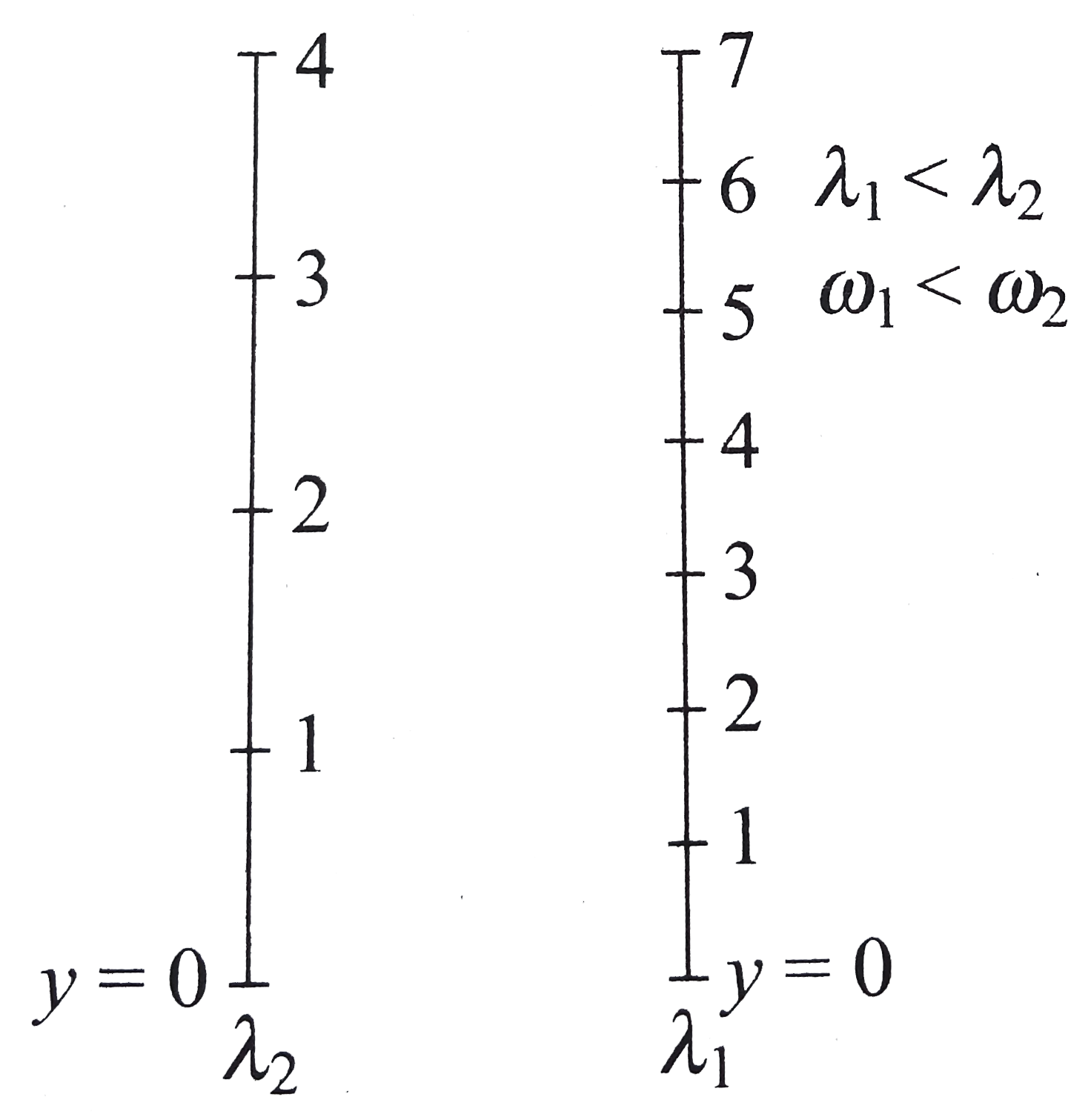
`7^(th)`

Let `n_(1)` bright fringes of `lambda_(1)` overlaps with `n_(2)` bright fringes of `lambda_(2)`. Then,
`(n_(1) lambda_(1) D)/(d) = (n_(2) lambda_(2) D)/(d)`
or `(n_(1))/(n_(2)) = (lambda_(2))/(lambda_(2)) = (700)/(400) = (7)/(4)`
The ratio implies tha 7th bright fringe of `lambda_(1)` will overlap with 4th bright fringe of `lambda_(2)`. Similarly, 14th bright fringe of `lambda_(1)` will overlap with 8th bright fringe of `lambda_(2)` and so on. So, the minimum order of `lambda_(1)` which of overlaps with `lambda_(2)` is 7.
.
Promotional Banner

Topper's Solved these Questions

  • WAVE OPTICS

    CENGAGE PHYSICS ENGLISH|Exercise Single Correct|128 Videos
  • WAVE OPTICS

    CENGAGE PHYSICS ENGLISH|Exercise Multiple Correct|8 Videos
  • WAVE OPTICS

    CENGAGE PHYSICS ENGLISH|Exercise Exercise 2.2|22 Videos
  • SOURCES OF MAGNETIC FIELD

    CENGAGE PHYSICS ENGLISH|Exercise single correct Ansewer type|12 Videos

Similar Questions

Explore conceptually related problems

Bichromatic light is used in YDSE having wavelengths lambda_(1)=400nm and lambda_(2)=700nm Find minimum order of lambda_(1) which overlaps with lambda_(2)

Bichromatic light of wavelengths lambda_1= 5000Å and lambda_2=7000Å are used in YDSE. Then,

White light is used in a Young's double slit experiment. Find the minimum order of the violet fringe (lamda = 400 nm) which overlaps with a red fringe (lamda = 700 nm) .

In young's double-slit experiment, the slit are 2 mm apart and are illuminated with a mixture ot two wavelengths lambda_(0) = 750 nm and lambda = 900 nm , The minimum distance from the common central bright fringe on a screen 2 m from the slits, where a bright fringe from one interference pattern coincides with a bright fringe from the other, is

In YDSE a parallel beam of incident light consists of two wavelengths lambda_(1)=4000Å and lambda_(2)=5600Å . The minimum distance y on the screen, measured from the central axis, where the bright fringe due to two wavelengths coincide is (nlambda_(1)D)/(d) . Find n.

In Young's double-slit experiment, the slits are 2mm apart and are illuminated by photons of two wavelengths lambda_1=12000Å and lambda_2=10000Å . At what minimum distance from the common central bright fringe on the screen 2m from the slit will a bright fringe from one interference pattern coincide with a bright fringe from the other?

In YDSE, if a bichromatic light having wavelengths lambda_(1) and lambda_(2) is used, then maxima due to both lights will overlaps at a certain distance y from the central maxima. Take separation between slits as d and distance between screen and slits as D. Then the value of y will be

In Young's double slit experiment, two wavelength lamda_(1)=780nm and lamda_(2)=520 nm are used to obtain interference fringes. If the nth bright band due to lamda_(1) coincides with (n+1)^(th) bright band due to lamda_(2) then the value of n is

In Young.s double slit experiment, the slits are 2mm apart and are illuminated by photons of two wavelengths lambda_(1)= 12000 A^(0)" and "lambda_(2)= 10,000 A^(0) . At what minimum distance from the common central bright fringe on the screen 2m from the slit will a bright fringe from one interference pattern coincide with a bright fringe from the other?

Wavelength of light used in an optical instrument are lambda_(1) = 4000 Å and lambda_(2) = 5000Å then ratio of their respective resolving powers (corresponding to lambda_(1) and lambda_(2) ) is

