Home
Class 12
PHYSICS
Two waves of light in air have the same ...

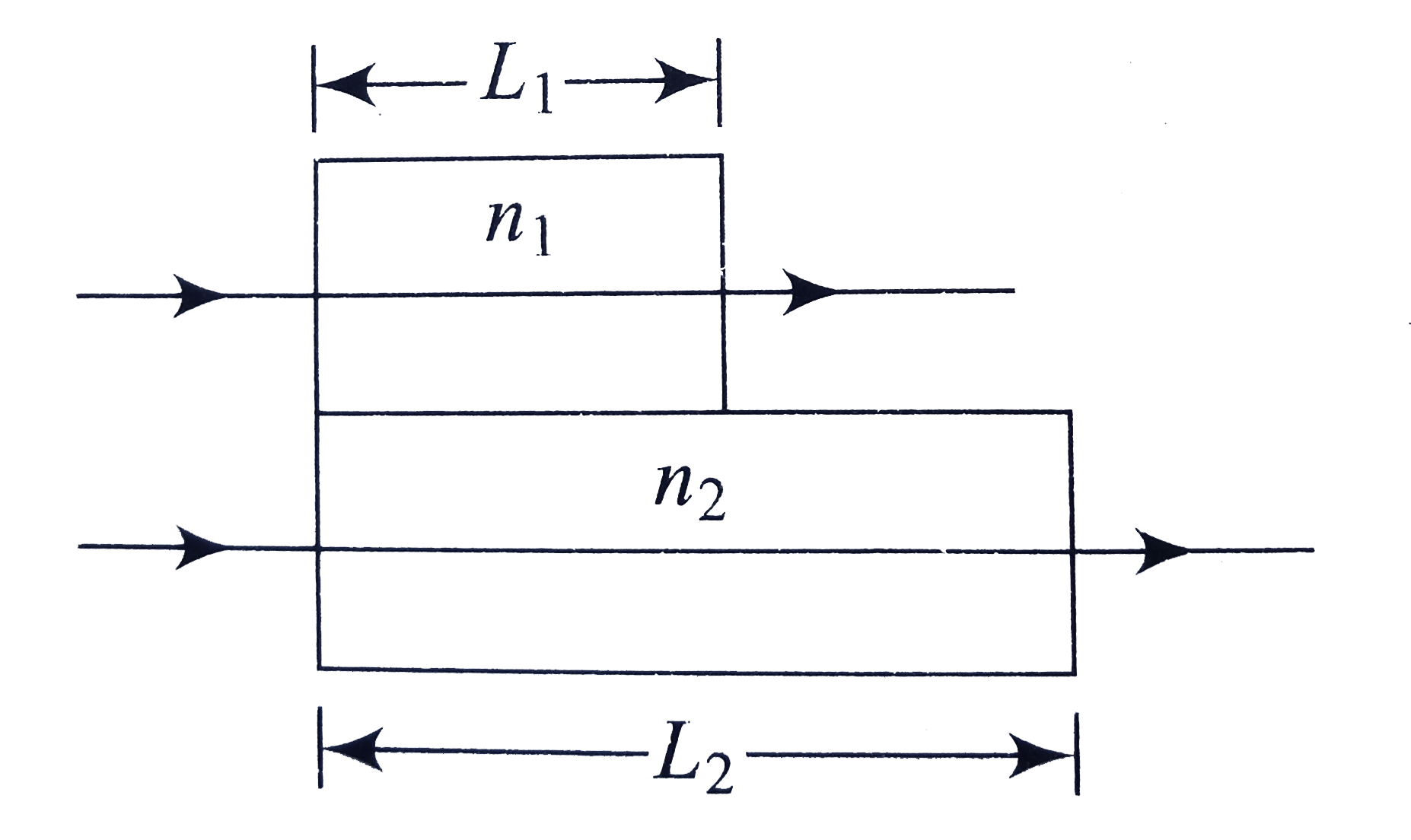
Two waves of light in air have the same wavelength and are intially in phase. They then travel through plastic layers with thickness of `L_(1) = 3.5 mm` and `L_(2) = 5.0 mm` and indices of refraction `n_(1) = 1.7` and `n_(2) = 1.25` as shown in figure. The rays later arrive at a common point. The longest wavelength of light for which constructive interference occurs at the point is

A

`0.8 m m`

B

`1.2 m m`

C

`1.7 m m`

D

`2.9 m m`

Text Solution

Verified by Experts

The correct Answer is:

b

`Delta x = `path difference between two light waves
`= [n_(1) L_(1) + L_(2) - L_(1)] - [n_(2) L_(2)]`
`Delta phi =` phase difference between two waves
For longest wavelengths, `Delta phi` is the smallest.
For constructive interference, `Delta phi = 2 pi`
`I_(max) = n_(1) L_(1) - n_(2) L_(2) + (L_(2) - L_(1))`
`(1.7) (3.5 xx 10^(-6)) - (1.25) (5.0 xx 10^(-6))`
`+ (5.0 - 3.5) xx 10^(-6)`
` = (5.95 - 6.25 + 1.5) xx 10^(-6) = 1.2 5 10^(-6)m`
`= 1.2 mu m`
Promotional Banner

Topper's Solved these Questions

  • WAVE OPTICS

    CENGAGE PHYSICS ENGLISH|Exercise Multiple Correct|8 Videos
  • WAVE OPTICS

    CENGAGE PHYSICS ENGLISH|Exercise Assertion- Reasoning|13 Videos
  • WAVE OPTICS

    CENGAGE PHYSICS ENGLISH|Exercise Subjective|11 Videos
  • SOURCES OF MAGNETIC FIELD

    CENGAGE PHYSICS ENGLISH|Exercise single correct Ansewer type|12 Videos

Similar Questions

Explore conceptually related problems

A light wave travels through three transparent materials of equal thickness rank in order from the highest to lowest the indices of refraction n_(1),n_(2) and n_(3) .

Two light waves having the same wavelength lambda in vacuum are in phase initially. Then the first ray travels a path of length L_(1) through a medium of refractive index mu_(1) . Then second ray travels a path of length L_(2) throug a medium of refractive index mu_(2) . The two waves are then combined to observed interference effects. The phase difference between the two, when they interfere, is

Two light waves having the same wavelength lambda in vacuum are in phase initially. Then the first ray travels a path of length L_(1) through a medium of refractive index mu_(1) . Then second ray travels a path of length L_(2) throug a medium of refractive index mu_(2) . The two waves are then combined to observed interference effects. The phase difference between the two, when they interfere, is

Two identical light sources S_1 and S_2 emit light of same wavelength lambda . These light rays will exhibit interference if

Two light rays initially in same phase travel through two media of equal length L having refraction index mu_1 and mu_2(mu_1 gt mu_2) as shown in figure. If the wavelength of light rays in air is lamda , the phase difference of the emerging rays is given by

The time required to pass the light through a glass slab of 2 mm thick is (mu_("glass")=1.5)

The wavelength of light in vacuum is 5000Å when it travels normally through diamond of thickness 1.0 mm find the number of waves of light in 1.0 mm of diamond. (Refractive index of diamond =2.417)

Thin films, including soap bubbles and oil show patterns of alternative dark and bright regions resulting from interference among the reflected ligth waves. If two waves are in phase, their crests and troughs will coincide. The interference will be cosntructive and the amlitude of resultant wave will be greater then either of constituent waves. If the two wave are not of phase by half a wavelength (180^(@)) , the crests of one wave will coincide width the troughs of the other wave. The interference will be destructive and the ampliutde of the resultant wave will be less than that of either consituent wave. 1. When incident light I, reaches the surface at point a, some of the ligth is reflected as ray R_(a) and some is refracted following the path ab to the back of the film. 2. At point b, some of the light is refracted out of the film and part is reflected back through the film along path bc. At point c, some of the light is reflected back into the film and part is reflected out of the film as ray R_(c) . R_(a) and R_(c) are parallel. However, R_(c) has travelled the extra distance within the film fo abc. If the angle of incidence is small, then abc is approxmately twice the film's thickness . If R_(a) and R_(c) are in phase, they will undergo constructive interference and the region ac will be bright. If R_(a) and R_(c) are out of phase, they will undergo destructive interference and the region ac will be dark. I. Refraction at an interface never changes the phase of the wave. II. For reflection at the interfere between two media 1 and 2, if n_(1) gt n_(2) , the reflected wave will change phase. If n_(1) lt n_(2) , the reflected wave will not undergo a phase change. For reference, n_(air) = 1.00 . III. If the waves are in phase after reflection at all intensities, then the effects of path length in the film are: Constrictive interference occurs when 2 t = m lambda // n, m = 0, 1,2,3 ,... Destrcutive interference occurs when 2 t = (m + (1)/(2)) (lambda)/(n) , m = 0, 1, 2, 3 ,... If the waves are 180^(@) out of the phase after reflection at all interference, then the effects of path length in the film ara: Constructive interference occurs when 2 t = (m + (1)/(2)) (lambda)/(n), m = 0, 1, 2, 3 ,... Destructive interference occurs when 2 t = (m lambda)/(n) , m = 0, 1, 2, 3 ,... The average human eye sees colors with wavelength between 430 nm to 680 nm. For what visible wavelength (s) will a 350 nm thick (n = 1.35) soap film produce maximum destructive interference?

A ray of light coming fromthe point (1, 2) is reflected at a point A on the x-axis and then passes through the point (5,3). The coordinates of the point A is :

As shown in figure waves with identical wavelengths and amplitudes and which are intially in phase travel through difference media. Ray 1 travels through air and Ray 2 through a transparent medium for equal length L, in four different situations. Rays reach a common point on the screen. The number of wavelengths in length L is N_(2) for Ray 2 and N_(1) for Ray 1. In the following table, values of N_(1) and N_(2) are given for all four situations. The order or the situations according to the intensity of the light at the common point in descending order is Situations 1 2 3 4 N_(1) 2.75 1.80 3.00 3.25 N_(2) 2.75 2.80 3.25 4.00

CENGAGE PHYSICS ENGLISH-WAVE OPTICS-Single Correct
  1. In Young's double-slit experiment, the slit are 0.5 mm apart and the i...

    Text Solution

    |

  2. Figure shows two coherent sources S(1) and S(2) emitting wavelength la...

    Text Solution

    |

  3. Two waves of light in air have the same wavelength and are intially in...

    Text Solution

    |

  4. Light from a sources emitting two wavelengths lambda(1) and lambda(2) ...

    Text Solution

    |

  5. The wavefront of a light beam is given by the equation x + 2y + 3x = c...

    Text Solution

    |

  6. As shown in figure waves with identical wavelengths and amplitudes and...

    Text Solution

    |

  7. If the distance between the first maxima and fifth minima of a double-...

    Text Solution

    |

  8. In YDSE, D = 1 m, d = 1 mm, and lambda = 5000 nm. The distance of the...

    Text Solution

    |

  9. Let S(1) and S(2) be the two slits in Young's double-slit experiment. ...

    Text Solution

    |

  10. Figure shows two coherent sources S(1)-S(2) vibrating in same phase. A...

    Text Solution

    |

  11. The path difference between two interfering waves at a point on the sc...

    Text Solution

    |

  12. In YDSE shown in figure a parallel beam of light is incident on the sl...

    Text Solution

    |

  13. In the figure shown, if a parallel beam of light is incident on the pl...

    Text Solution

    |

  14. In the figure shown, a parallel beam of light is incident on the plane...

    Text Solution

    |

  15. Interference fringes were produced using light in a doulbe-slit experi...

    Text Solution

    |

  16. Two coherent ligh sources each of wavelength lambda are separated by a...

    Text Solution

    |

  17. M(1) and M(2) are plane mirrors and kept parallel to each other. At po...

    Text Solution

    |

  18. A ray of light is incident on a thin film, As shown in figure, M and N...

    Text Solution

    |

  19. If one of the two slits of Young's double-slit experiment is painted s...

    Text Solution

    |

  20. Coherent light with wavelength 600nm passes through two very narrow sl...

    Text Solution

    |
