Home
Class 12
PHYSICS
Two thin films of the same material but ...

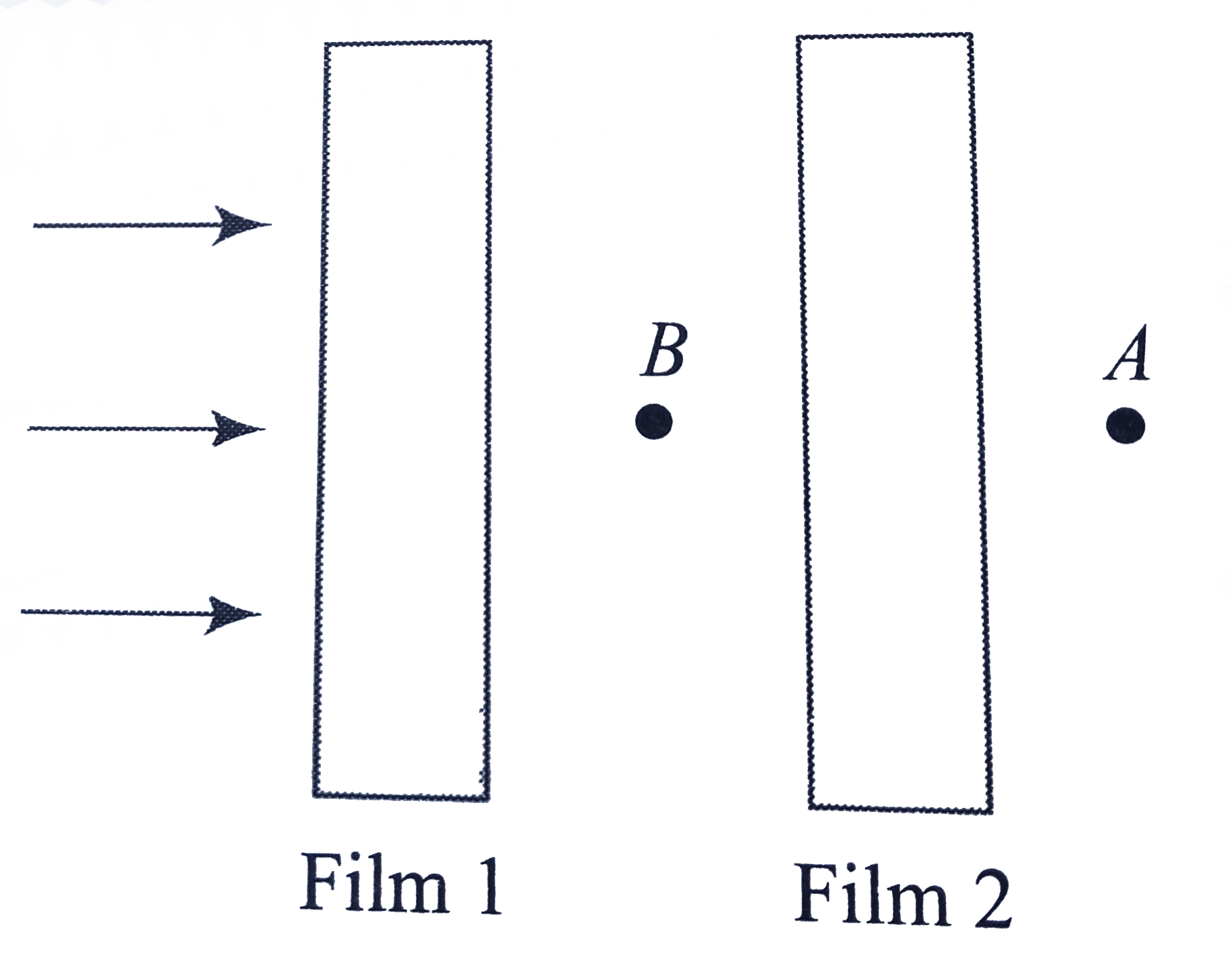
Two thin films of the same material but different thickness are separated by air. Monochormatic light is incident on the first film. When viewed normally form point A, the second film appears dark.

A

the first film will appear bright

B

the first film will appear dark

C

the second film will appear bright

D

the second film will appear dark

Text Solution

Verified by Experts

The correct Answer is:
d

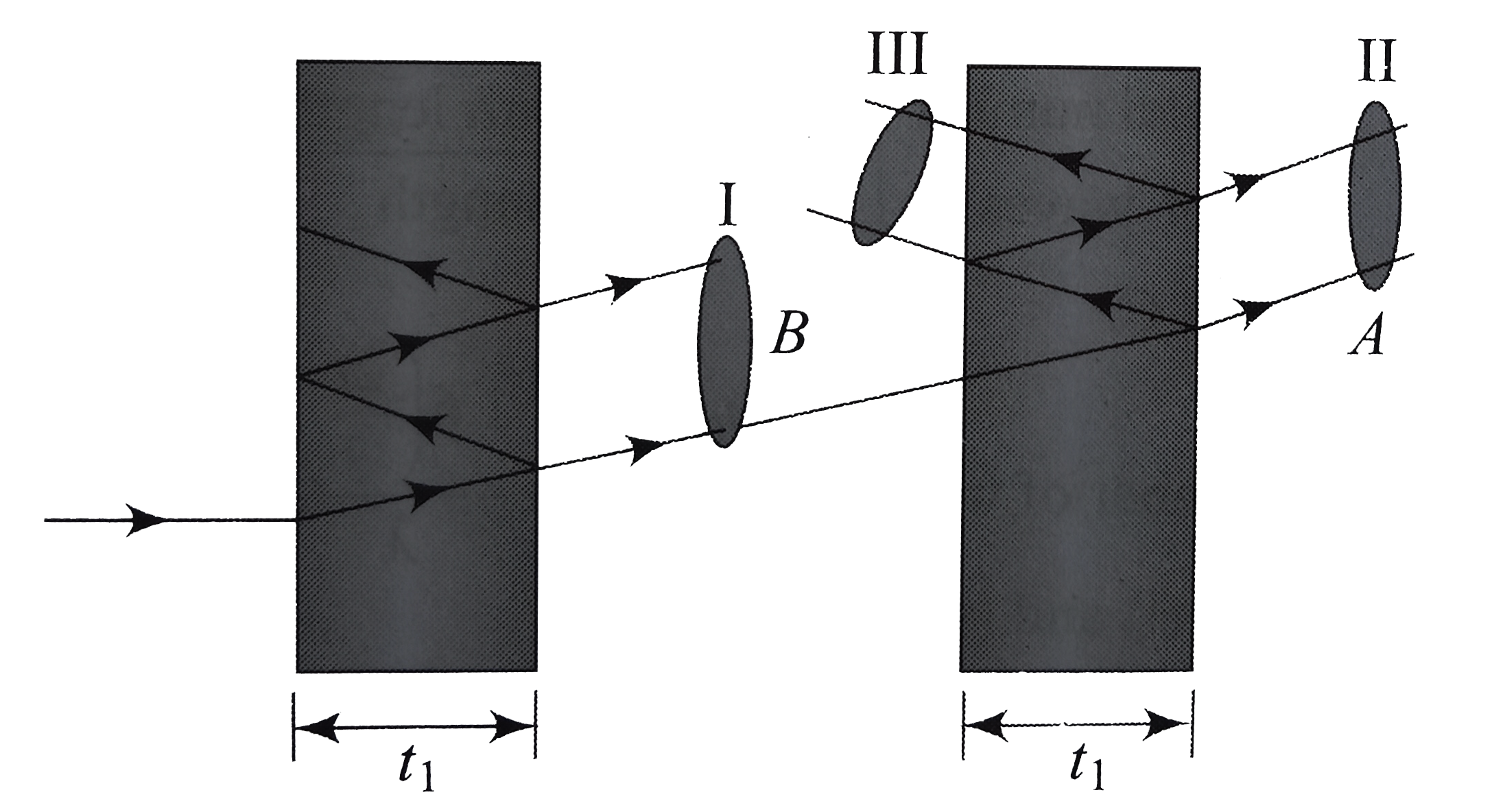
Path difference between waves of
`I` is `rarr 2 mu t_(1)`
`II` is `rarr 2 mu t_(2)`
`III` is `rarr 2 mu t_(3)`
System `I` is used to observe film 1 and A, system II is used to observe film 2 form B, and system III is is used to observe film 2 from A. It is given that `2 mu t_(2) =` odd multiple of `lambda//2`, i.e., dark. So, from A film 2 appears dark while for I, relation between `t_(1)` and `t_(2)` has to be known.
Promotional Banner

Topper's Solved these Questions

  • WAVE OPTICS

    CENGAGE PHYSICS ENGLISH|Exercise Multiple Correct|8 Videos
  • WAVE OPTICS

    CENGAGE PHYSICS ENGLISH|Exercise Assertion- Reasoning|13 Videos
  • WAVE OPTICS

    CENGAGE PHYSICS ENGLISH|Exercise Subjective|11 Videos
  • SOURCES OF MAGNETIC FIELD

    CENGAGE PHYSICS ENGLISH|Exercise single correct Ansewer type|12 Videos

Similar Questions

Explore conceptually related problems

A monochromatic beam of light of 6000 Å is used in YDSE set-up. The two slits are covered with two thin films of equal thickness t but of different refractive indices as shown in figure. Considering the intensity of the incident beam on the slits to be I_(0) , find the point on the screen at which intensity is I_(0) and is just above the central maxima. (Assume that there is no change in intensity of the light after passing through the films.) Consider t = 6 mu m, d = 1 mm, and D = 1 m, where d and D have their usual meaning. Give your answer in mm.

A thin film of a specific meterial can be used to decrease the intensity of reflected light. There is destrucive inteference of wave reflected from upper and lower surface of the film. These films are called non-reflecting or anti-reflecting coatings. The process of coating the lens or surface with non-reflecting film is called blooming as shown in figure The refracting index of coating (n_(1)) is less than that of the glass (n_(2)) . 4. If a light of wavelength lambda is incident normally and the thickness of film is t, then optical path difference between waves reflected from upper and lower surface of the film is

A parallel beam of white light is incident on a thin film of air of uniform thickness. Wavlength 7200 Å and 5400 Å are observed to be missing from the spectrum of reflected light viewed normally. The other wavelength in the visible region missing in the reflected spectrum is

A thin film of a specific meterial can be used to decrease the intensity of reflected light. There is destrucive inteference of wave reflected from upper and lower surface of the film. These films are called non-reflecting or anti-reflecting coatings. The process of coating the lens or surface with non-reflecting film is called blooming as shown in figure The refracting index of coating (n_(1)) is less than that of the glass (n_(2)) . 6. If the thickness of film in above question in not technologically possible to manufacture, then next thickness of film required is (approximately)

A thin film of a specific meterial can be used to decrease the intensity of reflected light. There is destrucive inteference of wave reflected from upper and lower surface of the film. These films are called non-reflecting or anti-reflecting coatings. The process of coating the lens or surface with non-reflecting film is called blooming as shown in figure The refracting index of coating (n_(1)) is less than that of the glass (n_(2)) . 5. magnesium fluoride (MgF_(2)) is generally use as anti-reflection coating. If refractive index of MgF_(2) is 1.25, then minimum thickness of film required is (Take lambda = 500 nm )

An oil film covers the surface of a small pond. The refractive index of the oil is greater than that of water. At one point on the film, the film has the smallest non-zero thickness for which there will be destructive interference in the reflected light when infrared radiation with wavelength 800 nm is incident normal to the film. When this film is viewed at normal incidence at this same point, for what visible wavelengths, if any, will there be constructive interference? (Visible light has wavelengths between 400nm and 700 nm )

What is the minimum thickness of a soap bubble needed for constructive interference in reflected light, if the light incident on the film is 750 nm? Assume that the refractive index for the film is n=1.33

What is the minimum thickness of a soap bubble needed for constructive interference in reflected light, if the light incident on the film is 750 nm? Assume that the refractive index for the film is n=1.33

There are two thin films A of liquid and B of polythene, identical in size they are being pulled with same maximum weight W. if the breadth of the films is increased from b to 2 b then the corresponding weights will be respectively

YDSE is carried out in a liquid of refractive index mu=1.3 and a thin film of air is formed in front of the lower slit as shown in the figure. If a maxima of third order is formed at the origin O, find the thickness of the air film. Find the positions of the fourth maxima. The wavelength of light is air is lambda_0 = 0.78 mum and D//d = 1000.

CENGAGE PHYSICS ENGLISH-WAVE OPTICS-Single Correct
  1. In YDSE, having slits of equal width, let beta be the fringe width and...

    Text Solution

    |

  2. Two identical coherent sources of wavelength lambda are placed at (100...

    Text Solution

    |

  3. Two thin films of the same material but different thickness are separa...

    Text Solution

    |

  4. Consider an YDSE that has different slit width. As a result, amplitude...

    Text Solution

    |

  5. In YDSE of equal width slits, if intensity at the center of screen is ...

    Text Solution

    |

  6. Two transparent slabs have the same thickness as shown in figure. One ...

    Text Solution

    |

  7. Find the speed of light of wavelength lambda =780nm (in air) in a medi...

    Text Solution

    |

  8. In young's double-slit experiment, the slit are 2 mm apart and are ill...

    Text Solution

    |

  9. In Young's interference experiment, if the slit are of unequal width, ...

    Text Solution

    |

  10. Two wavelengths of light lambda(1) and lambda(2) and sent through Youn...

    Text Solution

    |

  11. In Young's interference experiment, the central bright fringe can be i...

    Text Solution

    |

  12. A flake of glass (refractive index 1.5) is placed over one of the open...

    Text Solution

    |

  13. Two identical sources each of intensity I(0) have a separation d = lam...

    Text Solution

    |

  14. In a double-slit experiment, instead of taking slits of equal width, o...

    Text Solution

    |

  15. In Young's double slit experiment, 12 fringes are observed to be forme...

    Text Solution

    |

  16. A certain region of a soap bubble reflects red light of vacuum wavelen...

    Text Solution

    |

  17. In a Young's double slit experiment using monochromatic light, the fri...

    Text Solution

    |

  18. In the ideal double-slit experiment, when a glass-plate (refractive in...

    Text Solution

    |

  19. In Young's double slit experiment, the intensity of light at a point o...

    Text Solution

    |

  20. YDSE is carried with two thin sheets of thickness 10.4mu m each and r...

    Text Solution

    |

