Home
Class 12
PHYSICS
The minimum value of d os that there is ...

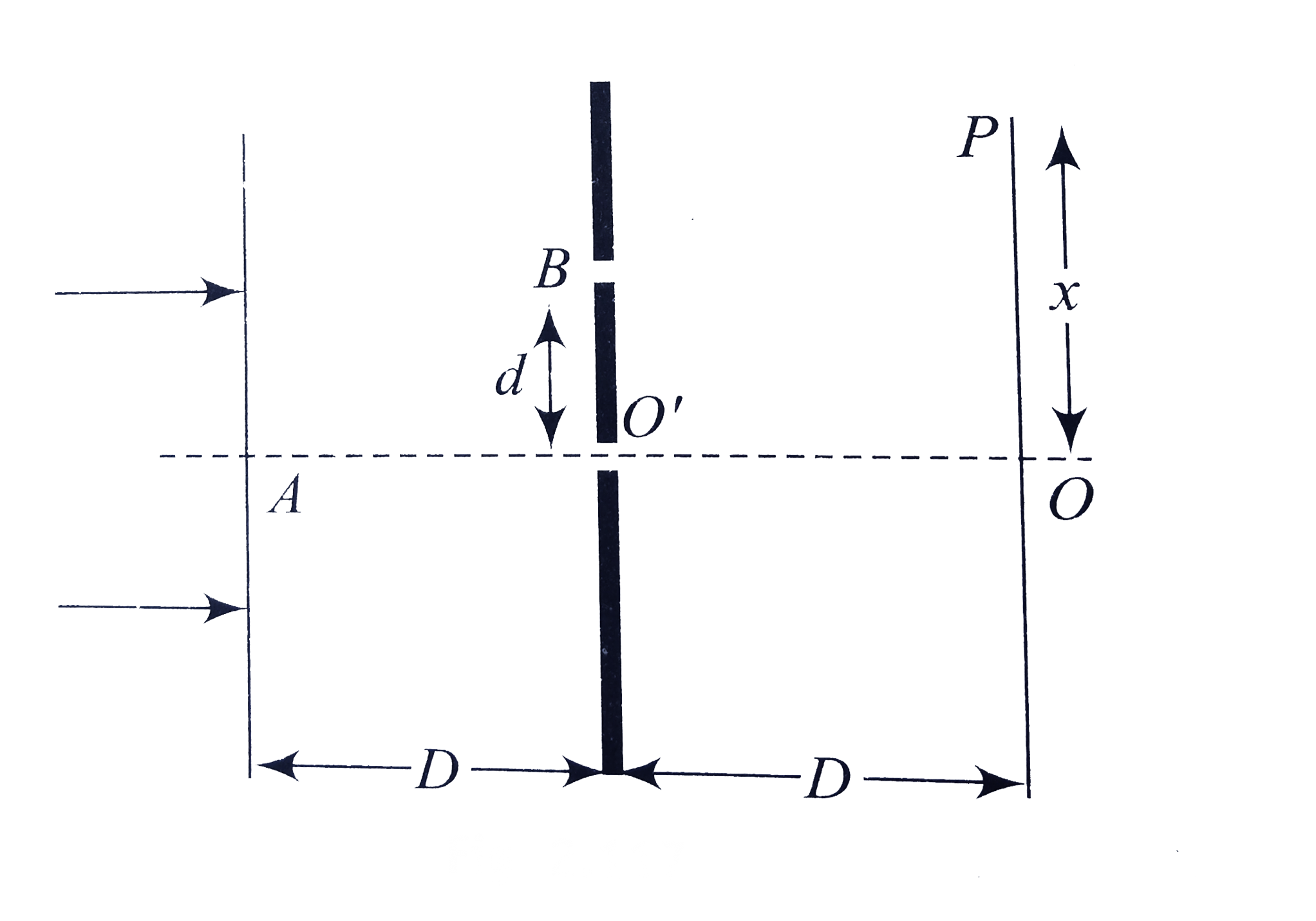
The minimum value of d os that there is a dark fringe at O is `d_(min)`. For the value of `d_(min)`, the distance at which the next bright fringe is formed is x. Then

A

`d_(min) = sqrt(lambda D)`

B

`d_(min) = sqrt((lambda D)/(2))`

C

`x = (d_(min))/(2)`

D

`x = d_(min)`

Text Solution

Verified by Experts

The correct Answer is:
b.,d

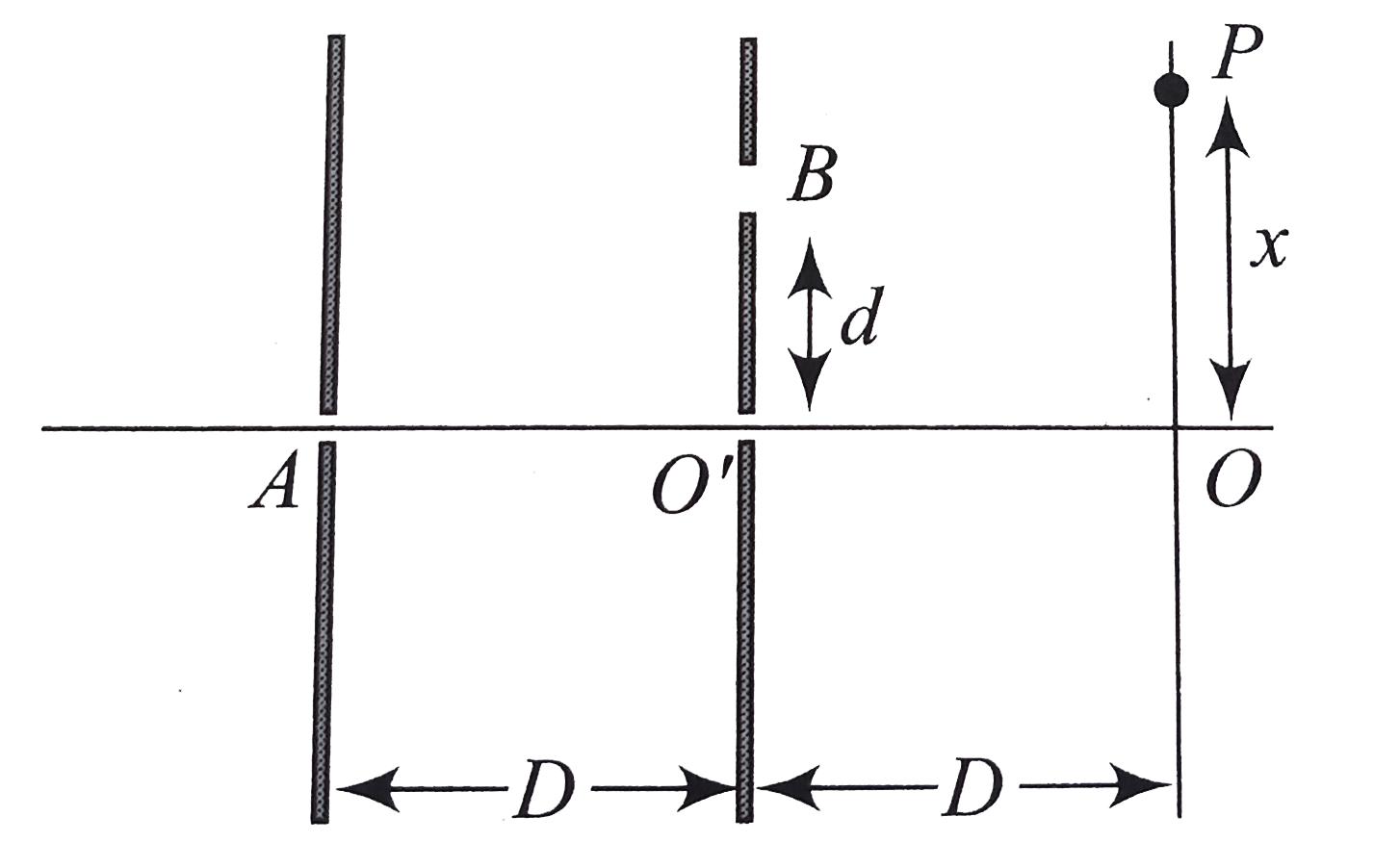
There is a dark fringe at O if the path difference `delta = ABO - AO'O = (lambda)/(2)`
`implies 2sqrt(D^(2) - d^(2)) - 2D = (2d^(2))/(2D) = (D^(2))/(D) = (lambda)/(2)`
`d_(min) = sqrt((lambda D)/(2))`
The bright fringe is formed at P if the path difference
`delta = A O' P - ABP = lambda`
`= D + sqrt(D^(2) + x^(2)) - sqrt(D^(2) + d^(2)) - sqrt(D^(2) + (x - d)^(2) = lambda`
`= (x^(2))/(2 D) - (d^(2))/(2 D) - ((s^(2) + d^(2) - 2 x d))/(2 D) = lambda`
Given `d = d_(min)`
On solving, `x = d_(min) = sqrt((lambda D)/(2))`
Promotional Banner

Topper's Solved these Questions

  • WAVE OPTICS

    CENGAGE PHYSICS ENGLISH|Exercise Assertion- Reasoning|13 Videos
  • WAVE OPTICS

    CENGAGE PHYSICS ENGLISH|Exercise Linked Comprehension|88 Videos
  • WAVE OPTICS

    CENGAGE PHYSICS ENGLISH|Exercise Single Correct|128 Videos
  • SOURCES OF MAGNETIC FIELD

    CENGAGE PHYSICS ENGLISH|Exercise single correct Ansewer type|12 Videos

Similar Questions

Explore conceptually related problems

In the arrangment shown in fin. Find the distance x at which the next fringe is formed.

Two coherent sources are 0.3 mm apart. They are 0.9m away from the screen. The second dark fringe is at a distance of 0.3cm from the centre. Find the distance of fourth bright fringe from the centre. Also, find the wavelength of light used.

The distance of nth bright fringe to the nth dark fringe in Young's experiment is equal to

In the arrangment shown in fin. For what minimum value of d is there a dark bant at point O on the screen?

In a double slit experiment, the distance between the slits is d. The screen is at a distance D from the slits. If a bright fringe is formed opposite to one of the slits, its order is

Red light I(lambda = 664 nm in vacuum) is used in Young's experiment with the slits separated by a distance from the screen given by D = 2.75 m. Find the distance y on the screen between the central bright fringe and the third-order bright fringe. Reasoning: This problem can be solved by the first using Eq. (i) to determine the value of theta that locates the third-order bright fringe. Then, trigonometry can be used to obatin the distance y.

In a double-slit experiment, two parallel slits are illuminated first bylight of wavelength 400 nm and then by light of unknown wavelength. The fourth-order dark fringe resulting from the known wavelength of light falls in the same place on the screen as the second-order bright fringe from the unknown wavelength. The value of unknown wavelength of light is

As shown in the figure Q, above point O is the position of first bright fringe. On the other side of O, D is the position of 11th bright fringe with respect to Q. If the wavelength of light used is 6000A^(0) then the value of S_(1)B will be

In Young's double-slit experiment, the slit are 0.5 mm apart and the interference is observed on a screen at a distance of 100 cm from the slits, It is found that the ninth bright fringe is at a distance of 7.5 mm from the second dark fringe from the center of the fringe pattern. The wavelength of the light used in nm is

In Young.s double slit experiment, the 10th bright fringe is at a distance x from the central fringe. Then a) the 10th dark fringe ia at a distance of 19x"/"20 from the central fringe b) the 10th dark fringe is at a distance of 21x"/"20 from the central fringe. c) the 5th dark fringe is at a distance of x"/"2 from the central fringe. d) the 5th dark fringe is at a distance of 9x"/"20 from the central fringe.

