Home
Class 12
PHYSICS
In a modified YDSE, sources S is kept in...

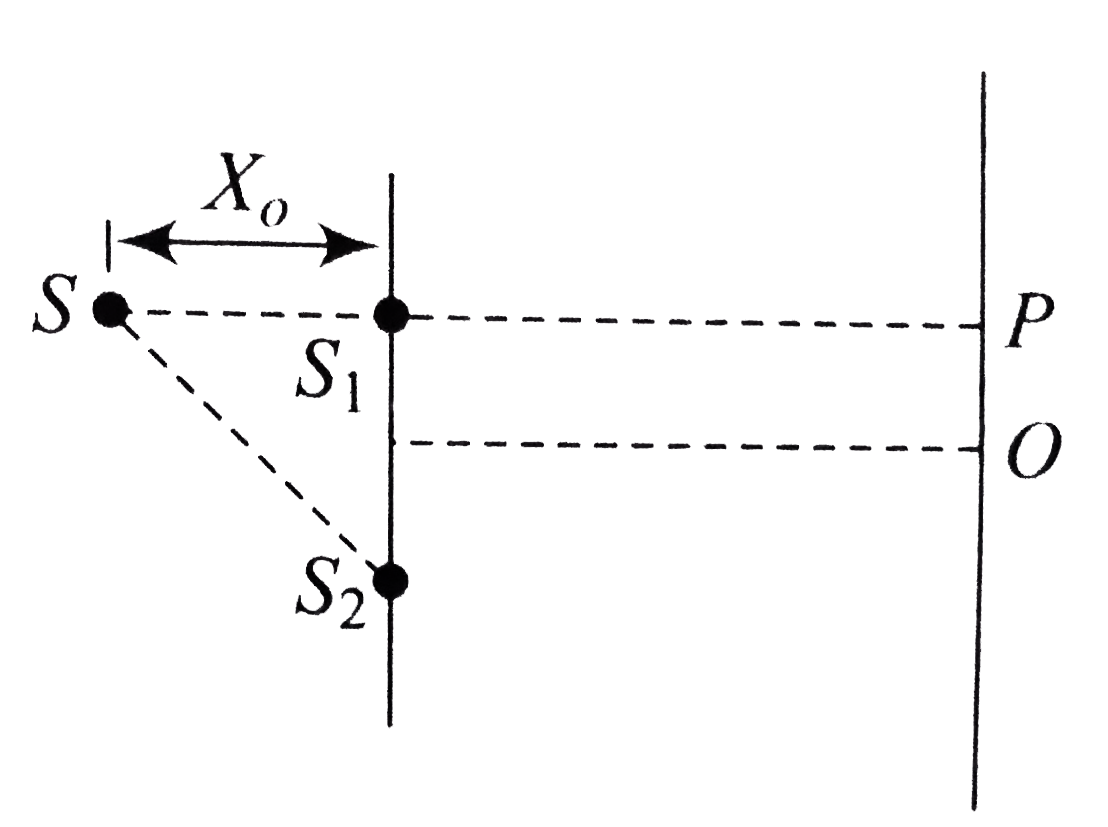
In a modified YDSE, sources `S` is kept in front of slit `S_(1)`. Find the phase difference at point O that is equidistant from slits `S_(1)` and `S_(2)` and point P that is in front of slit `S_(1)` in the following situations.

A liquid of refractive index `mu` is filled between the screen and slits.

A

`(2pi)/(lambda) . [ sqrt(d^(2) + x_(0)^(2)) + x_(0)] + (mu d^(2))/(2D)]`

B

`(2pi)/(lambda) . [[ sqrt(d^(2) + x_(0)^(2)) - x_(0)] + (mu d^(2))/(2D)]`

C

`(2pi)/(lambda) . [[ sqrt(d^(2) - x_(0)^(2)) + x_(0)] + (mu d^(2))/(2D)]`

D

`(2pi)/(lambda) . [[ sqrt(d^(2) - x_(0)^(2)) - x_(0)] + (mu d^(2))/(2D)]`

Text Solution

Verified by Experts

The correct Answer is:

b

While calculating path difference, it must be remembered that is is equal to difference of optical path lengths from sources S to point on the screen.
`:. Delta x_("total") = [Delta x]_("before slits") + [Delta x]_("after slits")`
` = (SS_(2) - SS_(1)) + (S_(2) P - S_(1) P)` ltbgt a. When liquid is filled between the slits and screen, then
`[S_(2) P]_("liquid") = [mu S_(2) P]_("air")`
`[S_(1) P]_("liquid") = [mu S_(1) P]_("air")`
At point O: `mu S_(2) O = mu S_(1) O`
Noth path difference is introduced after slits. So,
`Delta x_("total") = SS_(2) - SS_(1) = sqrt(d^(2) + X_(0)^(2)) - x_(0)`
Thus, phase diffenence,
`Delta phi = (2pi)/(lambda) (sqrt(d^(2) + X_(0)^(2)) - x_(0))`
At point P: `[Delta x]_("before slits") = sqrt(d^(2) + x_(0)^(2)) - x_(0)`
`[Delta x]_("after slits") = mu S_(2) P - mu S_(1) ap = mu (S_(2)P - S_(1)P)`
`= (mu yd)/(D) = (mu d^(2))/(2 D) ("as" y = (d)/(2))`
Thus phase difference,
`Delta phi = (2pi)/(lambda) [(sqrt(d^(2) + x_(0)^(2)) - x_(0)) + (mu d^(2))/(2 D)]`
b. When liquid is filled between the source and slits:
At point O: `(Delta x)_("before slits") = (SS_(2) + SS_(1))_("liquid")`
`(mu SS_(2) + mu SS_(1))_("air")`
`= mu (sqrt(d^(2) + x_(0)^(2)) - x_(0))`
`(Delta x)_("after slits") = S_(2) O + S_(1) O = 0`
`(Delta x)_("total") = mu (sqrt(d^(2) + x_(0)^(2)) - x_(0))`
Thus, phase differnce at P,
` Delta phi = (2pi)/(lambda) (mu sqrt(d^(2) + x_(0)^(2)) - x_(0))`
At point P: `(Delta x)_("before slits") = (SS_(2) + SS_(1))_("liquid") = (mu SS_(2) + mu SS_(1))_("air")`
`(Delta x)_("after slits") = (S_(2)P - S_(1)P)_("air") = (y d)/(D) = (d^(2))/(2D)`
`(Delta x)_("total") = [(mu sqrt(d^(2) + x_(0)^(2)) - x_(0)) + (d^(2))/(2D)]`
Thus, phase difference at P,
`Delta phi = (2 pi)/(lambda) [mu sqrt(D^(2) + x_(0)^(2)) - x_(0) + (d^(2))/(2D)]`
Promotional Banner

Topper's Solved these Questions

  • WAVE OPTICS

    CENGAGE PHYSICS ENGLISH|Exercise Integer|3 Videos
  • WAVE OPTICS

    CENGAGE PHYSICS ENGLISH|Exercise Archives|4 Videos
  • WAVE OPTICS

    CENGAGE PHYSICS ENGLISH|Exercise Assertion- Reasoning|13 Videos
  • SOURCES OF MAGNETIC FIELD

    CENGAGE PHYSICS ENGLISH|Exercise single correct Ansewer type|12 Videos

Similar Questions

Explore conceptually related problems

In the set up shown in figure, the two slits S_1 and S_2 are not equidistant from the slit S. The central fringe at O is then

In the YDSE apparatus shown in figure Deltax is the path difference between S_(2)P and S_(1)P . Now a glass slab is introduced in front of S_(2) , then match the following.

Monochromatic light of wavelength lamda passes through a very narrow slit S and then strikes a screen placed at a distance D = 1m in which there are two parallel slits S_(1) and S_(2) as shown. Slit S_(1) is directly in line with S while S_(2) is displaced a distance d to one side. The light is detected at point P on a second screen, equidistant from S_(1) and S_(2) When either slit S_(1) or S_(2) is open equal light intensities I are measured at point P. When both slits are open, the intensity is three times as large i.e. 3 I . If the minimum possible wavelength is Nd^(2) , then find the value of N (d lt lt D)

In figure S is a monochromatic source of light emitting light of wavelength of wavelength lambda (in air). Light on slits S_(1) from S and then reaches in the slit S_(2) and S_(3) through a medium of refractive index mu_(1) . Light from slit S_(2) and S_(3) reaches the screen through a medium of refractive index mu_(3) . A thin transparent film of refractive index mu_(2) and thickness t is used placed in front of S_(2) . Point P is symmetrical w.r.t. S_(2) and S_(3) . Using the values d = 1 mm, D = 1 m, mu_(1) = 4//3 , mu_(2) = 3//2, mu_(3) = 9//5 , and t = (4)/(9) xx 10^(-5) m , a. find distance of central maxima from P, b. If the film in front of S_(2) is removed, then by what distance and in which direction will be central maxima shift ? .

In the arrangement shown in figure, light of wavelength 6000 Å is incident on slits S_(1) and S_(2) have been opened such that S_(3) is the position of first maximum above the central maximum and S_(4) is the closest position where intensity is same as that of the ligth used, below the central maximum Point O is equidistant from S_(1) and S_(2) and O' is equidistant from S_(3) and S_(4) . Then intensity of inciden light is I_(0) Find the intensity at O' (on the screen).

In the arrangement shown in figure, light of wavelength 6000 Å is incident on slits S_(1) and S_(2) have been opened such that S_(3) is the position of first maximum above the central maximum and S_(4) is the closest position where intensity is same as that of the ligth used, below the central maximum Point O is equidistant from S_(1) and S_(2) and O' is equidistant from S_(3) and S_(4) . Then intensity of inciden light is I_(0) Find the intensity of the brightest fringe.

In standard Young's double - slit experiment, visible light lambdain(350 nm, 750 nm) is used in both the slits. Distance between the slits is 2 mm, and the distance of the screen from the slits is 1 m. A thin glass slab (mu=1.5) of thickness 6mum is placed in front of slit S_(2) . Which among the following wavelength is missing at point P, which is directly in front of slit S_(2) ? (Neglect dispersion of light)

At two point P and Q on screen in Young's double slit experiment, waves from slits S_(1) and S_(2) have a path difference of 0 and (lamda)/(4) respectively. The ratio of intensities at P and Q will be:

In YDSE arrangement as shown in figure, fringes are seen on screen using monochromatic source S having wavelength 3000 Å (in air). S_1 and S_2 are two slits seperated by d = 1 mm and D = 1m. Left of slits S_1 and S_2 medium of refractive index n_1 = 2 is present and to the right of S_1 and S_2 medium of n_2 = 3/2 , is present. A thin slab of thickness 't' is placed in front of S_1 . The refractive index of n_3 of the slab varies with distance from it's starting face as shown in figure. In order to get central maxima at the centre of screen, the thickness of slab required is :

In YDSE shown in figure a parallel beam of light is incident on the slits from a medium of refractive index n_(1) . The wavelength of light in this medium is lambda_(1) . A transparent slab of thickness t and refractive index n_(3) is put in front of one slit. The medium between the screen and the plane of the slits is n_(2) . The phase difference between the light waves reaching point O (symmetrical, relative to the slits) is

CENGAGE PHYSICS ENGLISH-WAVE OPTICS-Linked Comprehension
  1. In a YDSE perfromed with light of wavelength 600 Å, the screen is pla...

    Text Solution

    |

  2. In a double slit experiment using light of wavelength 600 nm, the angu...

    Text Solution

    |

  3. In a modified YDSE, sources S is kept in front of slit S(1). Find the ...

    Text Solution

    |

  4. In a midified YDESE, sources S is kept in front of slit S(1). Find the...

    Text Solution

    |

  5. In a modified YDSE, the region between the screen and slits is immerse...

    Text Solution

    |

  6. In a modified YDSE, the region between the screen and slits is immerse...

    Text Solution

    |

  7. In a YDSE using monochromatic visible light, the distance between the ...

    Text Solution

    |

  8. In a YDSE using monochromatic visible light, the distance between the ...

    Text Solution

    |

  9. In the figure shown, a screen is placed normal to the line joining the...

    Text Solution

    |

  10. In figure, a screen is placed normaol to the line joining the two poin...

    Text Solution

    |

  11. In figure, a screen is placed normaol to the line joining the two poin...

    Text Solution

    |

  12. In the arrangement shown in figure, light of wavelength 6000 Å is inci...

    Text Solution

    |

  13. In the arrangement shown in figure, light of wavelength 6000 Å is inci...

    Text Solution

    |

  14. A lens of focal length f is cut along the diameter into two identical ...

    Text Solution

    |

  15. A lens of focal length f is cut along the diameter into two identical ...

    Text Solution

    |

  16. In the arrangment shown in fin. For what minimum value of d is th...

    Text Solution

    |

  17. In the arrangment shown in fin. Find the distance x at which the n...

    Text Solution

    |

  18. In the arrangment shown in fin. Find the fringe width.

    Text Solution

    |

  19. Consider the situation shown in figure. The two slite S1 and S2 plac...

    Text Solution

    |

  20. Consider the situation shown in figure. The two slits S1 and S2 placed...

    Text Solution

    |
