Home
Class 12
PHYSICS
A lens of focal length f is cut along th...

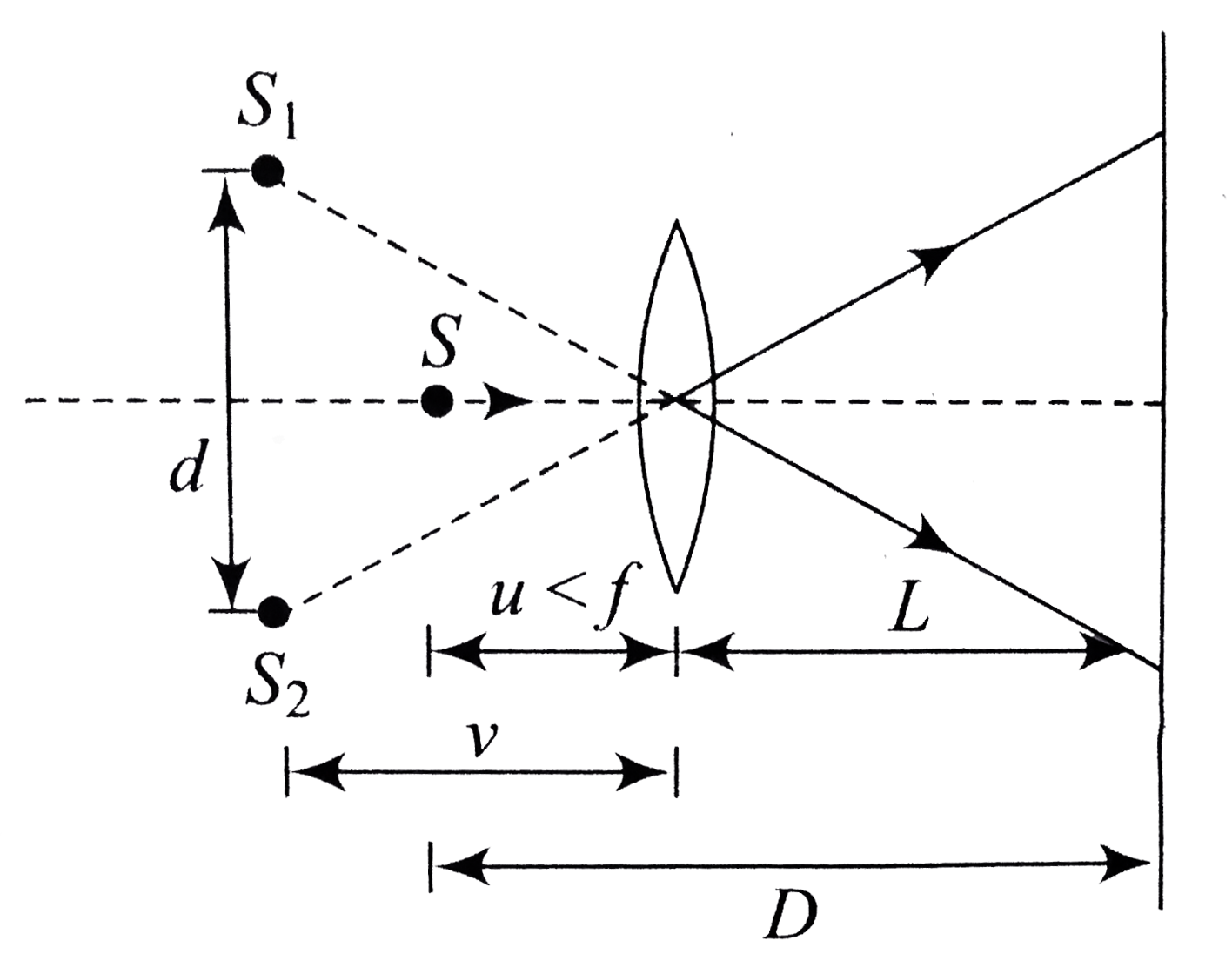
A lens of focal length f is cut along the diameter into two identical halevs. In this process, a layer of the lens t in thickness is lost, then the halves are put together to form a composite lens. In between the focal plane and the composite lens, a narrow slit is placed near the focal plane. The slit is emitting monochromatic `lambda`. Behind the lens, a screen is located at a distance L front it.

The expression for the number of visible maxima which are obtained through above said arrangement will turn out to be

A

`(L t^(2))/(lambda f^(2))`

B

`(2L t^(2))/(lambda f^(2))`

C

`(L t)/(2 lambda f^(2))`

D

`(L t^(2))/(2 lambda f^(2))`

Text Solution

Verified by Experts

The correct Answer is:
d

From lens equation, we have
`v = (u f)/(f - u)`
`d = 2 ((1)/(2)) [(v)/(u) - 1] = t [(u)/(f - u)]`
`D = L + v = L + (u f)/(f - u)`
Fringe width,
`beta = (lambda D)/(d) = [[lambda [ L + (u f)/(f - u)])/(t [(u)/(f - u)]]]`
`beta = (lambda)/(t) [f + (L(f - u))/(u)]`
When `u rarr f, beta = (lambda f)/(t)`
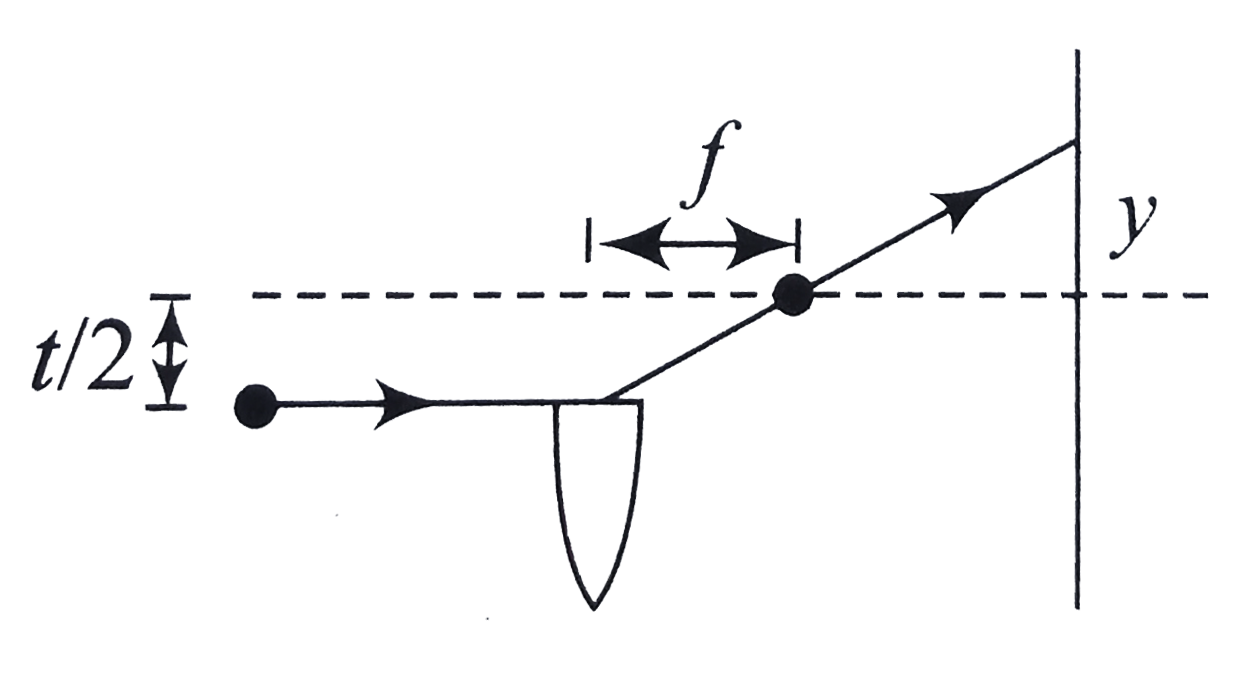
From the figure,
`(y)/(L - f) = (t // 2)/(f) implies y = (t // 2)/(f) (L - f)`
distance of the point up to which interference occurs,
`y_(0) = (t // 2)/(f) (L - f) + (t)/(2) = (tL)/(2f)`
Number of visible maxima `= (t L t)/(2 f xx lambda f) = (L t^(2))/(2 lambda f^(2))`
.
Promotional Banner

Topper's Solved these Questions

  • WAVE OPTICS

    CENGAGE PHYSICS ENGLISH|Exercise Integer|3 Videos
  • WAVE OPTICS

    CENGAGE PHYSICS ENGLISH|Exercise Archives|4 Videos
  • WAVE OPTICS

    CENGAGE PHYSICS ENGLISH|Exercise Assertion- Reasoning|13 Videos
  • SOURCES OF MAGNETIC FIELD

    CENGAGE PHYSICS ENGLISH|Exercise single correct Ansewer type|12 Videos

Similar Questions

Explore conceptually related problems

A lens of focal length f is cut along the diameter into two identical halevs. In this process, a layer of the lens t in thickness is lost, then the halves are put together to form a composite lens. In between the focal plane and the composite lens, a narrow slit is placed near the focal plane. The slit is emitting monochromatic lambda . Behind the lens, a screen is located at a distance L front it. Find the fringe width for the pattern obtained under given arrangement on the screen.

An equiconvex lens of focal length 15 cm is cut into two equal halves in thickness. What is the focal length of each half ?

A convex lens of focal length f cut into parts first horizontally and then vertically. Find the focal length of part A of the lens, as shown:

A convex lens of focal length 40 cm is in contact with a concave lens of focal length 25 cm. The power of the combination is

An object is placed at a distance f in front of a concave lens of focal length f. Locate its image.

A convex lens of focal length f is placed somewhere in between an object and a screen. The distance between the object and the screen is x . If the numerical value of the magnification produced by the lens is m , then the focal lnegth oof the lens is .

A convex lens of focal length 15 cm is placed on a plane mirror. An object is placed at 30 cm from the lens. The image is

In producing a pure spectrum, the incident light is passed through a narrow slit placed in the focal plane of an chromatic lens because a narrow slit

A convex lens of focal length A and a concave lens of focal length B are placed in contact. The focal length of the combination is

CENGAGE PHYSICS ENGLISH-WAVE OPTICS-Linked Comprehension
  1. In the arrangement shown in figure, light of wavelength 6000 Å is inci...

    Text Solution

    |

  2. A lens of focal length f is cut along the diameter into two identical ...

    Text Solution

    |

  3. A lens of focal length f is cut along the diameter into two identical ...

    Text Solution

    |

  4. In the arrangment shown in fin. For what minimum value of d is th...

    Text Solution

    |

  5. In the arrangment shown in fin. Find the distance x at which the n...

    Text Solution

    |

  6. In the arrangment shown in fin. Find the fringe width.

    Text Solution

    |

  7. Consider the situation shown in figure. The two slite S1 and S2 plac...

    Text Solution

    |

  8. Consider the situation shown in figure. The two slits S1 and S2 placed...

    Text Solution

    |

  9. Consider the situation shown in figure. The two slits S1 and S2 placed...

    Text Solution

    |

  10. The arrangement for a mirror experiment is shown in figure. S is a poi...

    Text Solution

    |

  11. The arrangement for a mirror experiment is shown in figure. S is a poi...

    Text Solution

    |

  12. The arrangement for a mirror experiment is shown in figure. S is a poi...

    Text Solution

    |

  13. Young's double-slit experiment setup with ligth of wavelength lambda =...

    Text Solution

    |

  14. Young's double-slit experiment setup with ligth of wavelength lambda =...

    Text Solution

    |

  15. Young's double-slit experiment setup with ligth of wavelength lambda =...

    Text Solution

    |

  16. An interference is observed due to two coherent sources S1 placed at o...

    Text Solution

    |

  17. An interference is observed due to two coherent sources S1 placed at o...

    Text Solution

    |

  18. The figure shows the interfernece pattern obtained in double slit expe...

    Text Solution

    |

  19. The figure shows the interfernece pattern obtained in double slit expe...

    Text Solution

    |

  20. The figure shows the interfernece pattern obtained in double slit expe...

    Text Solution

    |

