Home
Class 12
PHYSICS
A light ray travelling in glass medium i...

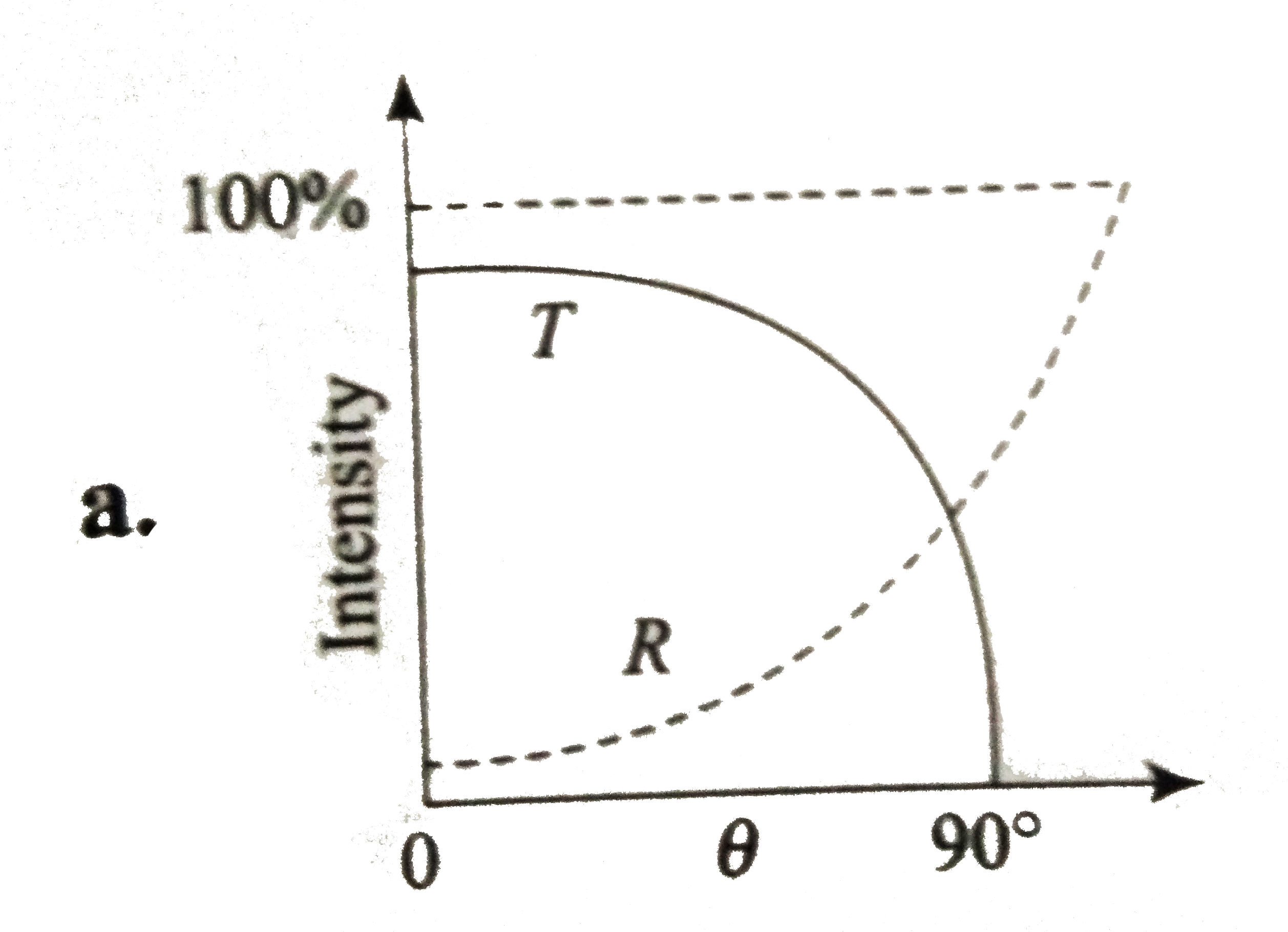
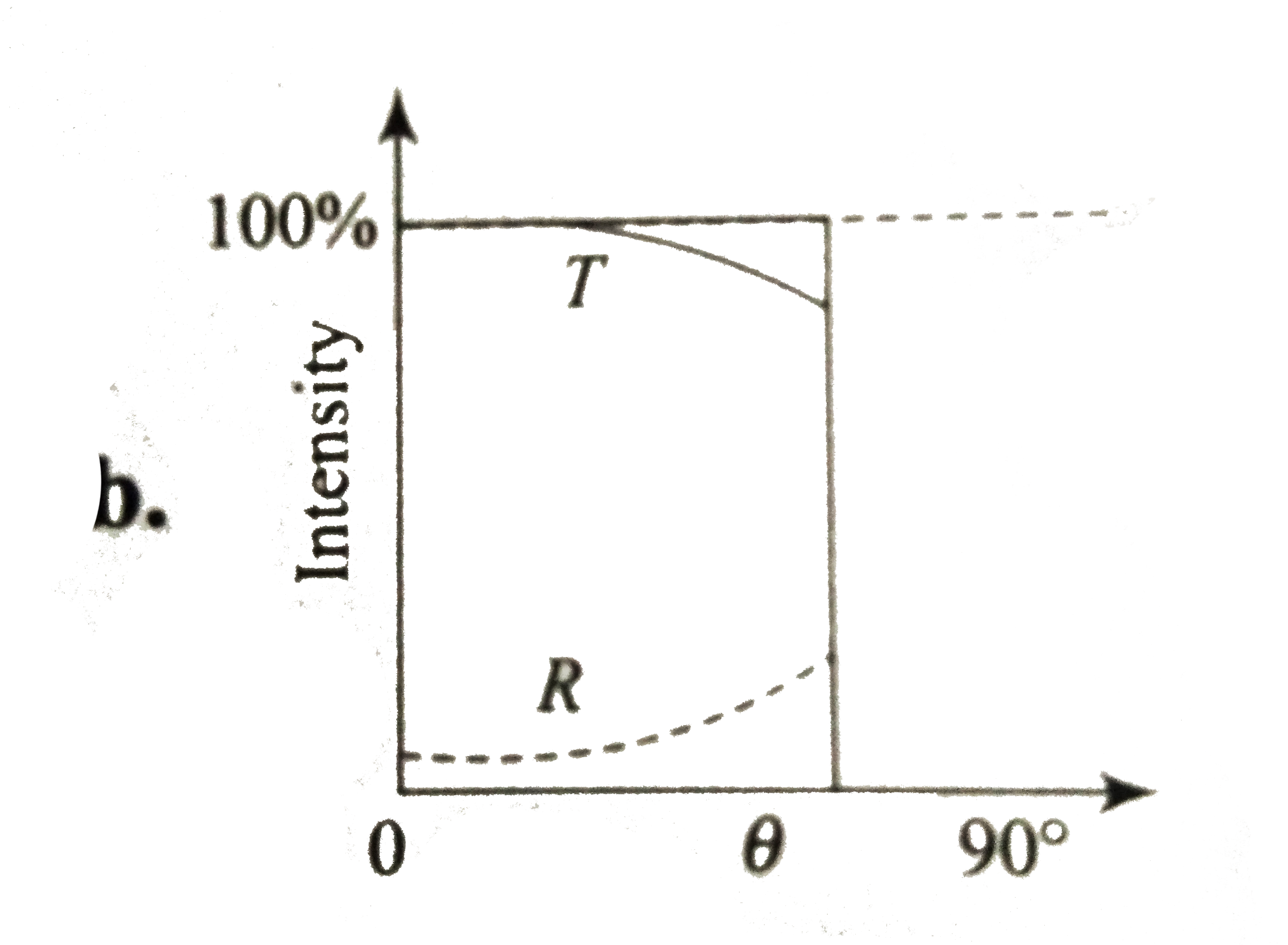
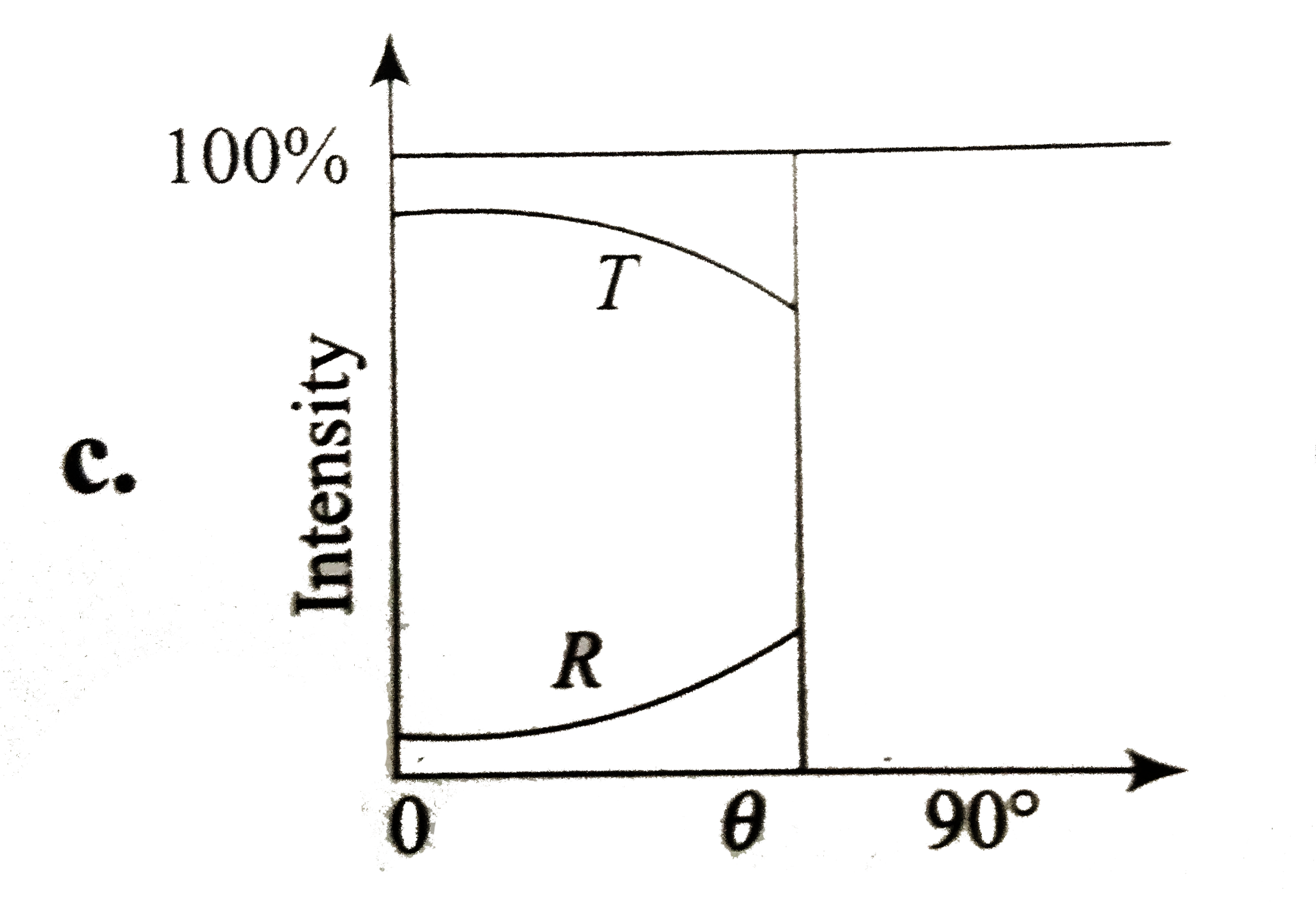
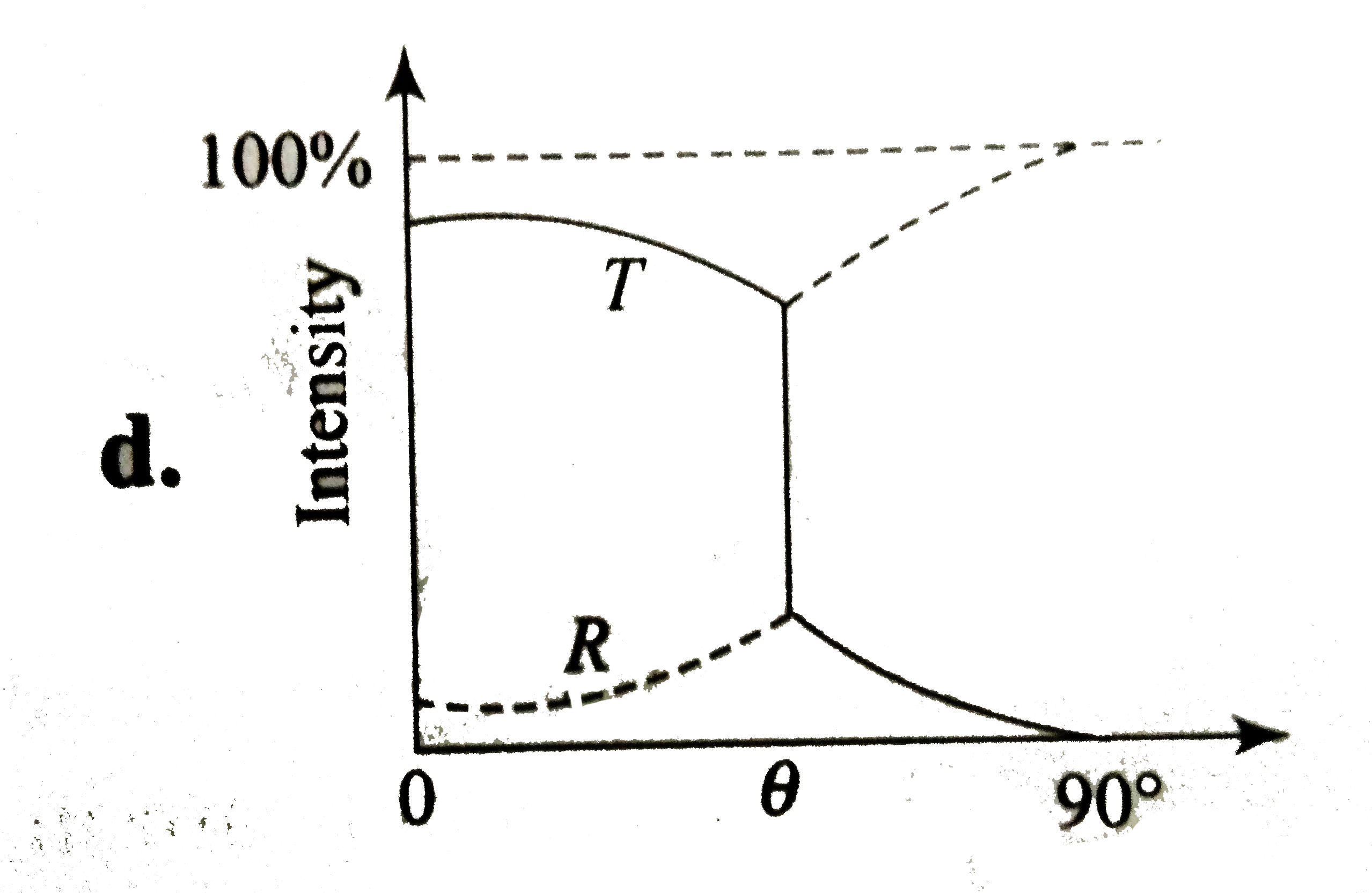
A light ray travelling in glass medium is incident of glass- air interface at an angle of incidence `theta`. The reflected `(R )` and transmitted (T) intensities, both as function of `theta`, are plotted The correct sketch is

A

B

C

D

Text Solution

Verified by Experts

The correct Answer is:
c

Initially, most of part will be transmitted. When `theta gt i_(c)`. All the light rays will be total internal reflected. So transmitted intensity = 0.
Promotional Banner

Topper's Solved these Questions

  • WAVE OPTICS

    CENGAGE PHYSICS ENGLISH|Exercise MCQ|2 Videos
  • WAVE OPTICS

    CENGAGE PHYSICS ENGLISH|Exercise Linked Comprehension type|5 Videos
  • WAVE OPTICS

    CENGAGE PHYSICS ENGLISH|Exercise True/False|2 Videos
  • SOURCES OF MAGNETIC FIELD

    CENGAGE PHYSICS ENGLISH|Exercise single correct Ansewer type|12 Videos

Similar Questions

Explore conceptually related problems

Unpolarized light is incident on a plane glass surface. The angle of incidence so that reflected and refracted rays and perpendicular to each other, then

A ray of light-is incident on glass at the polarising angle ip. Find the angle between the reflected and refracted rays.

A ray of ordinary light is travelling in air. It is incident on air glass pair at a polarising angle of 56^@ . Find the angle of refraction in glass.

A ray of light travelling in water is incident on its surface open to air. The angle of incidence is theta , which is less than the critical angle. Then there will be

Unpolarized light is incident on a plane glass surface. What should be the angle of incidence so that the reflected and refracted rays are perpendicular to eachother ?

When light travels from glass to air, the incident angle is theta_(1) and the refracted angle is theta_(2) . The true relation is

A ray of light in air is incident on a glass plate at polarising angle of incidence. It suffers a deviations of 22^(@) on entering glass. The angle of polarisation is

A ray of light is incident perpendicularly on a glass slab. The angle of incidence is 90^(0) .

Light is incident on a glass surface at polarising angle of 57.5^(@) Then the angle between the incident ray and the refracted ray is

A light ray is incident on a glass sphere at an angle of incidence 60^(@) as shown. Find the angles r, r^(1) , e and the total deviation after two refractions.

CENGAGE PHYSICS ENGLISH-WAVE OPTICS-Single correct Answer Type
  1. Monochromatic light of walelength 400nm and 560nm are incident simulta...

    Text Solution

    |

  2. In Young's double slit experiment intensity at a point is ((1)/(4)) of...

    Text Solution

    |

  3. A light ray travelling in glass medium is incident of glass- air inter...

    Text Solution

    |

  4. Young's double slit experiment is carried out by using green, red and ...

    Text Solution

    |

  5. In the Young's double slit experiment using a monochromatic light of w...

    Text Solution

    |

  6. The ratio of intensities of two waves is 9 : 1 When they superimpose, ...

    Text Solution

    |

  7. For different independent waves are represented by a) Y(1)=a(1)sin o...

    Text Solution

    |

  8. A ray of light of intensity I is incident on a parallel glass-slab at ...

    Text Solution

    |

  9. In the below diagram, CP represents a wavefront and AO and BP, the cor...

    Text Solution

    |

  10. Fig, here shows P and Q as two equally intense coherent sources emitti...

    Text Solution

    |

  11. Two point sources X and Y emit waves of same frequency and speed but Y...

    Text Solution

    |

  12. Following figures shows sources S1 and S2 that emits light of waveleng...

    Text Solution

    |

  13. Two coherent sources separated by distance d are radiating in phase ha...

    Text Solution

    |

  14. Two coherent sources S1 and S2 area separated by a distance four times...

    Text Solution

    |

  15. Three wave of equal frequency having amplitude 10 mum,4mum and 7 mum a...

    Text Solution

    |

  16. Two identical radiators have a separation of d=lambda//4 where lambda ...

    Text Solution

    |

  17. In Young's double slit experiment, if the two slits are illuminated wi...

    Text Solution

    |

  18. In Young's double slit experiment if monochromatic light is replaced b...

    Text Solution

    |

  19. In the set up shown in figure, the two slits S1 and S2 are not equidis...

    Text Solution

    |

  20. The maximum intensity of fringes in Young's experiment is I. If one of...

    Text Solution

    |

