Home
Class 12
PHYSICS
Most materials have the refractive index...

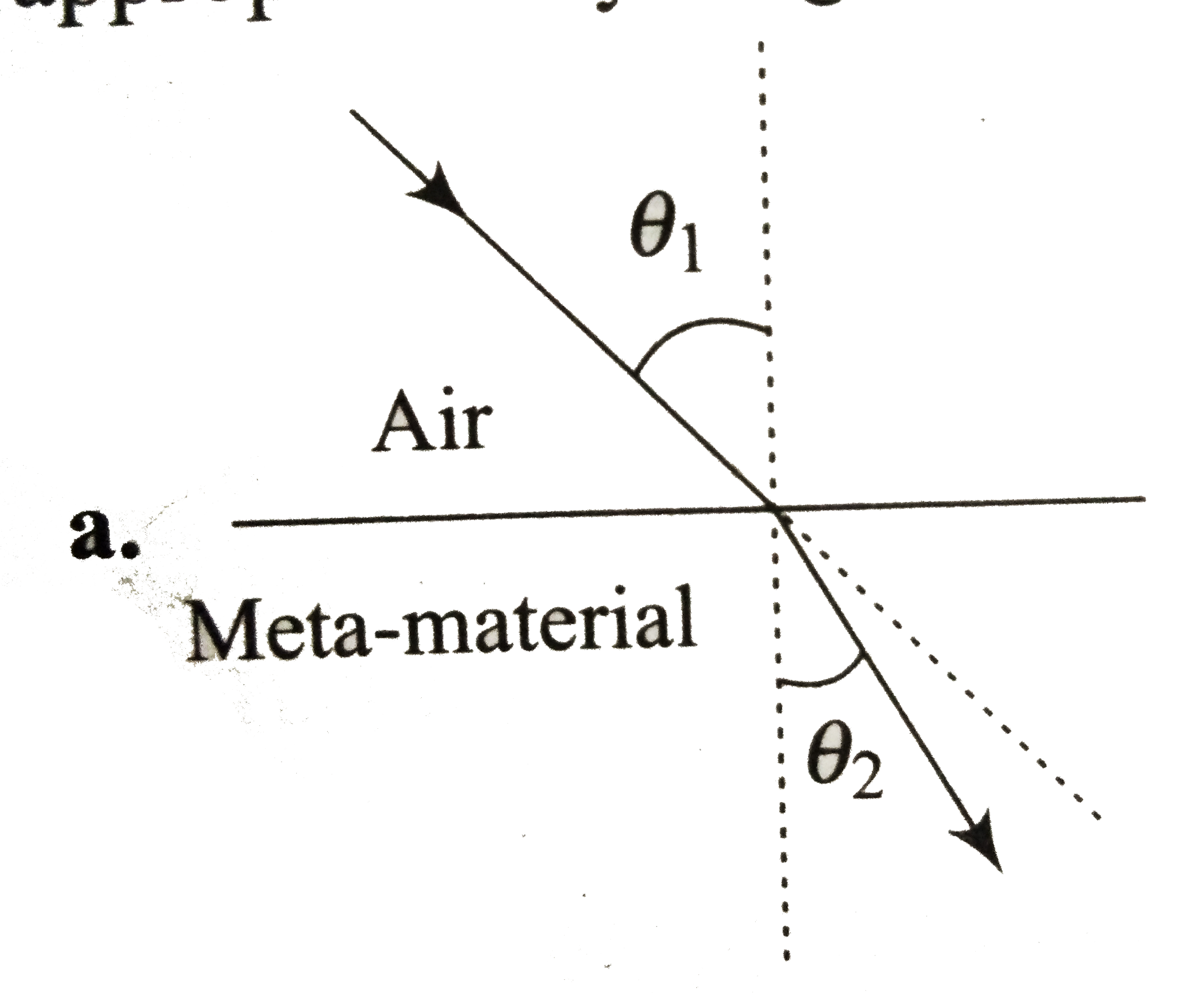
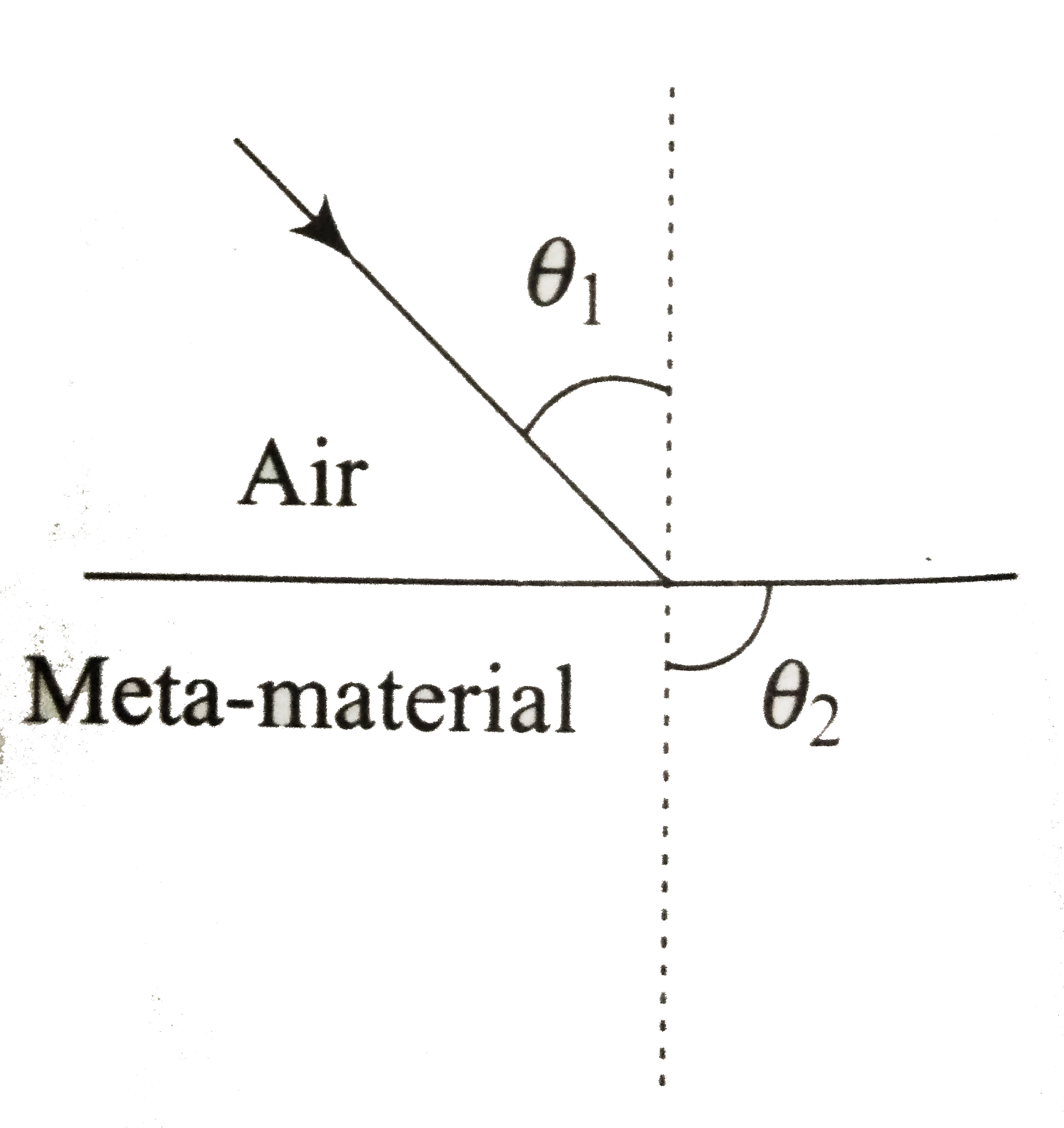
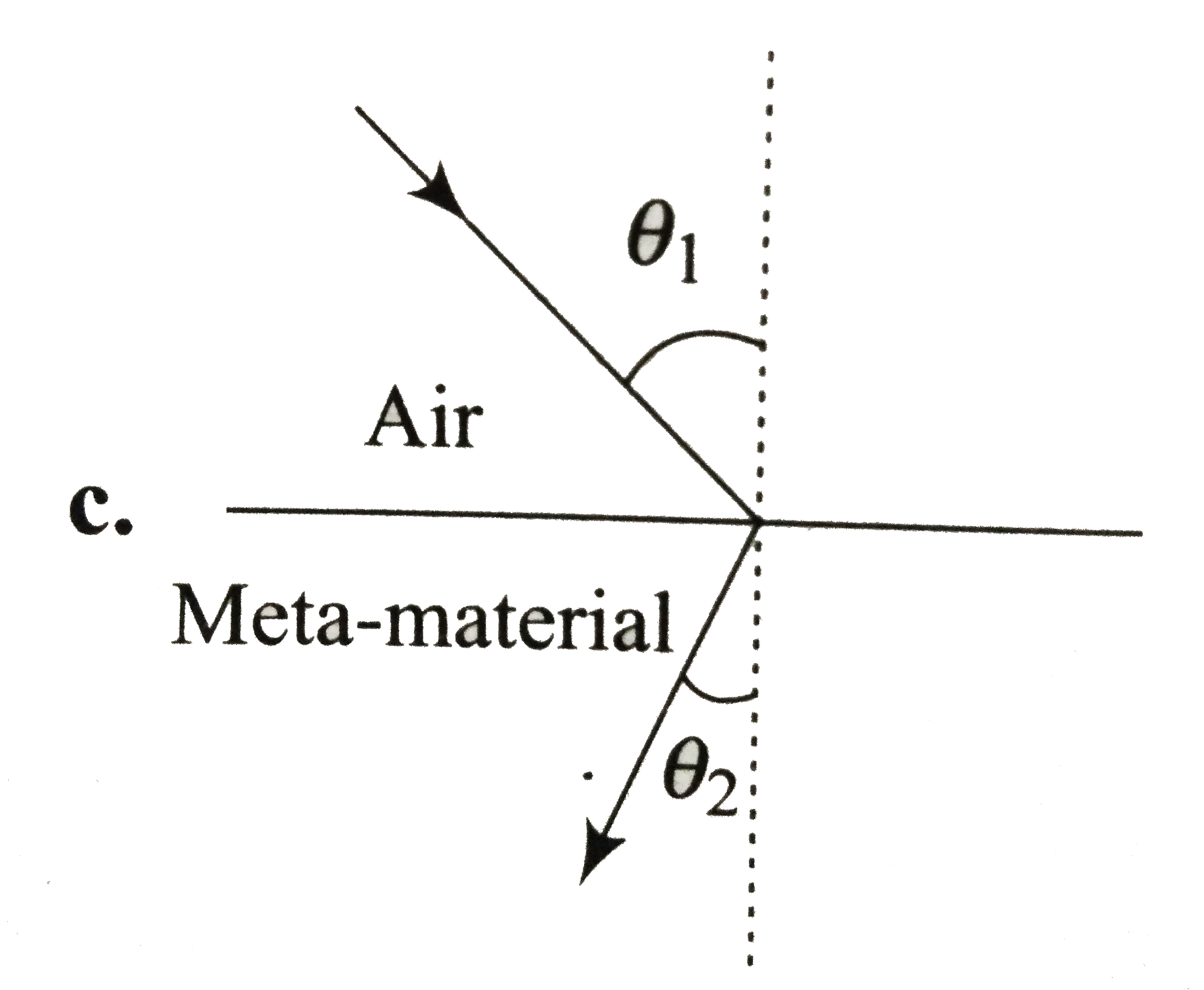
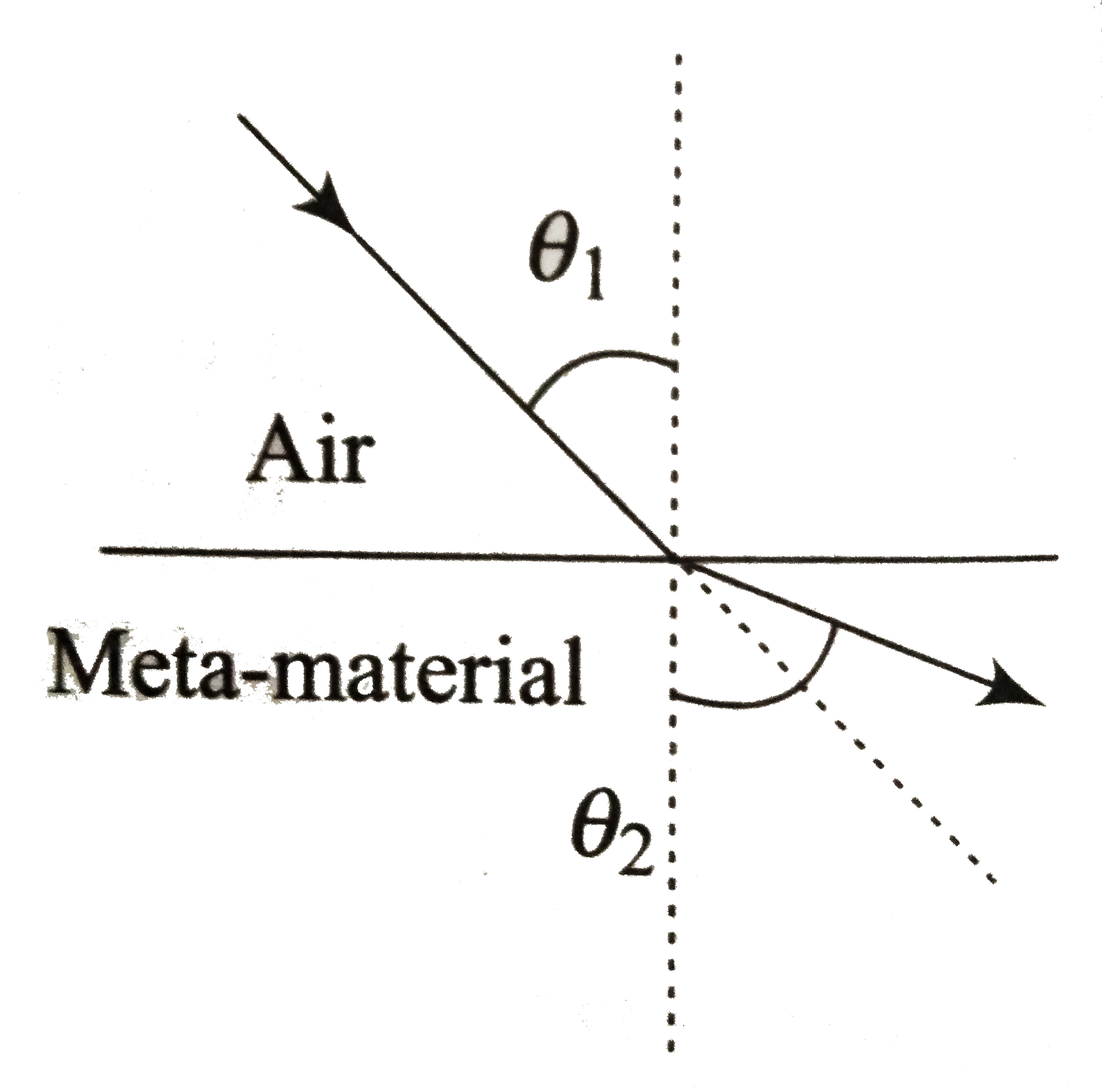
Most materials have the refractive index, `n gt 1`. So, when a light ray from air enters a naturally occuring material, then by Snell's law, `(sin theta_(1))/(sin theta_(2)) = (n_(1))/(n_(2))`, it is understood that the refracted ray bends towards the normal. But it never emerges on the same side of the normal as the incident ray. According to electromagnetism, the refractive index of the medium is given by the relation, `n = (c // v) = +- sqrt(epsilon_(r ), mu_(r ))`, where `c` is the speed of the electromagnetic waves in vacuum, `v` its speed in the medium, `epsilon_( r)` and `mu_( r)` are negative, one must choose the negative root of `n`. Such negative refractive index materials can now be artifically prepared and are called meta-materials. They exhibit significantly different optical behaviour, without violating any physical laws. Since `n` is negative, it results in a change in the direction of propagation of the refracted light. However, similar to normal materials, the frequency of light remains unchanged upon refraction even in meta-materials.
Answer the following questions :
For light incident from air on a meta-material, the appropriate ray diagram is

A

B

C

D

Text Solution

AI Generated Solution

The correct Answer is:

To solve the problem of determining the direction of the refracted ray when light passes from air into a metamaterial with a negative refractive index, we can follow these steps: ### Step 1: Understand Snell's Law Snell's law states that: \[ \frac{\sin \theta_1}{\sin \theta_2} = \frac{n_1}{n_2} \] where: - \( \theta_1 \) is the angle of incidence, - \( \theta_2 \) is the angle of refraction, - \( n_1 \) is the refractive index of the first medium (air, which is approximately 1), - \( n_2 \) is the refractive index of the second medium (metamaterial, which is negative). ### Step 2: Substitute Values Since the refractive index of air \( n_1 = 1 \) and the refractive index of the metamaterial \( n_2 < 0 \), we can rewrite Snell's law: \[ \sin \theta_2 = \frac{n_1 \sin \theta_1}{n_2} = \frac{\sin \theta_1}{n_2} \] Since \( n_2 \) is negative, this means: \[ \sin \theta_2 = \frac{\sin \theta_1}{n_2} < 0 \] This implies that \( \theta_2 \) must be negative. ### Step 3: Analyze the Implications A negative angle for \( \theta_2 \) indicates that the refracted ray is bending away from the normal. In typical scenarios where \( n_2 > 1 \), the light bends towards the normal, but in this case, since \( n_2 \) is negative, the light will bend in the opposite direction. ### Step 4: Draw the Ray Diagram 1. Draw the boundary between air and the metamaterial. 2. Draw the incident ray coming from air at an angle \( \theta_1 \) towards the boundary. 3. Since \( \theta_2 \) is negative, draw the refracted ray on the opposite side of the normal, indicating that it is bending away from the normal. ### Step 5: Identify the Correct Ray Diagram From the options provided, the correct ray diagram will show the refracted ray bending away from the normal, indicating that it is in the opposite direction compared to the incident ray. ### Conclusion The correct option for the ray diagram is the one that shows the refracted ray bending away from the normal. ---

To solve the problem of determining the direction of the refracted ray when light passes from air into a metamaterial with a negative refractive index, we can follow these steps: ### Step 1: Understand Snell's Law Snell's law states that: \[ \frac{\sin \theta_1}{\sin \theta_2} = \frac{n_1}{n_2} \] where: ...
Promotional Banner

Topper's Solved these Questions

  • WAVE OPTICS

    CENGAGE PHYSICS ENGLISH|Exercise Matching Column Type|2 Videos
  • WAVE OPTICS

    CENGAGE PHYSICS ENGLISH|Exercise Comprehension Type|14 Videos
  • WAVE OPTICS

    CENGAGE PHYSICS ENGLISH|Exercise MCQ|2 Videos
  • SOURCES OF MAGNETIC FIELD

    CENGAGE PHYSICS ENGLISH|Exercise single correct Ansewer type|12 Videos
