Home
Class 12
PHYSICS
A source of light of power P is shown in...


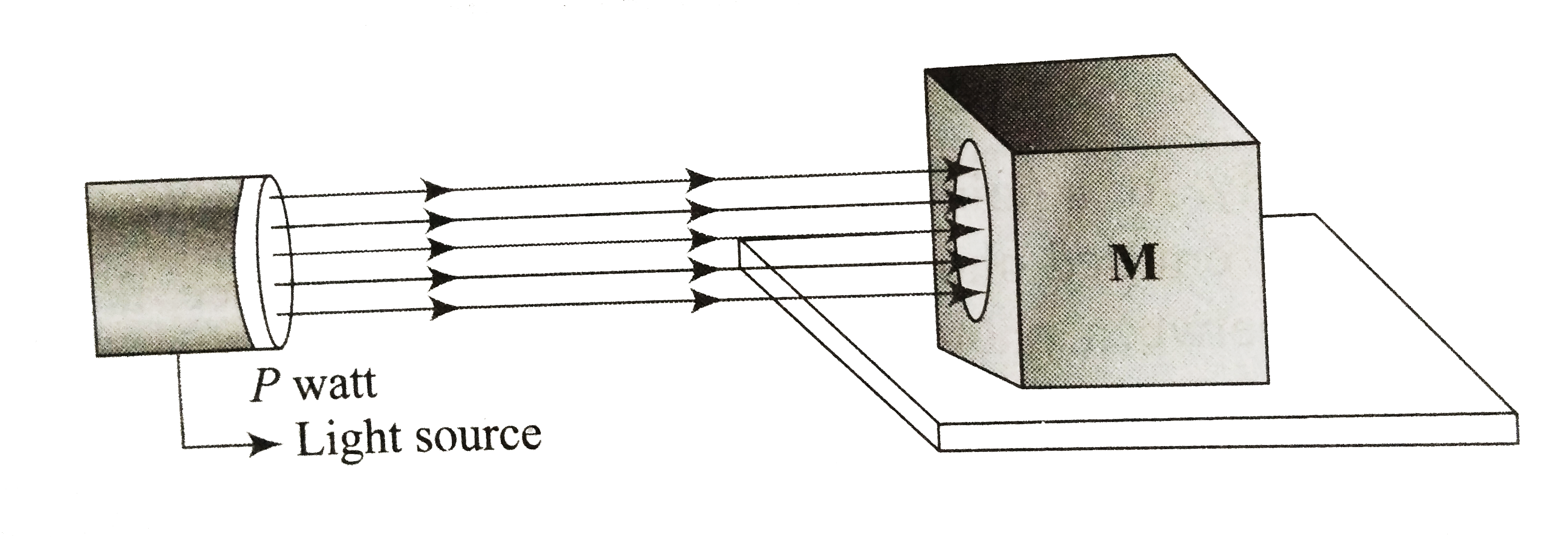
A source of light of power P is shown in Fig. 3.6. Find the force on the block placed in the path of the light rays. The surface of body on which the light beam is incident is having a reflection coefficient `a_r=0.7` and absorption coefficient `a_a=0.3`.

Text Solution

Verified by Experts

In this case `70%` of the incident photons are reflected back and `30%` are absorbed by the body. Thus, the photon which is absorbed will impart a momentum `(h)/(lamda)` to the body and the photon which is reflected will impart the change in momentum `(2h)/(lamda)` to the body. Thus, the net force acting on body can be given as
`F=(0.7Plamda)/(hc)xx(2h)/(lamda)+(0.3Plamda)/(hc)xx(h)/(lamda)`
`F=(1.7P)/(c)`
Promotional Banner

Topper's Solved these Questions

  • PHOTOELECTRIC EFFECT

    CENGAGE PHYSICS ENGLISH|Exercise Examples|8 Videos
  • PHOTOELECTRIC EFFECT

    CENGAGE PHYSICS ENGLISH|Exercise Exercise 3.1|15 Videos
  • NUCLEAR PHYSICS

    CENGAGE PHYSICS ENGLISH|Exercise ddp.5.5|14 Videos
  • RAY OPTICS

    CENGAGE PHYSICS ENGLISH|Exercise DPP 1.6|12 Videos

Similar Questions

Explore conceptually related problems

If the absorption coefficient and reflection coefficient of a surface of a body are 0.4 and 0.6 respectively then:-

A point source of light is placed at a distance h below the surface of a large deep lake.What is the percentage of light energy that escapes directly form the water surface if mu of the water= 4//3 ?(neglet partial reflection)

A light ray is incident at an angle of 45^@ with the normal to a sqrt2 cm thick plate (mu=2.0) . Find the shift in the path of the light as it emerges out from the plate.

A force of 200N is applied as shown in the figure on block of 3 kg. The coefficient of friction between the block and the wall is 0.3. Find the friction acting on the block. (in N) {Take g = 10 m//s^(2)

A ray of light is falling on a glass sphere of mu=sqrt(3) such that the incident ray and the emergent ray, when produced, intersect at a point on the surface of the sphere. Find the value of angle of incidence.

A light ray is incident normally on the face AB of a right-angled prism ABC (mu==1.50) as shown in figure. What is the largest angle phi for which the light ray is totally reflected at the surface AC ?

Consider a light beam incident from air to a glass slab at Brewster's angle as shown in figure. A polaroid is placed in the path of the emergent ray at point P and rotated about an axis passing through the centre and pependicular to the plane of the polaroid.

A cubical block of glass of refractive index n_1 is in contact with the surface of water of refractive index n_2. A beam of light is incident on vertical face of the block. After refraction a total internal reflection at the base and refraction at the opposite face take place. The ray emerges at angle theta as shown. The value of theta is given by

A beam of light from the point A(3,10) reflects from the line 2x+y-6=0 and then passes through the point B(5, 6).The equation of reflected beam is :

A beam of light from the point A(3,10) reflects from the line 2x+y-6=0 and then passes through the point B(5, 6).The equation of reflected beam is :
