Home
Class 12
PHYSICS
A totally reflecting, small plane mirror...

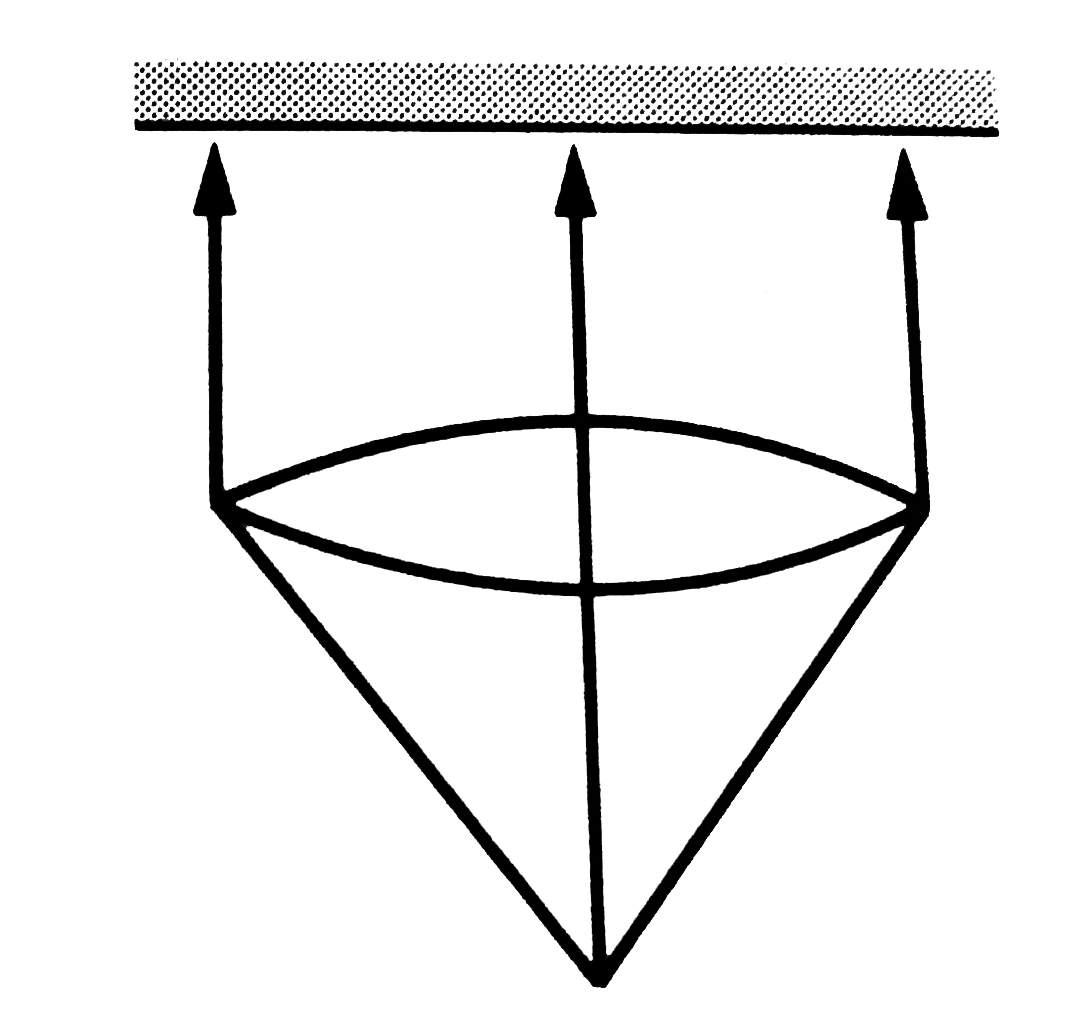
A totally reflecting, small plane mirror placed horizontally faces a parallel beam of lighy as shown in figure. The mass of the mirror is 20g. Assume that there is no absorption in the lens and that 30% of the light emitted by the source goes through the lens. Find the power of the source needed to support the weight of the mirror. Take ` g= 10 m s^-2. `

Text Solution

Verified by Experts

Let n photons (each of frequency f) per second are emitted from source. Then power of source is `P=nhf`
But on `30%` of the photons go towards mirror. The force exerted on mirror is
`F=2[(30)/(100)n](h)/(lamda)=(3)/(5)(nhf)/(c)=(3)/(5)(P)/(c)`
and this force should be equal weight of mirror, so
`(3)/(5)(P)/(c)=20xx10^(-3)g`
`impliesP=(5xx3xx10^(8)xx20xx10^(-3)xx10)/(3)=10^(8)W`
Promotional Banner

Topper's Solved these Questions

  • PHOTOELECTRIC EFFECT

    CENGAGE PHYSICS ENGLISH|Exercise Single Correct Answer Type|7 Videos
  • PHOTOELECTRIC EFFECT

    CENGAGE PHYSICS ENGLISH|Exercise Multiple Correct Answers Type|7 Videos
  • PHOTOELECTRIC EFFECT

    CENGAGE PHYSICS ENGLISH|Exercise Linked Comprehension|44 Videos
  • NUCLEAR PHYSICS

    CENGAGE PHYSICS ENGLISH|Exercise ddp.5.5|14 Videos
  • RAY OPTICS

    CENGAGE PHYSICS ENGLISH|Exercise DPP 1.6|12 Videos

Similar Questions

Explore conceptually related problems

A totally reflecting small plane mirror placed horizontally faces a parallel beam of light as shown in the figure. The mass of the mirror is 200 g. Assume that there is no absorption in the lens and that 20% of the light emitted by the source goes through the lens. The power of the source needs to support the weight of the mirror is P xx 10^(8) watt, where P is [take g = 10 ms^(-2) ]

A thin equiconvex lens made of glass of refractive index 3//2 and of focal length 0.3m in air is sealed into an opening at one end of a tank filled with water (mu=(3)/(2)) . On the opposite side of the lens, a mirror is placed inside the tank on the tank wall perpendicular to the lens axis as shown in Figure. The separation between the lens and mirror is 0.8m. A small object is placed outside the tank in front of the lens at a distance oa 0.9m from the lens along its axis. Find the position (relative to lens) of the image of the object formed by the system.

A converging lens and a diverging mirror are placed at a separation of 20 cm. The focal length of the lens is 30 cm and that of the mirror is 50 cm. Where should a point source be placed between the lens and the miror, so that the light, after getting reflected by the mirror and then getting transmitted by the lens, comes out parallel to the principal axis?

The block of mass m is being pulled by a horizontal force F=2 mg applied to a string as shown in figure (Take g=10(m)/(s^2) ). The pulley is massless and is fixed at the edge of an immovable table. What is the value of force exerted by the supporting table on the pulley (in Newton)

The block of mass m is being pulled by a horizontal force F=2 mg applied to a string as shown in figure (Take g=10(m)/(s^2) ). The pulley is massless and is fixed at the edge of an immovable table. What is the value of force exerted by the supporting table on the pulley (in Newton)

A source of light is located at double focal length from a convergent lens. The focal length of the lens is f=30cm. At what distance from the lens should a flat mirror be placed, so that the rays reflected from the mirror are parallel after passing through the lens for the second time?

In the figure shown a thin parallel beam of light is incident on a plane mirror m_(1) at small angle 'theta' . m_(2) is a concave mirror of focal length 'f' . After three successive reflefctions of this beam the x and y coordinates of the image is

A balloon is rising up along the axis of a concave mirror of radius of curvature 20 m A ball is dropped from the balloon at a height 15m from the mirror when the balloon has velocity 20m//s .Find the speed of the image of the ball formed by concave mirror after 4 seconds[take: g=10m//s^(2) ]

An equiconvex lens, f_(1)=10cm , is placed 40 cm in front of a concave mirror, f_(2)=7.50cm as shown in Figure ., An object 2 cm high is placed 20cm to the left of the lens . Find the position of the final image is formed when leftward travelling rays once again pass through the lens. Find overall magnification.

A small block of mass 'm' is kept on the smooth inclined plane of angle 37^@) , placed in an elevator going upward with acceleration a=g/3 , as shown in the figure. A horizontal electric field E perpendicular to the left and right vertical wall of the elevator exists. The charge on the block is +q . Find the time (in sec) when the block collide with the vertical wall. (take g=10m//s^(2) and (qE)/m=25m//s^(2) )
