Home
Class 12
PHYSICS
In a photoelectric experiment anode pote...

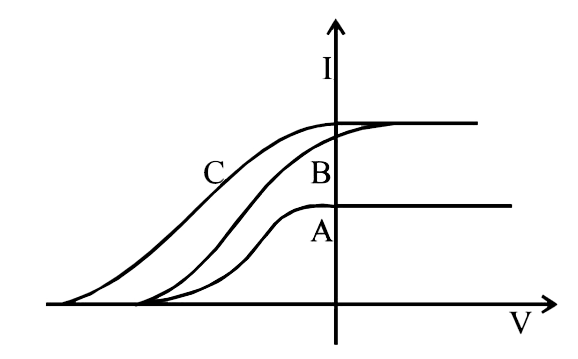
In a photoelectric experiment anode potential is ploted against plate current.

A

A nd B will have different while B and C will have different frequencies

B

B and C will have different intensities while A and C will have different frequencies

C

A and B will have different intensities while A and C will have equal frequencies

D

A and B will have equal intensities while B and C have different frequencies

Text Solution

Verified by Experts

The correct Answer is:

D

From the graph, it is clear that A and B have the same stopping potential and therefore the same frequency. Also, B and C have the same intensity.
Promotional Banner

Topper's Solved these Questions

  • PHOTOELECTRIC EFFECT

    CENGAGE PHYSICS ENGLISH|Exercise Multiple Correct Answers Type|7 Videos
  • PHOTOELECTRIC EFFECT

    CENGAGE PHYSICS ENGLISH|Exercise Linked Comprehension Type|3 Videos
  • PHOTOELECTRIC EFFECT

    CENGAGE PHYSICS ENGLISH|Exercise Integer|9 Videos
  • NUCLEAR PHYSICS

    CENGAGE PHYSICS ENGLISH|Exercise ddp.5.5|14 Videos
  • RAY OPTICS

    CENGAGE PHYSICS ENGLISH|Exercise DPP 1.6|12 Videos

Similar Questions

Explore conceptually related problems

In a photoelectric experiment , the stopping potential V_s is plotted against the frequency v of the incident light . The resulting curve is a straight line which makes an angle theta with the v - axis. Then tan theta will be equal to (Here E_0 = work function of the surface_

In a photoelectric experiment, if stopping potential is applied, then photocurrent becomes zero. This means that:

Variation of photoelectric current with anode potential

In photoelectric effect, stopping potential depends on

In photoelectric effect experiment potential difference between plates increases keeping incident light on cathode plate remains unchanged which of the following is correct about saturation current :

In a photoelectric experiment the relation between applied potential difference between cathode and anode V and the photoelectric current cathode and anode V and the photoelectric current l and was found to be shown in graph below. If planck's constant h=6.6xx10^(-34) Js, the frequency of incident radiation would be nearly (in s^(-1) )

In a photoelectric experiment, kinetic energy of photoelectrons was plotted against the frequency of incident radition (v) , as show in figure. Which of the following statements is correct ?

In a photoelectric experiment, the collector plate is at 2.0V with respect to the emitter plate made of copper (phi)=4.5eV) . The emitter is illuminated by a source of monochromatic light of wavelength 2000 Å nm.

In a photoelectric experiment, the collector plate is at 2.0 V with respect to the emitter plate made of copper phi = 4.5 . The emitter is illuminated by a source of monochromatic light of wavelength 200nm. Find the minimum and maximum kinetic energy of the photoelectrons reaching the collector.

The graph between photo electric current and cathode potential when the anode is kept at zero potential, for light of two different intensities out of the same frequency looks like the one:
