Home
Class 12
PHYSICS
(a)Find the wavelength of the radiation ...

(a)Find the wavelength of the radiation required to excited the electron is `Li^(++)` from the first to the third Bohr orbit (b) How many spectral lines are obseved in the emission spactrum of the above excited system?

Text Solution

Verified by Experts
The energy of the electron in nth orbit of hydrogen-like atom is
`E_(n_ = - (Z^(2) R h c)/(n^(2))` Here , `Z = 3`
and `R h c = 13.6 e V`
a. The energy required to excite the electron in `Li^(++)` from `(n = 1)` to `(n = 3)` is
` E_(3) - E_(1) = - (Z^(2) R h c)/(3^(2)) - ((-Z^(2) R h c)/(1^(2)))`
`= Z^(2) R h c ( 1 - (1)/(9))`
`(8)/(9) = Z^(2) R h c = (8)/(9) xx (3)^(2) xx 13.6 e V`
`= 8 xx 13.6 e V = 8 xx 13.6 xx 1.6 xx 10^(-19) J`

Therefore , the wavelength of incidiation radition required for excitation is given by
`(h c)/(lambda) = E_(3) - E_(1)`
or `lambda = (h c)/(E_(3) - E_(1)) = (6.63 xx 10^(-34) xx 3 xx 10^(8))/(8 xx 13.6 xx 1.6 xx 10^(-19))`
`= 114.26 xx 10^(-10) m - 114.26 Å`
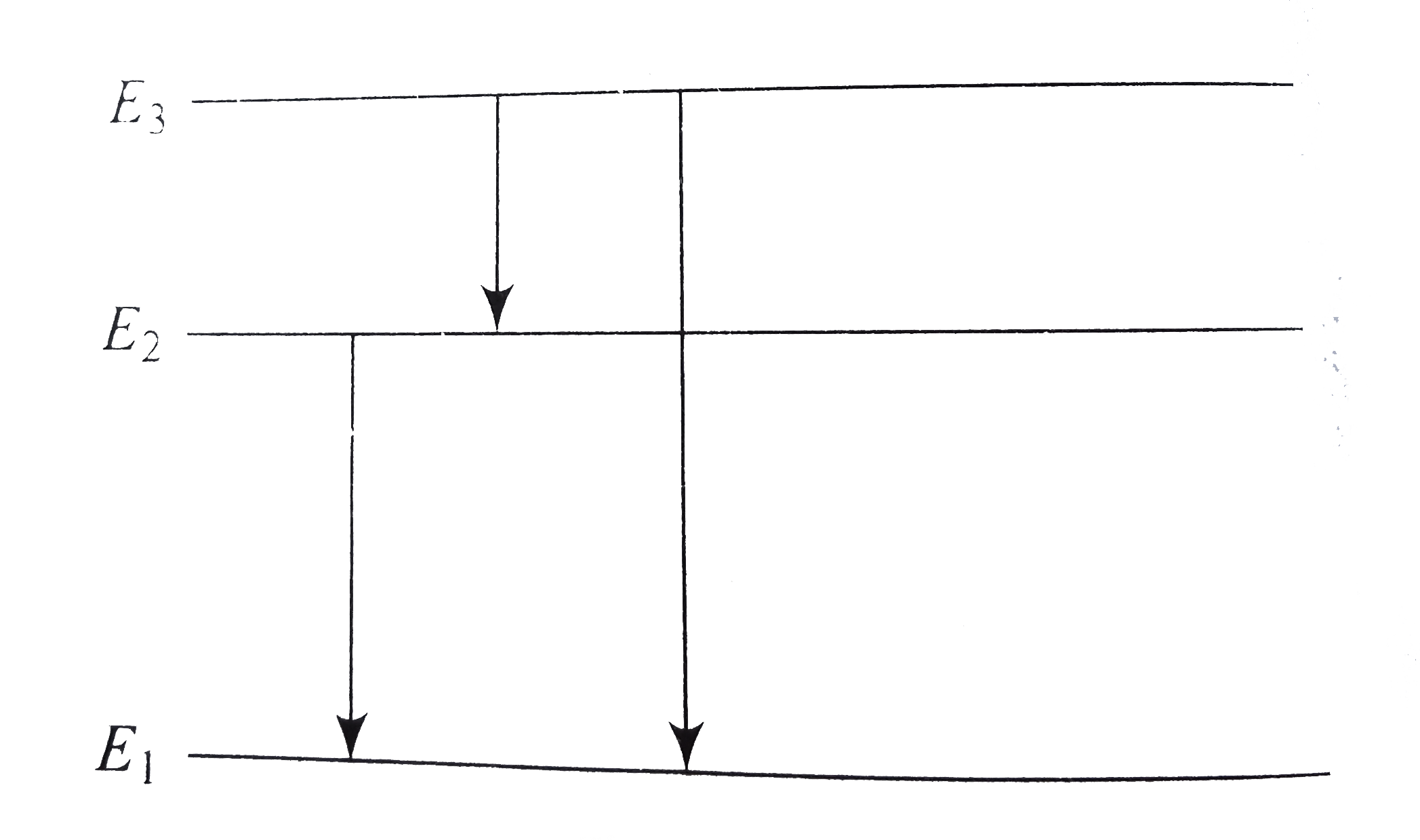
b. The possible lines in the emission spectrum of this excited system are `[(n n - 1)/(2) = 3 (3 - 1)/(2) = 3]`
Three in number , represented in figure.
Promotional Banner

Topper's Solved these Questions

  • ATOMIC PHYSICS

    CENGAGE PHYSICS ENGLISH|Exercise Exercise 4.1|15 Videos
  • ATOMIC PHYSICS

    CENGAGE PHYSICS ENGLISH|Exercise Exercise 4.2|12 Videos
  • ATOMIC PHYSICS

    CENGAGE PHYSICS ENGLISH|Exercise ddp.4.3|15 Videos
  • ALTERNATING CURRENT

    CENGAGE PHYSICS ENGLISH|Exercise Single Correct|10 Videos
  • CAPACITOR AND CAPACITANCE

    CENGAGE PHYSICS ENGLISH|Exercise Integer|5 Videos

Similar Questions

Explore conceptually related problems

Energy required for the electron excitation in Li^(++) from the first to the third Bohr orbit is:

A doubly ionized lithium atom is hydrogen like with atomic number 3. Find the wavelength of the radiation required to excite the electron in Li^(++) from the first to the third Bohr orbit (ionization energy of the hydrogen atom equals 13.6 eV).

A doubly ionized lithium atom is hydrogen like with atomic number 3. Find the wavelength of the radiation required to excite the electron in Li^(++) from to the third Bohr orbit (ionization energy of the hydrogen atom equals 13.6 eV).

Find the wavelength of radiation required to excite an electron in the ground levelll of Li^(2+) (z = 3) in the third energy level

A doubly ionized lithium atom is hydrogen like with atomic . number 3. Find the wavelength of the radiation to excite the electron in . Li++ form the first to the third Bohr orbit. The ionization energy of the hydrogen . Atom is 13.6V.

The wavelength of the radiation emitted when an electron falls from Bohr 's orbit 4 to 2 in H atom is

The ratio of the energy required to remove an electron from the first three Bohr's orbit of Hydrogen atom is

A single electron orbit around a stationary nucleus of charge + Ze where Z is a constant and e is the magnitude of the electronic charge. It requires 47.2 eV to excite the electron from the second bohr orbit to the third bohr orbit. Find (i) The value of Z (ii) The energy required by nucleus to excite the electron from the third to the fourth bohr orbit (iii) The wavelength of the electronmagnetic radiation required to remove the electron from the first bohr orbit to inlinity (iv) The energy potential energy potential energy and the angular momentum of the electron in the first bohr orbit (v) The radius of the first bohr orbit (The ionization energy of hydrogen atom = 13.6 eV bohr radius = 5.3 xx 10^(-11) matre velocity of light = 3 xx 10^(8) m//sec planks 's constant = 6.6 xx 10^(-34) jules - sec )

What will be the wavelength of radiation released in nano-metre when an electron drops from the 5th Bohr orbit to 2nd Bohr orbit in hydrogen atom?

A single electron orbits a stationary nucleus of charge + Ze , where Z is a constant and e is the magnitude of electronic charge . It requires 47.2 eV to excite electron from second Bohr orbit to third Bhor orbit . Find a the value of Z b the energy required to excite the electron from the third to the fourth Bohr orbit. c. the wavelength of electromagnetic rediation required to remove the electron from the first Bohr orbit to infinity. d Find the KE,PE , and angular momentum of electron in the first Bohr orbit. e. the redius of the first Bohr orbit [The ionization energy of hydrogen atom = 13.6 eV Bohr radius = 5.3 xx 10^(_11) m , "velocity of light" = 3 xx 10^(-8)jm s ^(-1) , Planck's constant = 6.6 xx 10^(-34)j - s]

CENGAGE PHYSICS ENGLISH-ATOMIC PHYSICS-Solved Examples
  1. A single electron orbit around a stationary nucleus of charge + Ze whe...

    Text Solution

    |

  2. The ionization energy of a hydrogen like bohr atom is 4 Rydbergs (i) W...

    Text Solution

    |

  3. (a)Find the wavelength of the radiation required to excited the electr...

    Text Solution

    |

  4. The energy of an electron in an excited hydrogen atom is - 3.4 e V. Ca...

    Text Solution

    |

  5. Light of wavlength of 2000 A falls on an aluminimum surface. In alumin...

    Text Solution

    |

  6. Find the frequency of light which ejects electrons from a metal surfac...

    Text Solution

    |

  7. A 40 W ultraviolet light source of wavelength 2480 A. Illuminates a ma...

    Text Solution

    |

  8. Hydrogen atom is ground state is excited by mean of monochromatic radi...

    Text Solution

    |

  9. A gas of identical hydrogen-like atoms has some atoms in the lowest in...

    Text Solution

    |

  10. The wavelength of the characteristic X - ray k(alpha ) line emitted by...

    Text Solution

    |

  11. Light form a dicharge tube containing hydrogen atoms falls on the surf...

    Text Solution

    |

  12. Two hydrogen-like atoms A and B are of different masses and each atom ...

    Text Solution

    |

  13. a. A stopping potential of 0.82V is required to stop the emission of p...

    Text Solution

    |

  14. An electron in the ground state of hydrogen atom is revolving in antic...

    Text Solution

    |

  15. The radiation emitted when an electron jumps from n=3 to n=2 orbit of ...

    Text Solution

    |

  16. An electron, in a hydrogen like atom , is in excited state. It has a t...

    Text Solution

    |

  17. Assume that the de-Broglie were associated with an electron can form a...

    Text Solution

    |

  18. A gas of hydrogen like ions is prepared in such a way that ions are on...

    Text Solution

    |

  19. Photoelectrons are emitted when 400 nm radiation is incident on a surf...

    Text Solution

    |

  20. When a beam of 10.6 eV photons of intensity 2.0 W//m^(2) falls on a pl...

    Text Solution

    |

