Home
Class 12
PHYSICS
A gas of hydrogen like ions is prepared ...

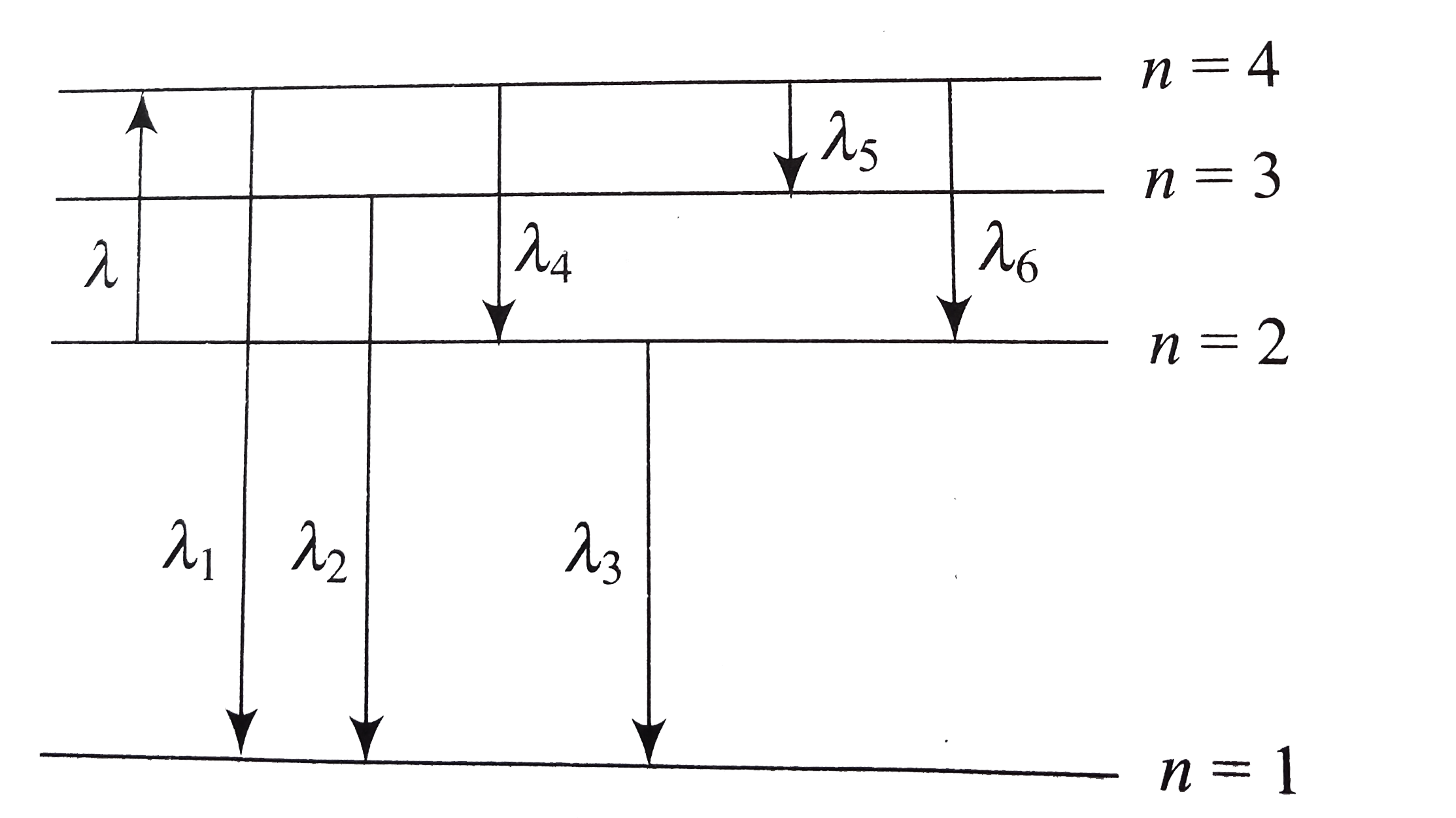
A gas of hydrogen like ions is prepared in such a way that ions are only in the ground state and the first excited state. A monochromatic light of wavelength 1216 Å is absorbed by the ions. The ions are lifted to higher excited states and emit radiations of six wavelengths. Find the principal quantum number of the final excited state.

Text Solution

Verified by Experts
The energy state of hydrogen-like atom is given by
`E_(n) = - (B)/(n^(2))`
where `B = Z^(2) Rhc`.
The emission of six wavelength implies that the higher excited state corresponds to quantum number `n = 4` . As some wavelength are lower and some wavelength are higher , it implies that the initial excited state is `n = 2` . Thus the principal quantum number of excited states are `n = , n = 3, n = 4`.

`:.(hc)/(lambda) = B ((1)/(2^(2)) - (1)/(4^(2))) implies (hc)/(lambda) = (3 B)/(16)`
`:. B = (1.6 xx 6.62 xx 10^(-34) xx 3 xx 10^(8))/(3 xx (1216 xx 10^(-10))`
`= 8.71 xx 10^(-18)J`
If `Z` is atimic number of necleus, then `B = Z^(2) Rhc`
`:. Z^(2) = (B)/(Rhc) = (8.17 xx 10^(-18)J)/(13.6 xx 1.6 xx 10^(-19) = 4`
`:. Z = 2`
The maximum wavelength of emitted redition corresponds to transition `n = 4 to n = 3` and is given by
`(hc)/(lambda _(max)) = B ((1)/(3^(2)) - (1)/(4^(2)))`
`implies lambda _(max) = (144 hc)/(7 B) = (144 xx 6.62 xx 10^(-34) xx 3 xx 10^(8))/(7 xx 8.71 xx 10^(-18))`
`= 4.69 xx 10^(-7) m`
The minimum wavelength of emitted rediction corresponds to transition `n = 4 to n = 1` and is given by
`(hc)/(lambda _(max)) = B ((1)/(1^(2)) - (1)/(4^(2)))`
`implies lambda _(max) = (16 hc)/(15 B) = (16 xx 6.62 xx 10^(-34) xx 3 xx 10^(8))/(15 xx 8.71 xx 10^(-18))`
`= 0.2 xx 10^(-7) m`
Promotional Banner

Topper's Solved these Questions

  • ATOMIC PHYSICS

    CENGAGE PHYSICS ENGLISH|Exercise Exercise 4.1|15 Videos
  • ATOMIC PHYSICS

    CENGAGE PHYSICS ENGLISH|Exercise Exercise 4.2|12 Videos
  • ATOMIC PHYSICS

    CENGAGE PHYSICS ENGLISH|Exercise ddp.4.3|15 Videos
  • ALTERNATING CURRENT

    CENGAGE PHYSICS ENGLISH|Exercise Single Correct|10 Videos
  • CAPACITOR AND CAPACITANCE

    CENGAGE PHYSICS ENGLISH|Exercise Integer|5 Videos

Similar Questions

Explore conceptually related problems

A gas of hydrogen - like ion is perpendicular in such a way that ions are only in the ground state and the first excite state. A monochromatic light of wavelength 1216 Å is absorved by the ions. The ions are lifted to higher excited state and emit emit radiation of six wavelength , some higher and some lower than the incident wavelength. Find the principal quantum number of the excited state identify the nuclear charge on the ions . Calculate the values of the maximum and minimum wavelengths.

When a hydrogen atom is excited from ground state to first excited state, then

A gaseous excited hydrogen-like species with nuclear charge Z can emit radiations of six different photon energies. The principal quantum number of the excited state is :

An excited state of H atom emits a photon of wavelength lamda and returns in the ground state. The principal quantum number of excited state is given by:

A He^(+) ion is in its first excited state. Its ionization energy is

A gas of hydrogen like ions is prepared in a particular excited state A. if emit photons having wavelength equal to the wavelength of the first line of the lyman series together with photons of five other wavelength identify the gas and find the principal quantum number of the state A

If He^(+) ion is in its first excited state then its ionization energy is

Hydrogen atom from excited state comes to the ground state by emitting a photon of wavelength lambda . If R is the Rydberg constant, then the principal quatum number n of the excited state is

Hydrogen atom in its ground state is excited by means of monochromatic radiation of wavelength 975A^(@) . How many different lines are possible in the resulting spectrum? Calculate the longest wavelength amongst them.

The energy of an atom or ion in the first excited state is -13.6 eV. It may be

CENGAGE PHYSICS ENGLISH-ATOMIC PHYSICS-Solved Examples
  1. (a)Find the wavelength of the radiation required to excited the electr...

    Text Solution

    |

  2. The energy of an electron in an excited hydrogen atom is - 3.4 e V. Ca...

    Text Solution

    |

  3. Light of wavlength of 2000 A falls on an aluminimum surface. In alumin...

    Text Solution

    |

  4. Find the frequency of light which ejects electrons from a metal surfac...

    Text Solution

    |

  5. A 40 W ultraviolet light source of wavelength 2480 A. Illuminates a ma...

    Text Solution

    |

  6. Hydrogen atom is ground state is excited by mean of monochromatic radi...

    Text Solution

    |

  7. A gas of identical hydrogen-like atoms has some atoms in the lowest in...

    Text Solution

    |

  8. The wavelength of the characteristic X - ray k(alpha ) line emitted by...

    Text Solution

    |

  9. Light form a dicharge tube containing hydrogen atoms falls on the surf...

    Text Solution

    |

  10. Two hydrogen-like atoms A and B are of different masses and each atom ...

    Text Solution

    |

  11. a. A stopping potential of 0.82V is required to stop the emission of p...

    Text Solution

    |

  12. An electron in the ground state of hydrogen atom is revolving in antic...

    Text Solution

    |

  13. The radiation emitted when an electron jumps from n=3 to n=2 orbit of ...

    Text Solution

    |

  14. An electron, in a hydrogen like atom , is in excited state. It has a t...

    Text Solution

    |

  15. Assume that the de-Broglie were associated with an electron can form a...

    Text Solution

    |

  16. A gas of hydrogen like ions is prepared in such a way that ions are on...

    Text Solution

    |

  17. Photoelectrons are emitted when 400 nm radiation is incident on a surf...

    Text Solution

    |

  18. When a beam of 10.6 eV photons of intensity 2.0 W//m^(2) falls on a pl...

    Text Solution

    |

  19. An electron in hydrogen-like atom makes a transition from nth orbit or...

    Text Solution

    |

  20. An X-ray tube operated at 40 k V emits a continous X-ray spectrum with...

    Text Solution

    |

