Home
Class 12
PHYSICS
A charged particle of mass m and charge ...

A charged particle of mass m and charge q is accelerated through a potential difference of V volts. It enters a region of uniform magnetic field which is directed perpendicular to the direction of motion of the particle. Find the radius of circular path moved by the particle in magnetic field.

Text Solution

Verified by Experts
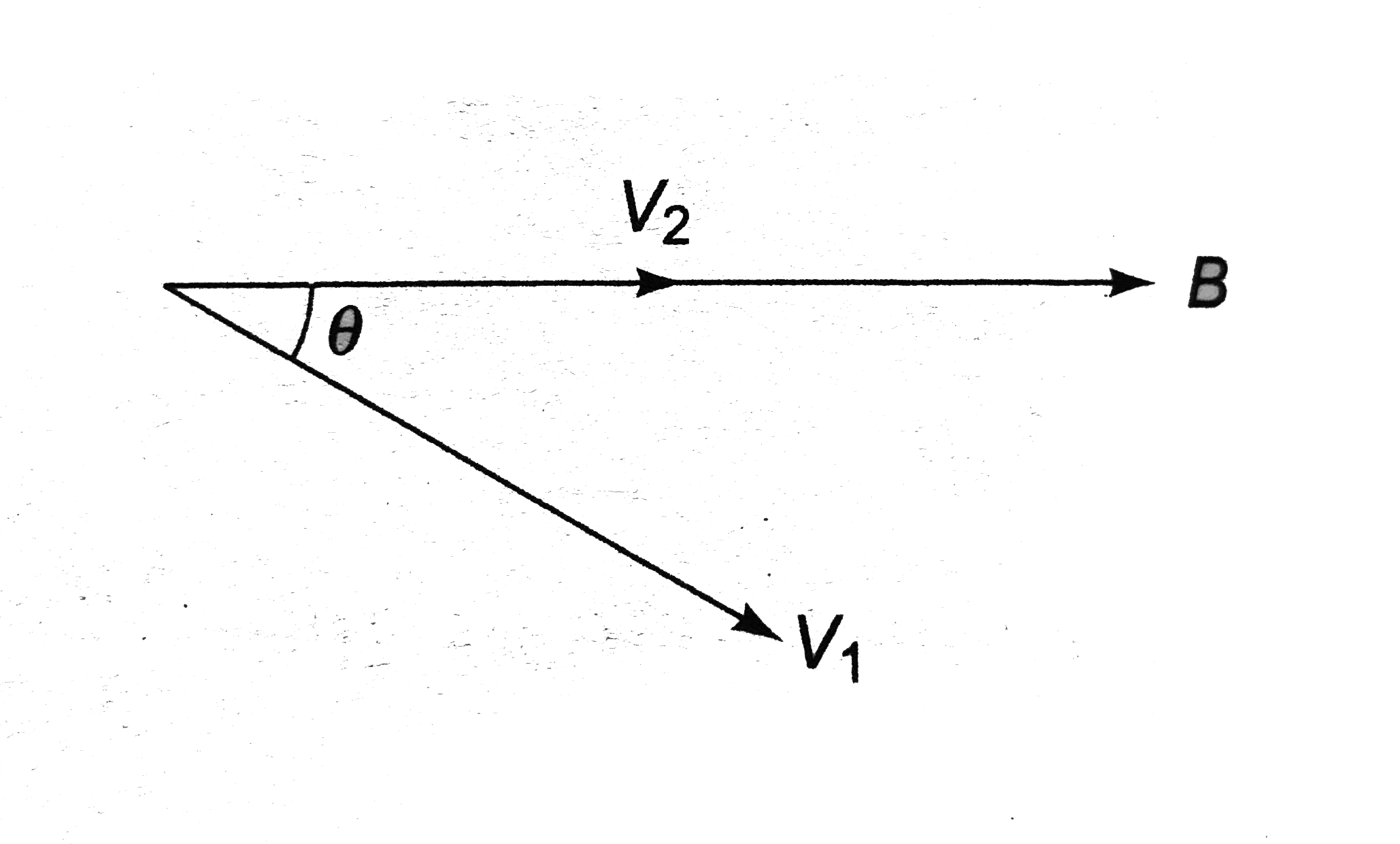
`qV=1/2mv_1^2 implies v_1 =sqrt((2qV)/m)`
To meet them again and again:
`v_2=v_1cos theta=sqrt((2qV)/m) cos theta`

Time interval : `T=(2pim)/(qB)`
Distance after which they meet=1pitch=`v_2T`
`=sqrt((2qV)/m)cos thetaxx(2pim)/(qB)=pisqrt((8Vm)/(qB^2))cos theta`
Promotional Banner

Topper's Solved these Questions

  • MAGNETIC FIELD AND MAGNETIC FORCES

    CENGAGE PHYSICS ENGLISH|Exercise Exercise 1.2|13 Videos
  • MAGNETIC FIELD AND MAGNETIC FORCES

    CENGAGE PHYSICS ENGLISH|Exercise Exercise1.3|14 Videos
  • MAGNETIC FIELD AND MAGNETIC FORCES

    CENGAGE PHYSICS ENGLISH|Exercise Solved Example|25 Videos
  • INDUCTANCE

    CENGAGE PHYSICS ENGLISH|Exercise Concept Based|8 Videos
  • MISCELLANEOUS VOLUME 3

    CENGAGE PHYSICS ENGLISH|Exercise True and False|3 Videos

Similar Questions

Explore conceptually related problems

A charged particle of mass m and charge q is accelerated through a potential differences of V volts. It enters of uniform magnetic field B which is directed perpendicular to the direction of motion of the particle. The particle will move on a circular path of radius

A proton and an alpha -particle, accelerated through same potential difference, enter a region of uniform magnetic field with their velocities perpendicular to the field. Compare the radii of circular paths followed by them.

A particle of mass m carrying charge q is accelerated by a potential difference V. It enters perpendicularly in a region of uniform magnetic field B and executes circular arc of radius R, then q/m equals

An electron of mass m and charge e is accelerated by a potential difference V. It then enters a uniform magnetic field B applied perpendicular to its path. The radius of the circular path of the electron is

A charged particle, having charge q_(1) accelerated through a potential difference V enters a perpendicular magnetic field in which it experiences a force F. It V is increased to 5V, the particle will experience a force

A proton, a deutron and an alpha particle, after being accelerated through the same potential difference enter a region of uniform magnetic field vecB , in a direction perpendicular to vecB . Find the ratio of their kinetic energies. If the radius of proton's circular path is 7cm , what will be the radii of the paths of deutron and alpha particle?

A proton and alpha - particle are accelerated with same potential difference and they enter in the region of constant magnetic field B perpendicular to the velocity of particles. Find the ratio of radius of curvature of alpha - particle .

An electron of mass 'm' is accelerated through a potential difference of V and then it enters a magnetic field of induction B . Normal to the lines of force. Then the radius of the circular path is

A particle of mass m and charge q is accelerated by a potential difference V volt and made to enter a magnetic field region at an angle theta with the field. At the same moment, another particle of same mass and charge is projected in the direction of the field from the same point. Magnetic field induction is B. What would be the speed of second particle so that both particles meet again and again after regular interval of time. Also, find the time interval after which they meet and the distance travelled by the second particle during that interval.

A particle of mass m and charge q is accelerated by a potential difference V volt and made to enter a magnetic field region at an angle theta with the field. At the same moment, another particle of same mass and charge is projected in the direction of the field from the same point. Magnetic field induction is B. What would be the speed of second particle so that both particles meet again and again after regular interval of time. Also, find the time interval after which they meet and the distance travelled by the second particle during that interval.

CENGAGE PHYSICS ENGLISH-MAGNETIC FIELD AND MAGNETIC FORCES-Exercise 1.1
  1. A positive charge particle of charge q and mass m enters into a unifor...

    Text Solution

    |

  2. Repeat above Question 3, if the charge is negative and the angle made ...

    Text Solution

    |

  3. A uniform mangetic field of strength B exists in a region of width d. ...

    Text Solution

    |

  4. In Fig. what should be the speed of the charged particle so that it ca...

    Text Solution

    |

  5. A charged particle enters a region which offers a resistance against i...

    Text Solution

    |

  6. An electron moves in a uniform magnetic field and follows a spiral pat...

    Text Solution

    |

  7. A charged particle moves in a gravity free space where an electric fie...

    Text Solution

    |

  8. A particle with charge -5.60 nC is moving in a uniform magnetic field ...

    Text Solution

    |

  9. A particle with charge 7.00 mu C is moving with velocity vec v =- (4xx...

    Text Solution

    |

  10. A particle with charge 6.40 xx 10^(-19) C travels in a circular orbit...

    Text Solution

    |

  11. Figure 1.31 shows the trace of the path of a charged particle in a bub...

    Text Solution

    |

  12. A charged particle of mass m and charge q is accelerated through a pot...

    Text Solution

    |

  13. A beam of equally charged particles after being accelerated through a ...

    Text Solution

    |

  14. A proton and an alpha particle are projected in a magnetic field which...

    Text Solution

    |

  15. A beam of singly ionized atoms of carbon (each charge +e) all have the...

    Text Solution

    |

  16. When a proton has a velocity v=(2hati+3hat)xx10^(6)ms^(-1), ti exper...

    Text Solution

    |

  17. The force on a charged particle moving in a magnetic field can be comp...

    Text Solution

    |

  18. A particle of charge qgt0 is moving at speed v in the +z direction thr...

    Text Solution

    |

  19. Protons having a kinetic energy of 50 eV are moving in the positive x-...

    Text Solution

    |

  20. Electrons in a beam are accelerated from rest through a potential diff...

    Text Solution

    |

