Home
Class 12
PHYSICS
In a trapeze-shaped structure, two rigid...

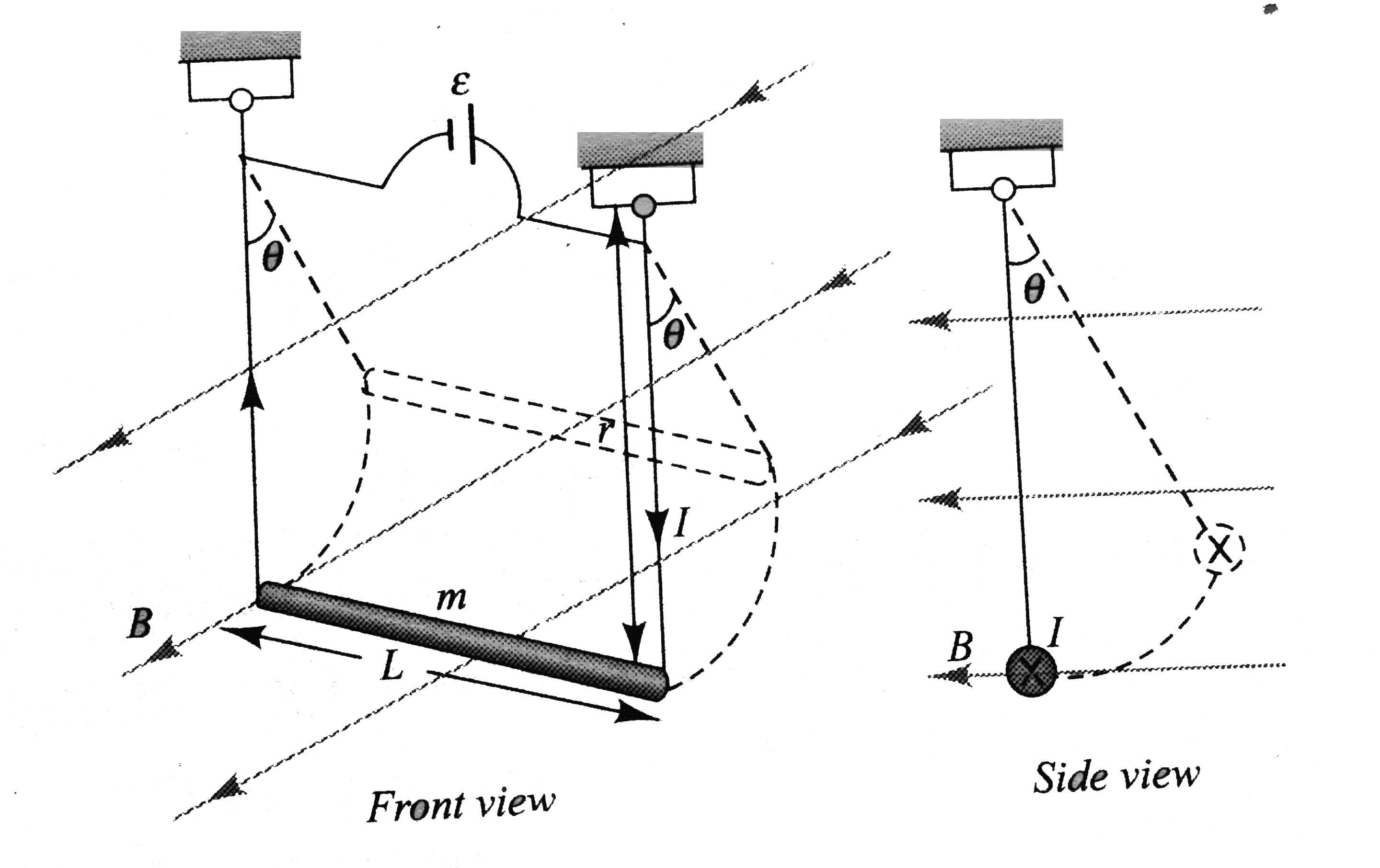
In a trapeze-shaped structure, two rigid wires of negligble mass support a conducting bar of mass m and length L as shown in Fig. A source of emf is applied to the wires so that a current I flows through the bar. A uniform magnetic field `vec B` is perpendicular to the plane of the wires and bar.
a. Compute the current that the source of emf must provide so that there is no tension in the wires.
b. If the current is reduced to half the value computed in (a) and the plane of the structure is moved through an angle `theta`, compute the tension in the wires and the magnitude of the net unbalanced force on the bar at the instant it is released from this angle.

Text Solution

Verified by Experts

The correct Answer is:
(a) `i=(mg)/(LB)` ; (b) `T=(mg)/4 cos theta; F_("net")=(mg)/2 cos theta`

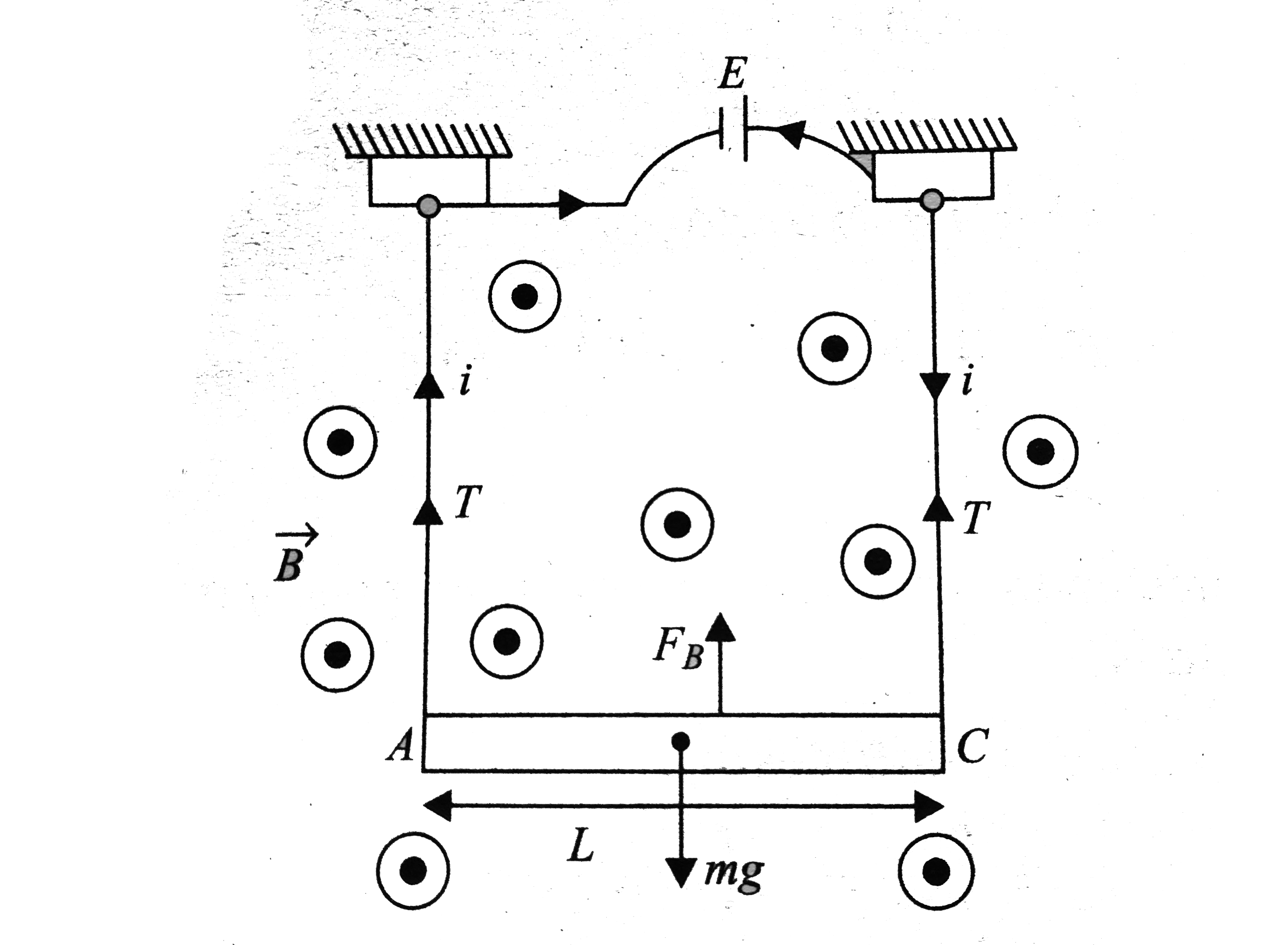
(a) Writing torque equation about A
`vectau=(mg-F_B)L/2-TL`
Since the rod is in equilibrium, there is no torque in vertical
directio.
`implies TL=1/2(mg-F_B)`
For wires to be tension free, `T=0`
`implies F_B=mg implies iLB implies mg implies i=(mg)/(LB)`

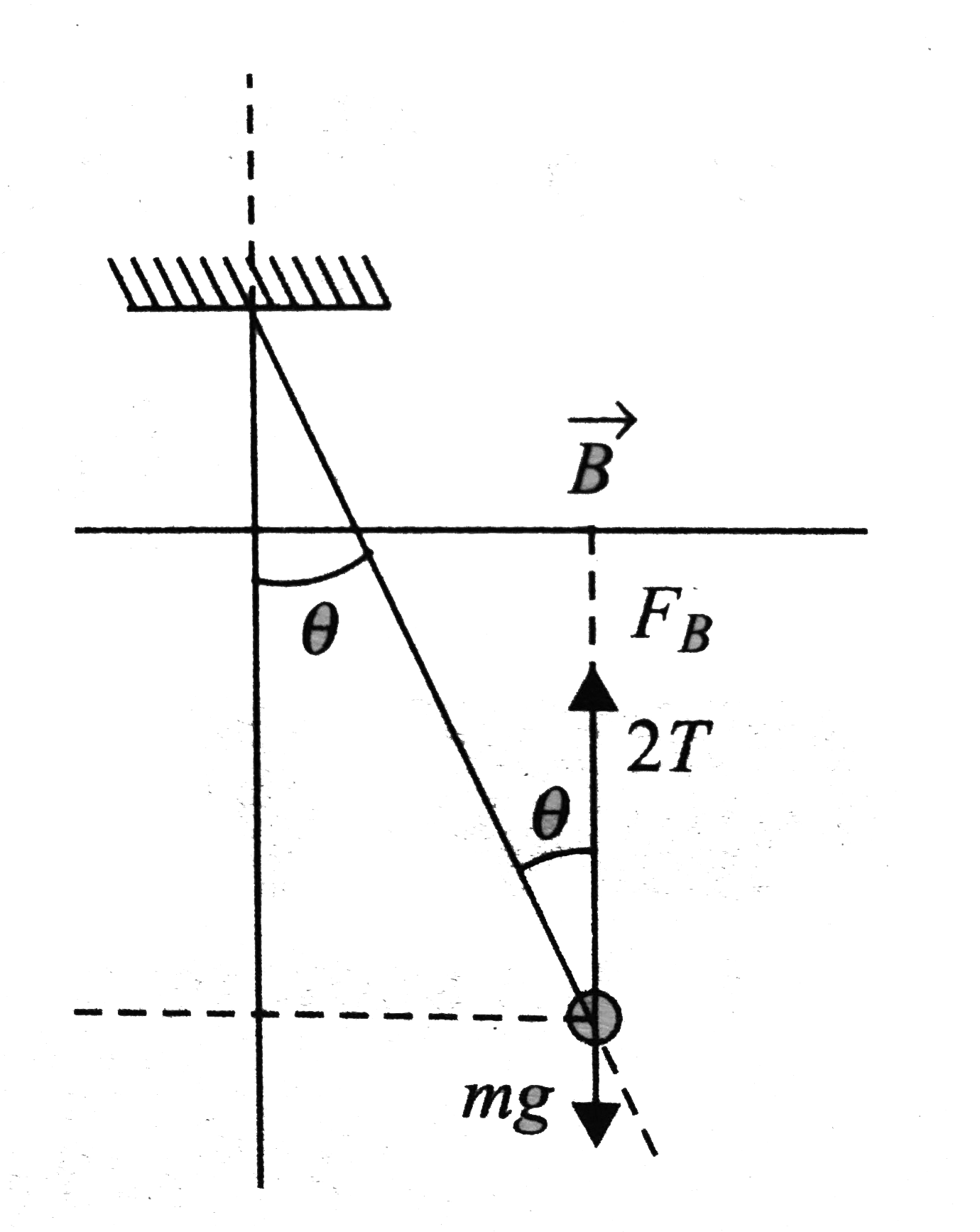
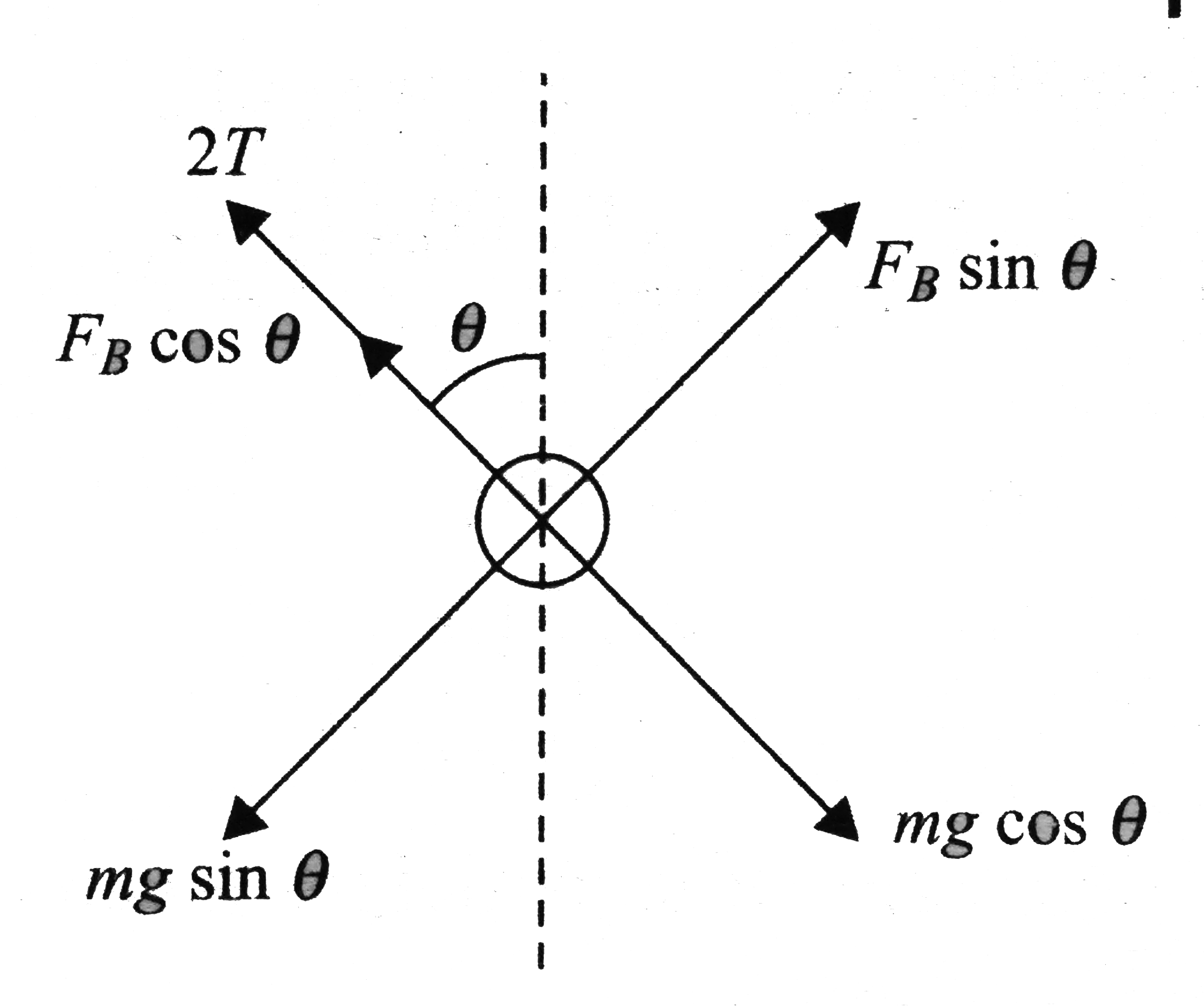
(b) If the wire is in equilibrium, the forces acting on it are as shown in Fig.
`i=(mg)/(2LB) :. F_B=1/2mg`
For tension in the wire, `2T+F_B cos`
`theta=mg cos theta`
`T=(mg)/4 cos theta`
Net unbalanced force on the rod will be in the direction perpendicular to the wire

`F_(n et)=mgsin theta-F_B sin theta`
`F_(n et) =(mg)/2 cos theta`
.
Promotional Banner

Topper's Solved these Questions

  • MAGNETIC FIELD AND MAGNETIC FORCES

    CENGAGE PHYSICS ENGLISH|Exercise Exercises Single Correct|70 Videos
  • MAGNETIC FIELD AND MAGNETIC FORCES

    CENGAGE PHYSICS ENGLISH|Exercise Exercises Multiple Correct|25 Videos
  • MAGNETIC FIELD AND MAGNETIC FORCES

    CENGAGE PHYSICS ENGLISH|Exercise Exercise1.3|14 Videos
  • INDUCTANCE

    CENGAGE PHYSICS ENGLISH|Exercise Concept Based|8 Videos
  • MISCELLANEOUS VOLUME 3

    CENGAGE PHYSICS ENGLISH|Exercise True and False|3 Videos

Similar Questions

Explore conceptually related problems

A circular loop of wire is carring a current i (as shown in the figure). On applying a uniform magnetic field inward perpendicular to the plane of the loop, the loop

In the circuit shown in Fig. A conducting wire HE is moved with a constant speed v towards left. The complete circuit is placed in a uniform magnetic field vec(B) perpendicular to the plane of circuit inwards. The current in HKDE is

In the circuit shown in Fig. A conducting wire HE is moved with a constant speed v towards left. The complete circuit is placed in a uniform magnetic field vec(B) perpendicular to the plane of circuit inwards. The current in HKDE is

a conducting wire os mass m slides down two smooth conducting bars, set at an angle theta to the horizontal as shown in . The separatin between the bars is l . The system is located in the magnetic field B , perpendicular to the plane of the sliding wire and bars. The constant velocity of the wire is

Prove that the force acting on a current carrying wire, joining two fixed points a and b in a uniform magnetic field, is independent of the shape of the wire.

A wire cd of length l and mass m is sliding without friction on conducting rails ax and by as shown. The verticle rails are connected to each other with a resistance R between a and b . A uniform magnetic field B is applied perpendicular to the plane abcd such that cd moves with a constant velocity of

A unifrom conducting wire ABC has a mass of 10g . A current of 2 A flows through it. The wire is kept in a unifrom magnetic field B = 2T . The accleration of the wire will be

A loop of irregular shape of conducting wire PORS (as shown in figure) placed in a uniform magnetic field perpendicular to the plane of the paper changes into a circular shape. The direction of induced current will be

A horizontal wire is free to slide on the verticle rails of a conducting frame as shown in figure. The wire has a mass m and length l and the resistance of the circuit is R . If a uniform magnetic field B is directed perpendicular to the frame, the terminal speed of the wire as it falls under the force of gravity is

The magnetic field at the origin due to the current flowing in the wire is