Home
Class 12
PHYSICS
A particle of specific charge alpha is p...

A particle of specific charge `alpha` is projected from origin with velocity `v=v_0hati-v_0hatk` in a uniform magnetic field `B=-B_0hatk`. Find time dependence of velocity and position of the particle.

A

`vecv(t)=v_0cos (alphaB_0t)hati+v_0sin(alphaB_0t)hatj-v_0hatk`

B

`vecv(t)=-v_0cos (alphaB_0t)hati+v_0sin(alphaB_0t)hatj+v_0hatk`

C

`vecv(t)=-v_0cos (alphaB_0t)hati+v_0sin(alphaB_0t)hatj-v_0hatk`

D

`vecv(t)=v_0cos (alphaB_0t)hati+v_0sin(alphaB_0t)hatj+v_0hatk`

Text Solution

Verified by Experts

The correct Answer is:
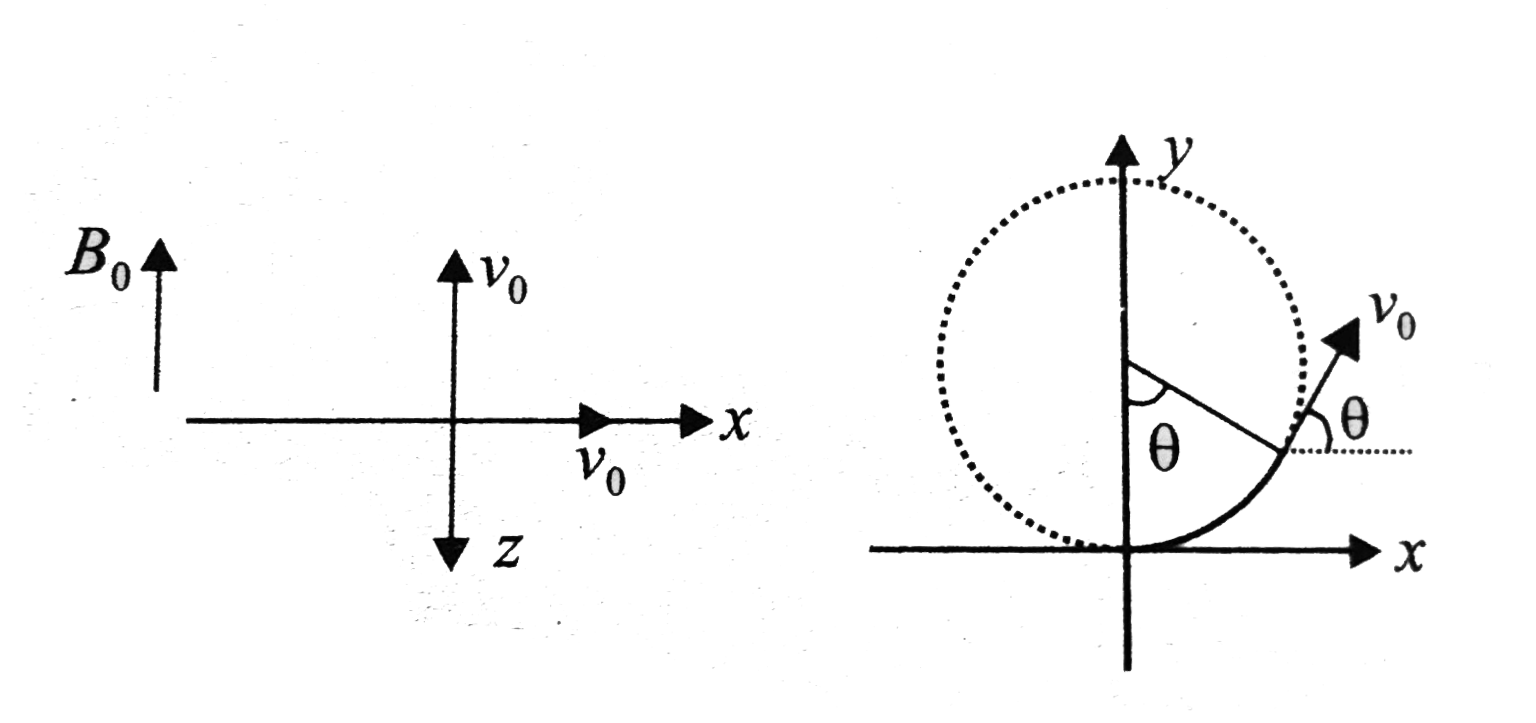
a


`vecv=v_0cos thetahati+v_0sin thetahatj-v_0hatk`
where `theta=omegat=(qB_0)/mt=alphaB_0t`
Promotional Banner

Topper's Solved these Questions

  • MAGNETIC FIELD AND MAGNETIC FORCES

    CENGAGE PHYSICS ENGLISH|Exercise Exercises Multiple Correct|25 Videos
  • MAGNETIC FIELD AND MAGNETIC FORCES

    CENGAGE PHYSICS ENGLISH|Exercise Exercises Assertion -reasoning|8 Videos
  • MAGNETIC FIELD AND MAGNETIC FORCES

    CENGAGE PHYSICS ENGLISH|Exercise Exercises Subjective|10 Videos
  • INDUCTANCE

    CENGAGE PHYSICS ENGLISH|Exercise Concept Based|8 Videos
  • MISCELLANEOUS VOLUME 3

    CENGAGE PHYSICS ENGLISH|Exercise True and False|3 Videos

Similar Questions

Explore conceptually related problems

A particle of charge q and mass m is projected from the origin with velocity v=v_0 hati in a non uniformj magnetic fiedl B=-B_0xhatk . Here v_0 and B_0 are positive constants of proper dimensions. Find the maximum positive x coordinate of the particle during its motion.

A charge praticule of sepeific charge (charge/ mass ) alpha is realsed from origin at time t=0 with velocity v= v_(0)(hati+hatj) in unifrom magnetic fields B= B_(0)hati . Co-ordinaties of the particle at time t = (pi)/(B_(0)alpha) are

A particle of specific charge alpha enters a uniform magnetic field B=-B_0hatk with velocity v=v_0hati from the origin. Find the time dependence of velocity and position of the particle.

A portion is fired from origin with velocity vec(v) = v_(0) hat(j)+ v_(0) hat(k) in a uniform magnetic field vec(B) = B_(0) hat(j) . In the subsequent motion of the proton

A particle of spectfic charge alpha enters a uniform magnetic field B=-B_(0)hatk with velocity V=v_(0)hati from the origin Find the time dependence of velocity and position of the particle

In uniform magnetic field, if angle between vec(v) and vec(B) is 0^(@) lt 0 lt 90^(@) , the path of particle is helix. Let v_(1) be the component of vec(v) along vec(B) and v_(2) be the component perpendicular to vec(B) . Suppose p is the pitch. T is the time period and r is the radius of helix. Then T = (2pim)/(qB), r = (mv_(2))/(qB), P = (v_(1))T Assume a charged particle of charge q and mass m is released from the origin with velocity vec(v) = v_(0) hat(i) - v_(0) hat(k) in a uniform magnetic field vec(B) = -B_(0) hat(k) . Pitch of helical path described by particle is

In uniform magnetic field, if angle between vec(v) and vec(B) is 0^(@) lt 0 lt 90^(@) , the path of particle is helix. Let v_(1) be the component of vec(v) along vec(B) and v_(2) be the component perpendicular to vec(B) . Suppose p is the pitch. T is the time period and r is the radius of helix. Then T = (2pim)/(qB), r = (mv_(2))/(qB), P = (v_(1))T Assume a charged particle of charge q and mass m is released from the origin with velocity vec(v) = v_(0) hat(i) - v_(0) hat(k) in a uniform magnetic field vec(B) = -B_(0) hat(k) . Angle between v and B is

A particle of charge per unit mass alpha is released from origin with a velocity vecv=v_(0)hati uniform magnetic field vecB=-B_(0)hatk . If the particle passes through (0,y,0) , then y is equal to

A charged particle (q.m) released from origin with velocity v=v_(0)hati in a uniform magnetic field B=(B_(0))/(2)hati+(sqrt3B_(0))/(2)hatJ . Pitch of the helical path described by the particle is

A charged particle (q.m) released from origin with velocity v=v_(0)hati in a uniform magnetic field B=(B_(0))/(2)hati+(sqrt3B_(0))/(2)hatJ . Maximum z-coordinate of the particle is

CENGAGE PHYSICS ENGLISH-MAGNETIC FIELD AND MAGNETIC FORCES-Exercises Single Correct
  1. A uniform magnetic field exist in a region which forms an equilateral ...

    Text Solution

    |

  2. A particle of positive charge q and mass m enters with velocity Vhatj ...

    Text Solution

    |

  3. In the plane mirror, the coordinates of image of a charged particle (i...

    Text Solution

    |

  4. A uniform magnetic field of 1.5T exists in a cylinderical region of ra...

    Text Solution

    |

  5. An insulating rod of length I carries a charge q distrubuted uniformly...

    Text Solution

    |

  6. Two straight segments of wire ab and bc each carrying current I, are p...

    Text Solution

    |

  7. A current carrying loop is placed in the non-uniform magnetic field wh...

    Text Solution

    |

  8. A current carrying loop lies on a smooth horizontal plane. Then,

    Text Solution

    |

  9. A semicircular wire of radius R, carrying current I, is placed in a ma...

    Text Solution

    |

  10. A wire of cross-sectional area A forms three sides of a square and is ...

    Text Solution

    |

  11. A proton of mass 1.67xx10^(-27) kg charge 1.6xx10^(-19) C is projected...

    Text Solution

    |

  12. A beam of mixture of alpha particle and protons are accelerted through...

    Text Solution

    |

  13. An electron is projected at an angle theta with a uniform magnetic fie...

    Text Solution

    |

  14. A charged particle moves in a uniform magnetic field perpendicular to ...

    Text Solution

    |

  15. A particle of specific charge alpha is projected from origin with velo...

    Text Solution

    |

  16. A straight peice of conducting wire with mass M and length L is placed...

    Text Solution

    |

  17. In a moving coil galvanometer is based on the

    Text Solution

    |

  18. In a moving coil galvanometer, we use a radial magnetic field so that ...

    Text Solution

    |

  19. The current that must flow through the coil of a galvanometre so as to...

    Text Solution

    |

  20. In a moving coil galvanometer, the deflection of the coil theta is rel...

    Text Solution

    |

