Home
Class 12
PHYSICS
Repeat the above problem, but with the c...

Repeat the above problem, but with the current in both wires shown in fig. directed into the plane of the figure.
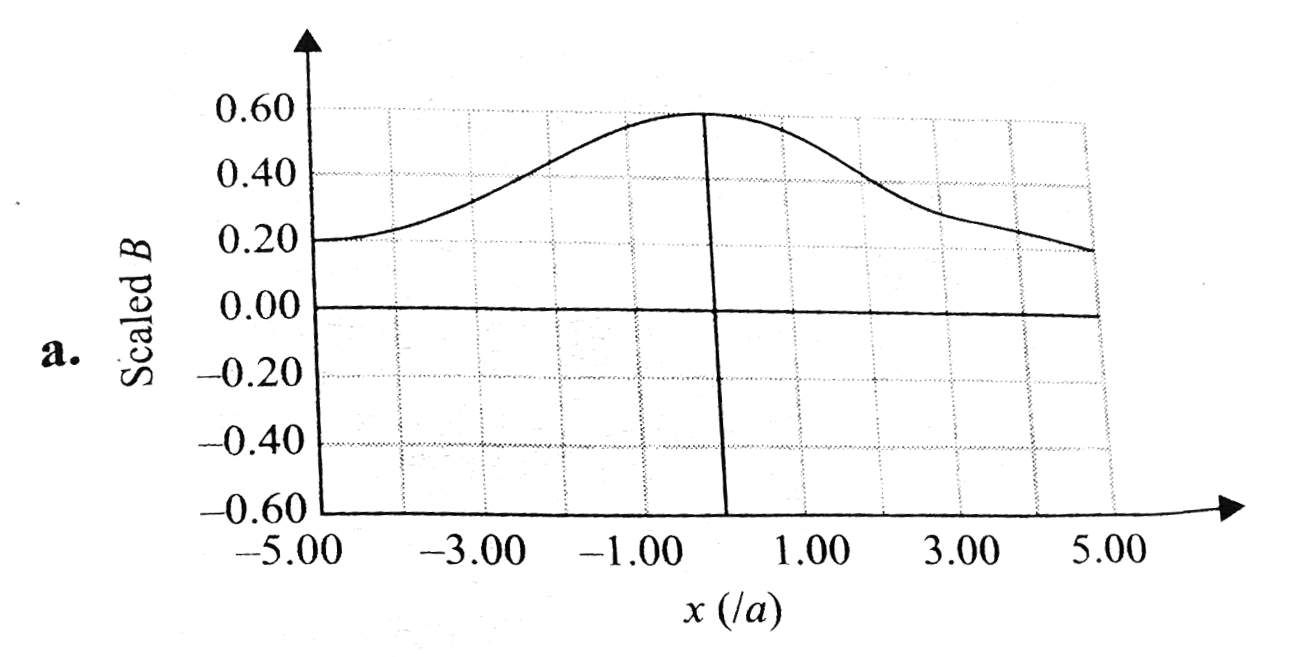
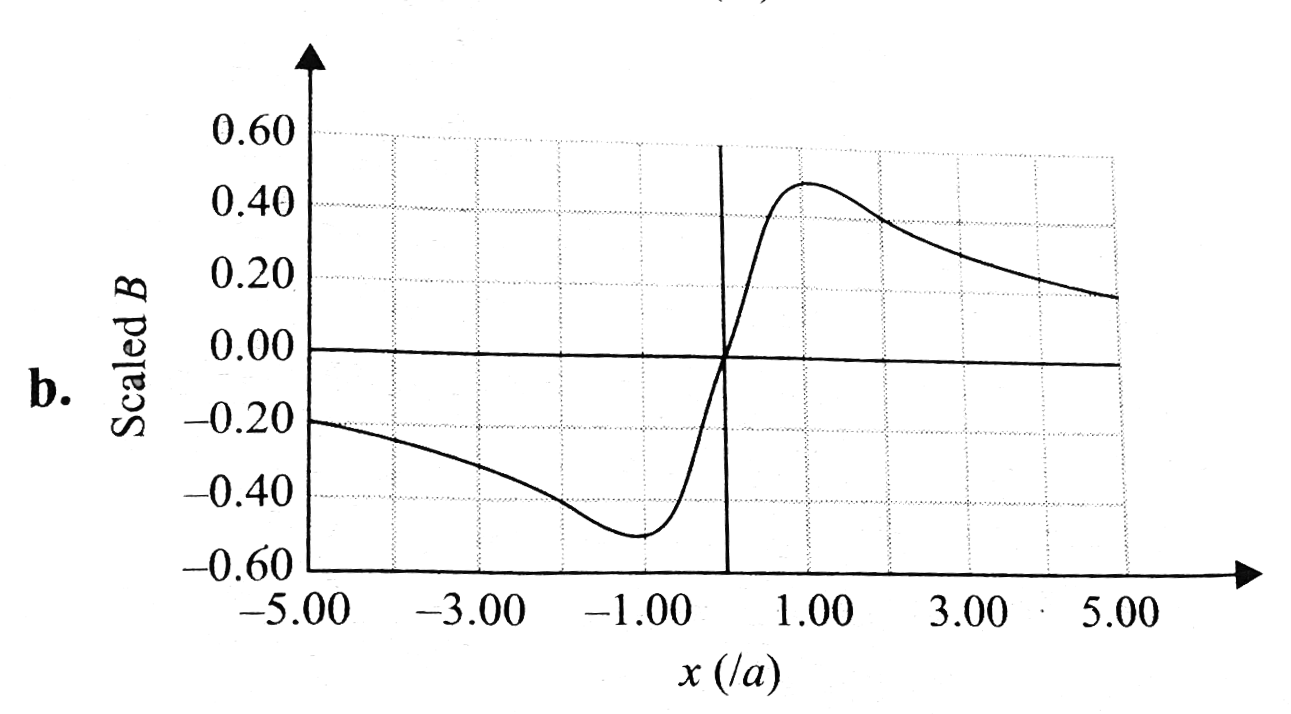
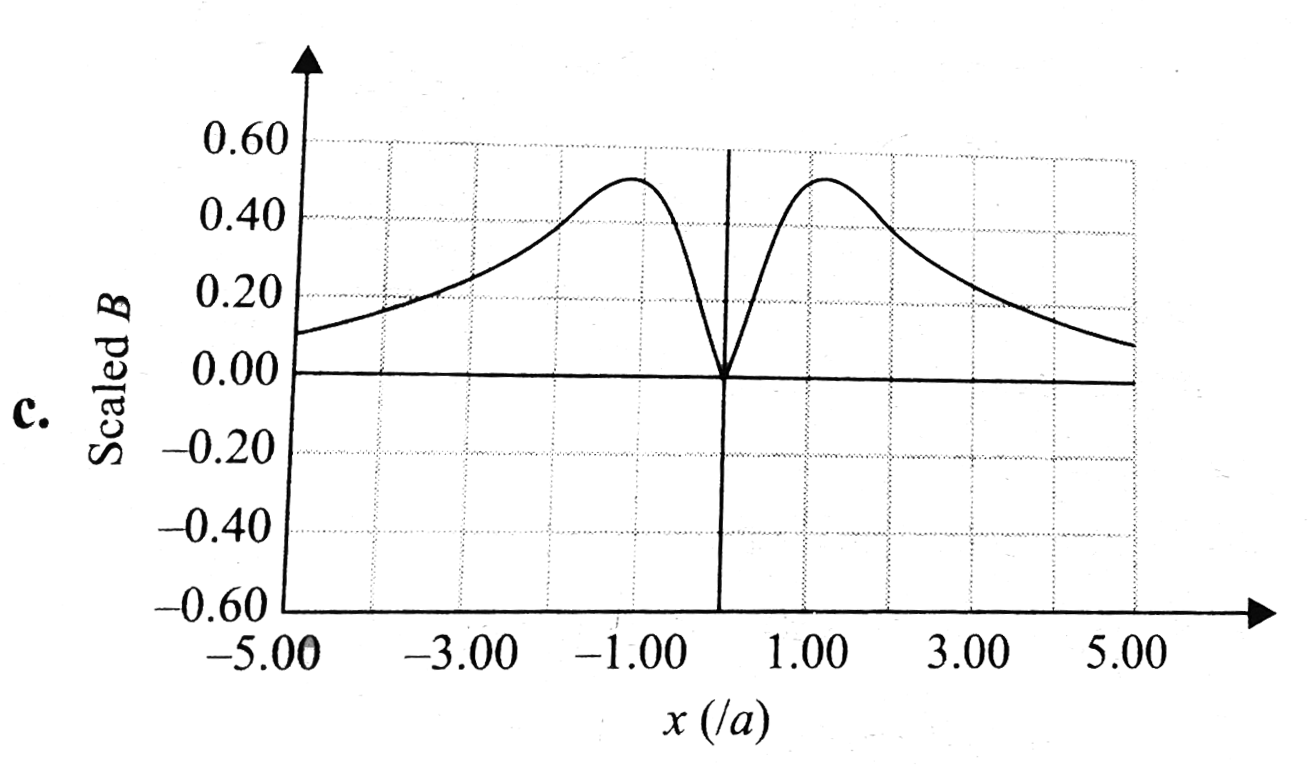
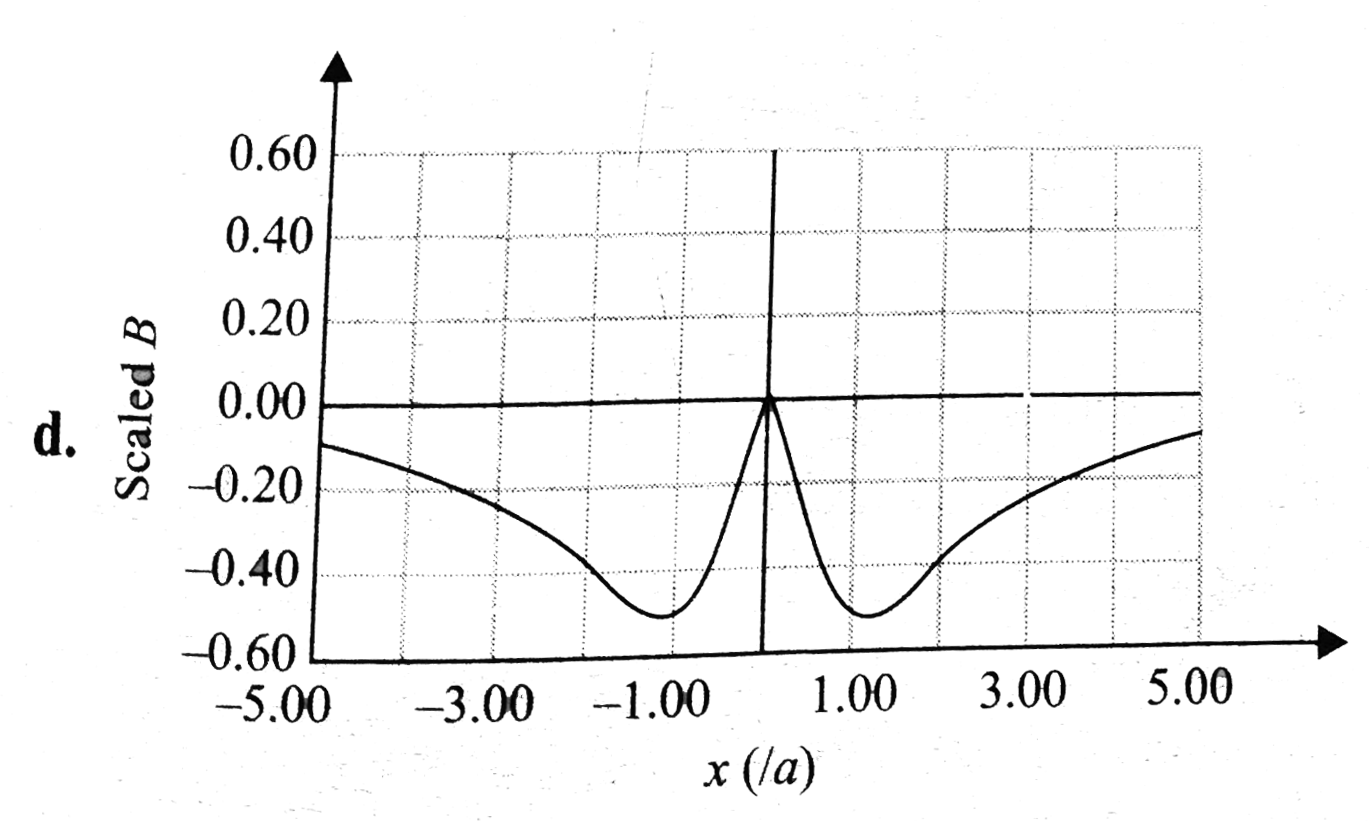
Graph the magnitude of `vecB` at points on the x-axis.

A

B

C

D

Text Solution

AI Generated Solution

The correct Answer is:

To solve the problem of finding the magnetic field \( \vec{B} \) at points on the x-axis due to two parallel wires carrying current into the plane of the figure, we can follow these steps: ### Step 1: Understand the Configuration We have two long straight wires, both carrying currents \( I \) into the plane of the paper. Let’s denote the distance of each wire from the origin as \( A \). The wires are positioned symmetrically about the origin on the y-axis. ### Step 2: Determine the Magnetic Field Contribution from Each Wire Using the right-hand rule for magnetic fields around a current-carrying wire, the magnetic field \( \vec{B} \) at a point on the x-axis due to a single wire is given by: \[ B = \frac{\mu_0 I}{2\pi r} \] where \( r \) is the distance from the wire to the point where we are calculating the magnetic field. ### Step 3: Calculate the Magnetic Field at a Point on the x-axis Let’s consider a point \( P \) on the x-axis at a distance \( x \) from the origin. The distances from the two wires to point \( P \) will be: - From the wire at \( y = A \): \( r_1 = \sqrt{x^2 + A^2} \) - From the wire at \( y = -A \): \( r_2 = \sqrt{x^2 + A^2} \) Since both currents are directed into the plane, the magnetic fields at point \( P \) due to both wires will be in opposite directions. Therefore, the total magnetic field \( B \) at point \( P \) is: \[ B = B_1 - B_2 = \frac{\mu_0 I}{2\pi r_1} - \frac{\mu_0 I}{2\pi r_2} \] Since \( r_1 = r_2 \), we can simplify this to: \[ B = 0 \] at the point directly on the x-axis when \( x = 0 \). ### Step 4: Analyze the Behavior of the Magnetic Field as \( x \) Changes 1. **At \( x = 0 \)**: The magnetic field \( B = 0 \). 2. **As \( x \to \infty \)**: The distance \( r \) becomes very large, and thus: \[ B \to 0 \] 3. **At \( x = A \)**: We can substitute \( x = A \) into the magnetic field equation: \[ B = \frac{\mu_0 I}{2\pi A} - \frac{\mu_0 I}{2\pi A} = 0 \] 4. **At \( x = -A \)**: Similarly, we find: \[ B = 0 \] ### Step 5: Determine the Maximum Value of \( B \) To find the maximum value of \( B \), we can differentiate the expression for \( B \) with respect to \( x \) and set it to zero. This will give us the points where \( B \) could be maximized. ### Step 6: Graph the Magnitude of \( B \) The graph of the magnetic field \( B \) as a function of \( x \) will show: - \( B = 0 \) at \( x = 0 \) - \( B \) will reach a maximum value at \( x = A \) and \( x = -A \) - \( B \to 0 \) as \( x \to \infty \) or \( x \to -\infty \) ### Conclusion The graph will show a symmetrical behavior around the origin, with peaks at \( x = A \) and \( x = -A \), and it will touch the x-axis at \( x = 0 \) and as \( x \to \pm \infty \). ---

To solve the problem of finding the magnetic field \( \vec{B} \) at points on the x-axis due to two parallel wires carrying current into the plane of the figure, we can follow these steps: ### Step 1: Understand the Configuration We have two long straight wires, both carrying currents \( I \) into the plane of the paper. Let’s denote the distance of each wire from the origin as \( A \). The wires are positioned symmetrically about the origin on the y-axis. ### Step 2: Determine the Magnetic Field Contribution from Each Wire Using the right-hand rule for magnetic fields around a current-carrying wire, the magnetic field \( \vec{B} \) at a point on the x-axis due to a single wire is given by: \[ ...
Promotional Banner

Topper's Solved these Questions

  • SOURCES OF MAGNETIC FIELD

    CENGAGE PHYSICS ENGLISH|Exercise Exercise (integer)|7 Videos
  • SOURCES OF MAGNETIC FIELD

    CENGAGE PHYSICS ENGLISH|Exercise Archives (fill In The Blanks)|1 Videos
  • SOURCES OF MAGNETIC FIELD

    CENGAGE PHYSICS ENGLISH|Exercise Exercise (assertion-reasioning )|2 Videos
  • RAY OPTICS

    CENGAGE PHYSICS ENGLISH|Exercise DPP 1.6|12 Videos
  • WAVE OPTICS

    CENGAGE PHYSICS ENGLISH|Exercise Comprehension Type|14 Videos

Similar Questions

Explore conceptually related problems

Repeat the above problem, but with the current in both wires shown in fig. directed into the plane of the figure. At what value of x is the magnitude of vecB is maximum?

Repeat the above problem, but with the current in both wires shown in fig. directed into the plane of the figure. Derive the expression for the magnitude of vecB at any point on the x-axis in terms of the x-coordinate of the point. What is the direciton of vecB ?

Figure shows an end view of two long, parallel wires perpendicular to the xy plane, each carrying a current I, but in opposite directions. Graph the magnitude of vecB at point on the x-axis.

Figure shows an end view of two long, parallel wires perpendicular to the xy plane, each carrying a current I, but in opposite directions. Derive an expression for the magnitude of vecB at any point on the x-axis in terms of the x-coordinate of the point. What is the direction of vecB ?

a straight wire current element is carrying current 100 A as shown in figure. the magnitude of magnetic field at a point P.

A wire carrying current i is bent as shown in figure and placed in the plane of uniform magnetic field Bvec. The magnitude of magnetic force experienced by

A conducting wire carrying current I is shown in the figure. The magnitude of magnetic field at the point P will be

A wire is bent to form the double loop shown in figure. There is a uniform magnetic field directed into the plane of the loop. If the magnitude of this field is decreasing current will flow from:

Two straight infinitely long current carrying wires are kept along Z-axis at the coordinates (0,a,0) and (0, -a, 0) respectively, as shown in the figure. The current in each of the wire is equal and along negative Z-axis (into the plane of the paper). The variation of magnetic field on the X-axis will be approximately

Two infinitely long straight parallel wire are 5 m apart, perpendicular to the plane of paper. One of the wires, as it passes perpendicular to the plane of paper, intersects it at A and carries current I in the downward direction. The other wire intersects the plane of paper at point B and carries current k int the outward direction O in the plane of paper as shown in Fig. With x and y axis shown, magnetic induction at O in the component form can be expressed as

CENGAGE PHYSICS ENGLISH-SOURCES OF MAGNETIC FIELD-Exercise (linked Comprehension)
  1. There exists a long conductor along z-axis carrying a current I0 along...

    Text Solution

    |

  2. Curves in the graph shown in Fig. give, as function of radius distance...

    Text Solution

    |

  3. Curves in the graph shown in Fig. give, as function of radius distance...

    Text Solution

    |

  4. Curves in the graph shown in Fig. give, as function of radius distance...

    Text Solution

    |

  5. Ampere's law provides us an easy way to calculate the magnetic field d...

    Text Solution

    |

  6. Ampere's law provides us an easy way to calculate the magnetic field d...

    Text Solution

    |

  7. Ampere's law provides us an easy way to calculate the magnetic field d...

    Text Solution

    |

  8. According to Biot-Savarat's law, magentic field due to a straight curr...

    Text Solution

    |

  9. According to Biot-Savarat's law, magentic field due to a straight curr...

    Text Solution

    |

  10. In Fig. the circular and the straight parts of the wire are made of sa...

    Text Solution

    |

  11. In Fig. the circular and the straight parts of the wire are made of sa...

    Text Solution

    |

  12. Two long, straight, parallel wires are 1.00m apart (as shown in Fig). ...

    Text Solution

    |

  13. Two long, straight, parallel wires are 1.00m apart (as shown in Fig). ...

    Text Solution

    |

  14. Two long, straight, parallel wires are 1.00m apart (as shown in Fig). ...

    Text Solution

    |

  15. Figure shows an end view of two long, parallel wires perpendicular to ...

    Text Solution

    |

  16. Figure shows an end view of two long, parallel wires perpendicular to ...

    Text Solution

    |

  17. Figure shows an end view of two long, parallel wires perpendicular to ...

    Text Solution

    |

  18. Repeat the above problem, but with the current in both wires shown in ...

    Text Solution

    |

  19. Repeat the above problem, but with the current in both wires shown in ...

    Text Solution

    |

  20. Repeat the above problem, but with the current in both wires shown in ...

    Text Solution

    |
