Home
Class 12
PHYSICS
Two long parallel wires are at a distanc...

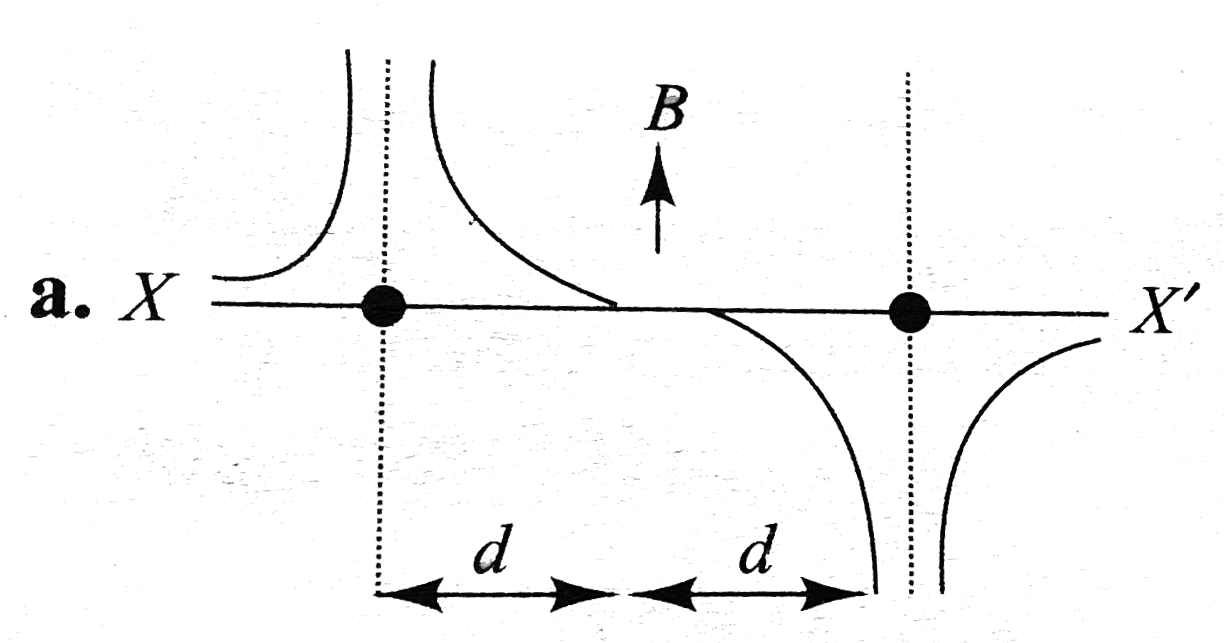
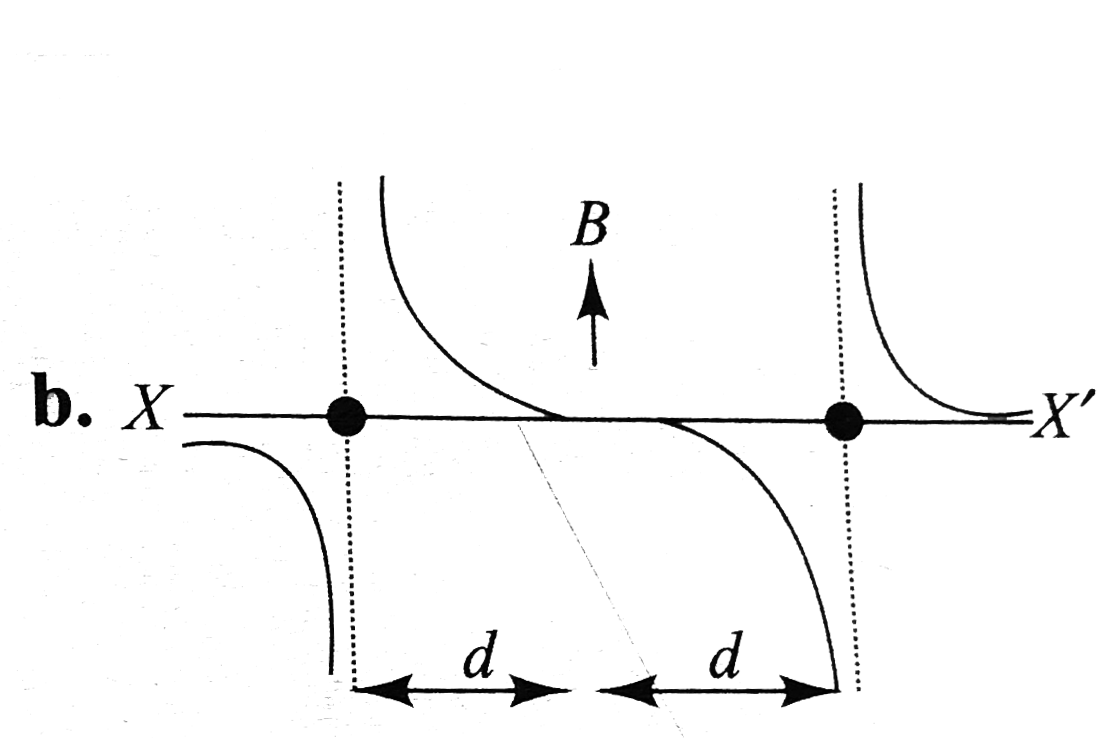
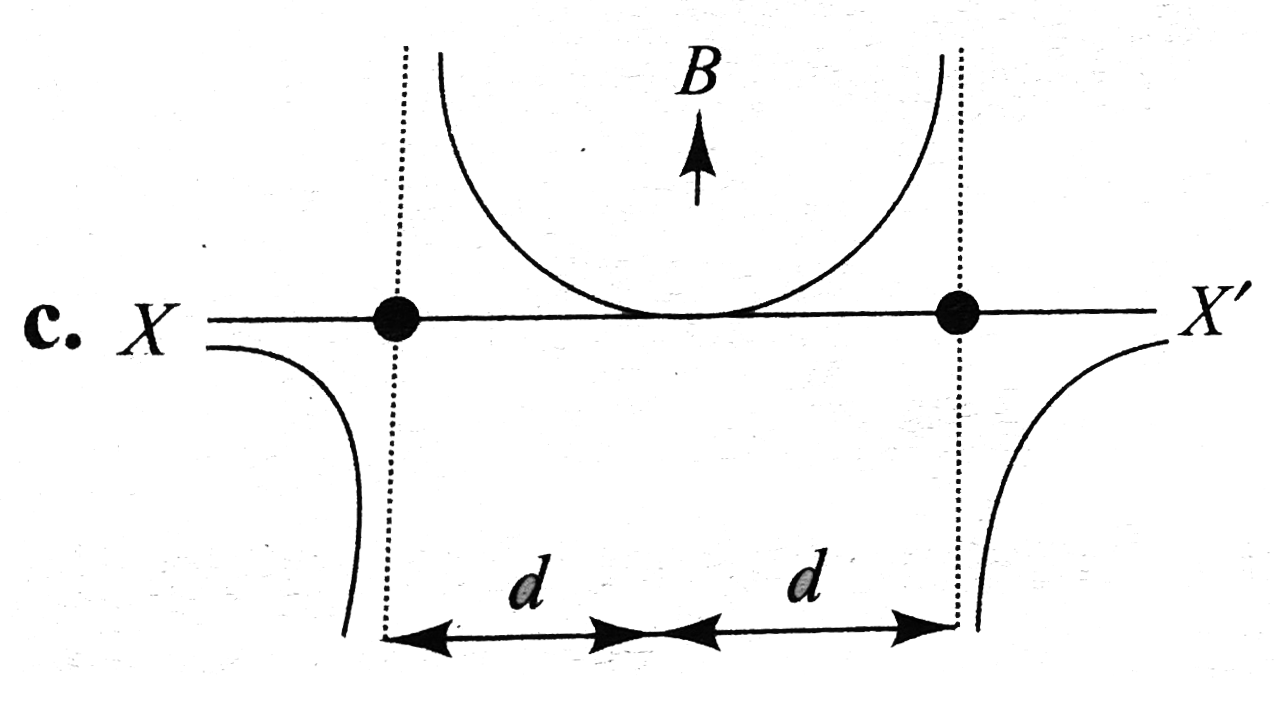
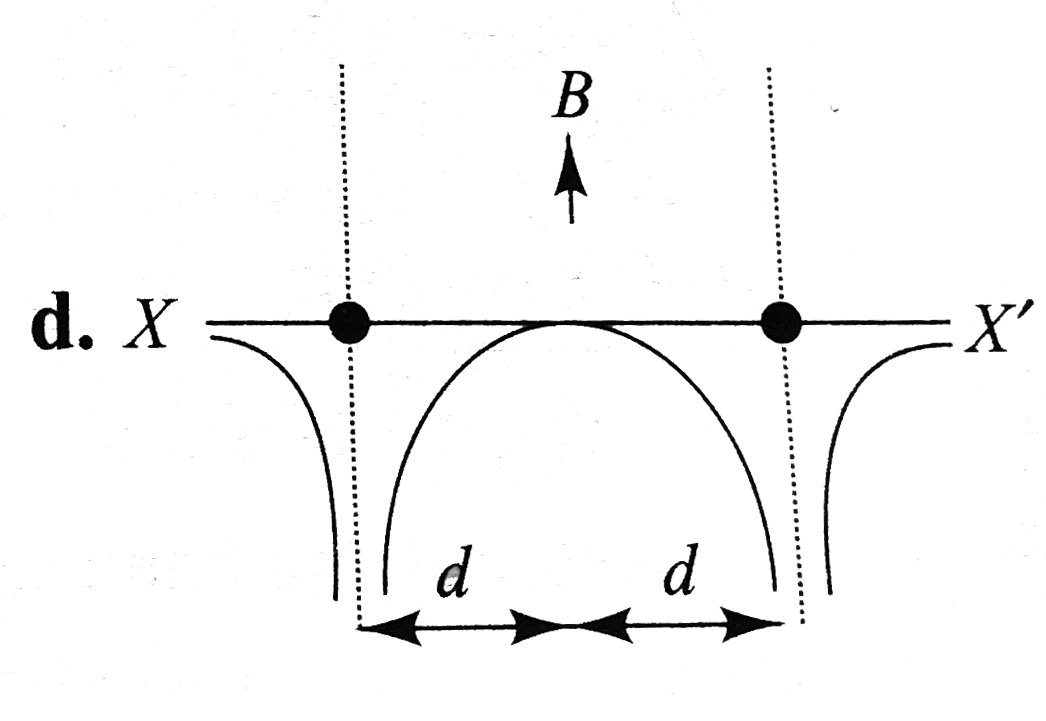
Two long parallel wires are at a distance ` 2d` apart. They carry steady equal currents flowing out of the plane of the paper , as shown. The variation of the magnetic field `B` along the line `XX` is given by

A

B

C

D

Text Solution

AI Generated Solution

The correct Answer is:

To solve the problem of finding the variation of the magnetic field \( B \) along the line \( XX \) due to two long parallel wires carrying equal currents, we can follow these steps: ### Step 1: Understand the Setup We have two long parallel wires separated by a distance of \( 2d \), with both wires carrying equal currents flowing out of the plane of the paper. We need to analyze the magnetic field at various points along the line \( XX \). ### Step 2: Define the Position Let’s denote the left wire as wire 1 and the right wire as wire 2. We can define a point \( P \) located at a distance \( x \) from wire 1. Consequently, the distance from wire 2 to point \( P \) will be \( 2d - x \). ### Step 3: Calculate the Magnetic Field from Each Wire Using the formula for the magnetic field \( B \) due to a long straight wire, we have: \[ B_1 = \frac{\mu_0 I}{2 \pi x} \quad \text{(magnetic field due to wire 1)} \] \[ B_2 = \frac{\mu_0 I}{2 \pi (2d - x)} \quad \text{(magnetic field due to wire 2)} \] ### Step 4: Determine the Directions of the Magnetic Fields Using the right-hand rule: - For wire 1 (left wire), the magnetic field \( B_1 \) at point \( P \) will be directed upwards (positive \( j \)-direction). - For wire 2 (right wire), the magnetic field \( B_2 \) at point \( P \) will be directed downwards (negative \( j \)-direction). ### Step 5: Write the Net Magnetic Field The net magnetic field \( B_{\text{net}} \) at point \( P \) can be expressed as: \[ B_{\text{net}} = B_1 - B_2 = \frac{\mu_0 I}{2 \pi x} - \frac{\mu_0 I}{2 \pi (2d - x)} \] ### Step 6: Simplify the Expression Factoring out the common terms: \[ B_{\text{net}} = \frac{\mu_0 I}{2 \pi} \left( \frac{1}{x} - \frac{1}{2d - x} \right) \] ### Step 7: Analyze Special Cases 1. **At \( x = d \)**: \[ B_{\text{net}} = \frac{\mu_0 I}{2 \pi} \left( \frac{1}{d} - \frac{1}{d} \right) = 0 \] The magnetic field is zero at the midpoint between the two wires. 2. **For \( x < d \)**: The term \( \frac{1}{x} \) dominates, making \( B_{\text{net}} > 0 \) (upward direction). 3. **For \( x > d \)**: The term \( \frac{1}{2d - x} \) dominates, making \( B_{\text{net}} < 0 \) (downward direction). ### Step 8: Conclusion The variation of the magnetic field \( B \) along the line \( XX \) can be summarized as: - \( B > 0 \) for \( x < d \) (upward) - \( B = 0 \) for \( x = d \) - \( B < 0 \) for \( x > d \) (downward)

To solve the problem of finding the variation of the magnetic field \( B \) along the line \( XX \) due to two long parallel wires carrying equal currents, we can follow these steps: ### Step 1: Understand the Setup We have two long parallel wires separated by a distance of \( 2d \), with both wires carrying equal currents flowing out of the plane of the paper. We need to analyze the magnetic field at various points along the line \( XX \). ### Step 2: Define the Position Let’s denote the left wire as wire 1 and the right wire as wire 2. We can define a point \( P \) located at a distance \( x \) from wire 1. Consequently, the distance from wire 2 to point \( P \) will be \( 2d - x \). ...
Promotional Banner

Topper's Solved these Questions

  • SOURCES OF MAGNETIC FIELD

    CENGAGE PHYSICS ENGLISH|Exercise Archives (multiple Correct )|1 Videos
  • SOURCES OF MAGNETIC FIELD

    CENGAGE PHYSICS ENGLISH|Exercise Archives (linked Comprehension)|4 Videos
  • SOURCES OF MAGNETIC FIELD

    CENGAGE PHYSICS ENGLISH|Exercise Archives (fill In The Blanks)|1 Videos
  • RAY OPTICS

    CENGAGE PHYSICS ENGLISH|Exercise DPP 1.6|12 Videos
  • WAVE OPTICS

    CENGAGE PHYSICS ENGLISH|Exercise Comprehension Type|14 Videos

Similar Questions

Explore conceptually related problems

Two long, straight, parallel wires are 1.00m apart (as shown in Fig). The upper wire carries a current I_1 of 6.00A into the plane of the paper. What is the magnitude of the net field at Q?

Two long, straight, parallel wires are 1.00m apart (as shown in Fig). The upper wire carries a current I_1 of 6.00A into the plane of the paper. What is the magnitude of the net field at S?

Two thin, long, parallel wires, separated by a distance 'd' carry a current of 'i' A in the same direction. They will

Let two long parallel wires, a distance d apart, carry equal currents I in the same direction. One wires at x=0 , the other at x=d (as shown in Fig) Determine magnetic field at any point x-axis between the wires as a function of x.

In Fig. two long parallel wires (seen end-on) that are a distance R apart carry equal currents i in the same sense. Find the magnitude of the magnetic field at point P , which lies quidistant from the two wires at an angle theta from the plane of the wires.

Two thin long wires are parallel to each other at a separation d apart and they carry equal currents l each along the same direction as shown in figure. The magnetic field (B) at a point P varieswith x according to graph.

Two long conductors are arranged as shown above to form overlapping cylinders, each of radius r, whose centers are separated by a distance d. Current of density J flows into the plane of the page along the shaded part of one conductor and an equal current flows out of the plane of the page along the shaded portion of the other, as shown. What are the magnitude and direction of the magnetic field at point A? :

Figure shows an arrangement in which long parallel wires carrying equal currents into or out of the page of paper at the corners of a square. The magnetic field at the centre of square is

Two long wires carrying same currents in opposite directions are placed at separation D as shown.Predict variation of magnetic field as one moves from the point O and A

A current carrying wire AB of the length L is turned along a circle, as shown in figure. The magnetic field at the centre O.
