Home
Class 12
PHYSICS
An infinite wire carries a current I. A...

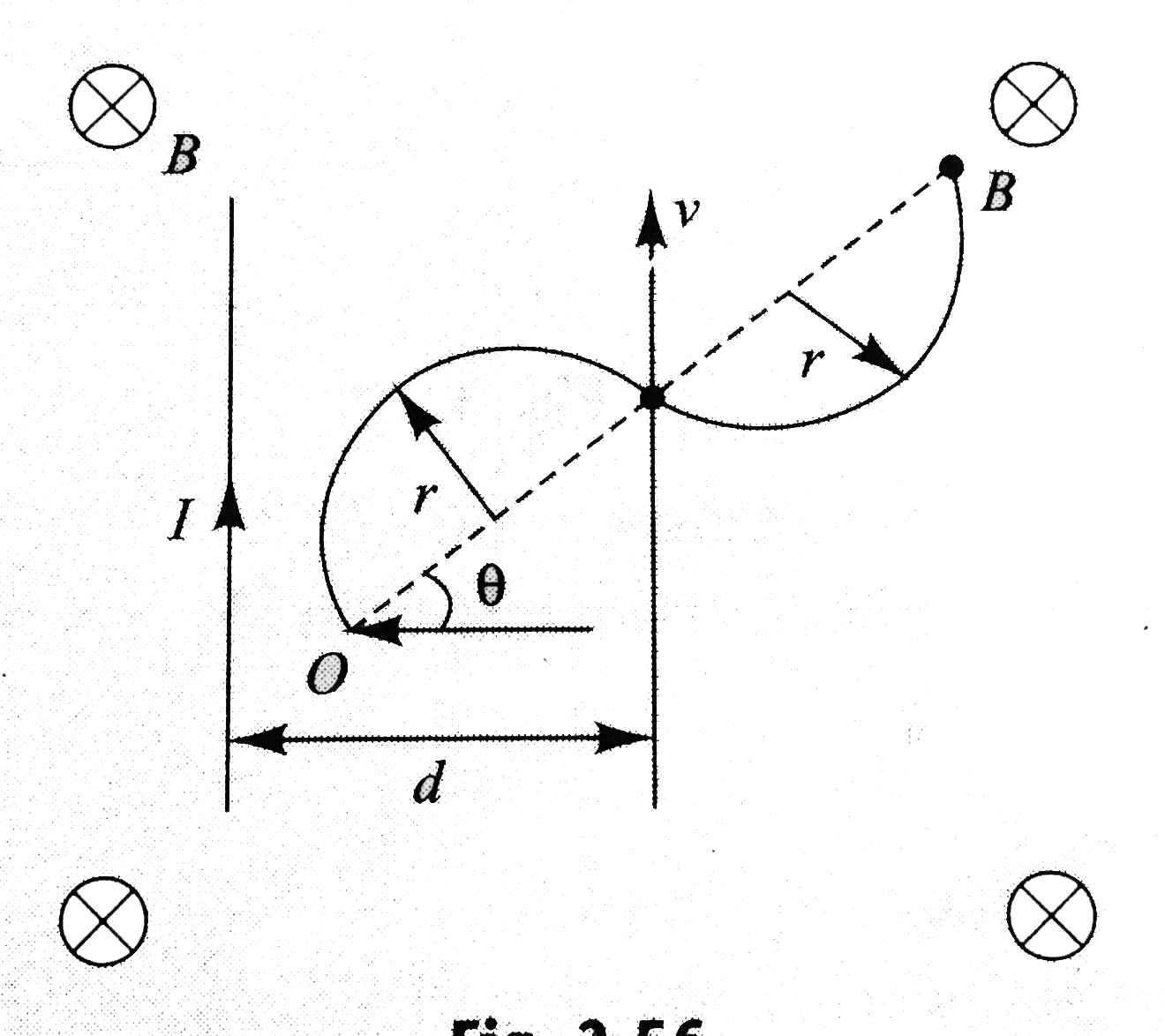
An infinite wire carries a current `I`. An S- shaped conducting rod of two semicircles esch of radius `r` is placed at an angle `theta` to the wire. The center of the conductor is at a distance `d` from the wire. If the rod translates parallel to the wire with a velocity `v` as shown in Fig. .3.56, calculate the emf induced across the ends `Ob` of the rod.

Text Solution

Verified by Experts
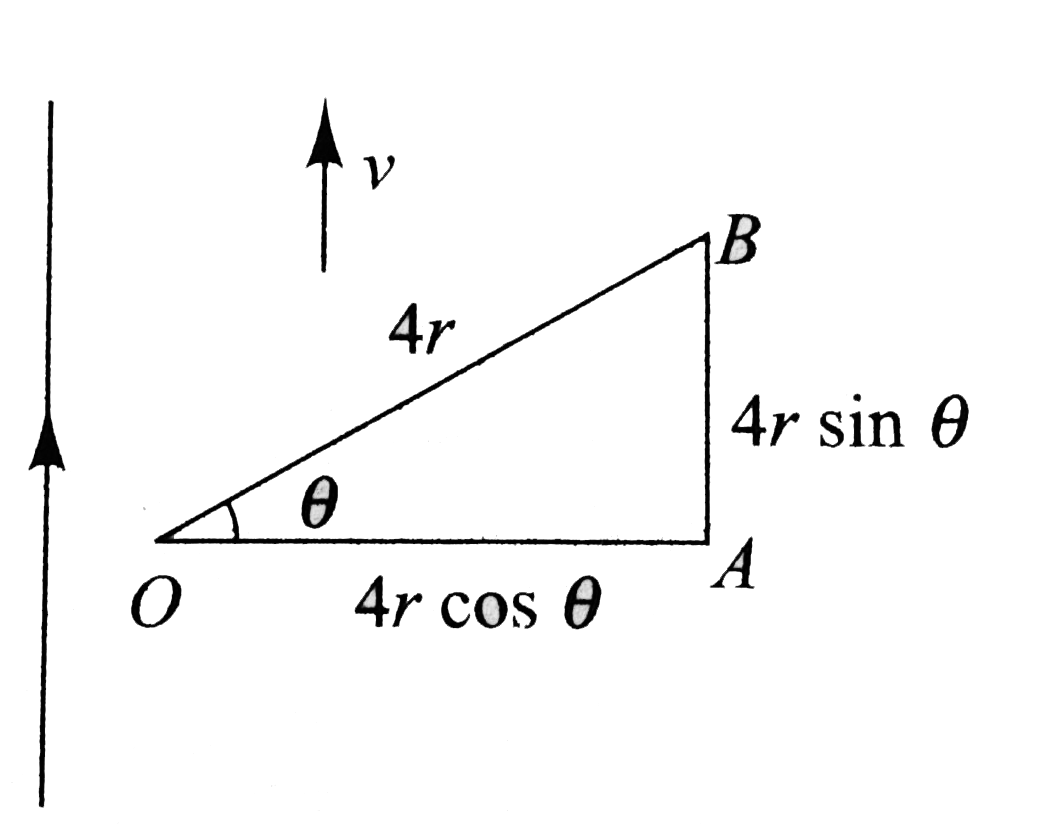
Join the end points `O` and `b` and replace the two semicircles bya straight rod of length `4r` (Fig. 3.57).
Induced emf in straight rod `OB` will be same as in the actual conductor. Now this straight rod can be replaced by a combination of two rods `OA` and `AB`. induced emf in `OB` will be same as the sum of induced emf in `OA` and induced emf in `AB`. But induced emf in `AB` will be zero because its velocity will be parallel to its length. Hence, induced emf in `OA` will be the net induced emf in actual conductor.
We now have a ros of effective length `4r cos theta` translating in a non-uniform magnetic field. consider a small element of the wire of length `dx` located at a distance `x` from the wire. The magnetic field at this element is `B = ((mu)(0)I)/(2pix)` ltbr. The potential difference across this element is `dV = (mu_(0)I)/(2pix)vdx`.
The potential difference across the ends of the rod can be calculated by integrating over the whole end. Therefore,
`V = int dV = int_(d + 2r cos theta)^(d - 2r cos theta)(mu_(0)I)/(2pix) vdx`
`=(mu_(0)Iv)/(2pi)1n[(d + 2r cos theta)/(d - 2r cos theta)]`
From the right hand rule, we see that electrons will accumulate at end `B`. Therefore, end `O` is at a higher potential than `B`.
Promotional Banner

Topper's Solved these Questions

  • ELECTROMAGNETIC INDUCTION

    CENGAGE PHYSICS ENGLISH|Exercise Solved Example|5 Videos
  • ELECTROMAGNETIC INDUCTION

    CENGAGE PHYSICS ENGLISH|Exercise Exercise 3.1|15 Videos
  • ELECTRICAL MEASURING INSTRUMENTS

    CENGAGE PHYSICS ENGLISH|Exercise M.C.Q|2 Videos
  • ELECTRON,PHONTS,PHOTOELECTRIC EFFECT & X-RAYS

    CENGAGE PHYSICS ENGLISH|Exercise dpp 3.3|15 Videos

Similar Questions

Explore conceptually related problems

Figure shows an irregular shaped wire AB moving with velocity v, as shown. Find the emf induced in the wire

The current carrying wire and the rod AB are in the same plane. The rod moves parallel to the wire with a velocity v . Which one of the following statements is true about induced emf in the rod

A straight wire carrying current is parallel to the y-axis as shown in Fig. The

A square loop of side a is placed in the same plane as a long straight wire carrying a current i . The centre of the loop is at a distance r from wire where r gt gt a . The loop is moved away from the wire with a constant velocity v . The induced e.m.f in the loop is

A long wire carrying a steady current I lies in the plane of circular conducting loop placed at a certain distance from the wire. There will be an induced current in the loop if it is

An infinitely long current carrying wire and a small current carrying wire and a small current carrying loop are in the plane of thye paper as shown. The ardius of the loop is a and distance of its centre from the wire is d (dgtgta). If the loop applies a force F on the wire then :

A rod of length l is placed perpendicular to a long wire carrying current i . The rod is moved parallel to the wire with a velocity v . Find the emf induced in the rod, if its nearest end is at a distance a from the wire.

A rod of length l is placed perpendicular to a long wire carrying current i . The rod is moved parallel to the wire with a velocity v . Find the emf induced in the rod, if its nearest end is at a distance a from the wire.

An infinitely long current carrying wire and a small current carrying loop are in the plane of the paper as shown. The radius of the loop is a and distance of its centre from the wire is d (d>>a). If the loop applies a force F on the wire then :

A square frame with side a and a long straight wire carrying a current i are located in the same plane as m shown in figure. The fram translates to the right with a constant velocity v . Find the emf induced in the frame as a function of distance x .

